
In This Article
Let me paint you a familiar picture: it’s 7:15 AM in late October, your Grade 8 kid is wrestling their backpack over a winter jacket, and by the time they reach school, their shoulders are already complaining. Sound familiar? You’re not alone — and picking the right backpack for grade 8 students is genuinely one of the smartest investments you can make before September rolls around.
Grade 8 is a transitional year in Canada. Students are carrying more than ever — Chromebooks or laptops issued by the school board, thick binders for multiple subjects, a lunch bag, gym clothes, and a water bottle. The average load can easily tip the scales at 4–6 kg (9–13 lbs) on a heavy day. According to pediatric guidelines supported by the American Academy of Pediatrics, a packed backpack should weigh no more than 10–15% of a child’s body weight. For a typical 13-year-old weighing around 50 kg (110 lbs), that means keeping the total load under 5–7.5 kg. The right bag design makes a meaningful difference in hitting that target comfortably.
What does a backpack for grade 8 students actually need? At minimum: a dedicated padded laptop compartment that fits a 13–15.6-inch device, multiple organized pockets for binders and supplies, water-resistant fabric for Canadian rain and slush, and an ergonomic back panel with padded shoulder straps. Bonus points for a chest strap, USB charging port, and a profile slim enough to fit in a crowded school locker.
In this guide, I’ve researched and ranked seven real, Amazon.ca-available backpacks that deliver on all of these fronts. Whether you’re shopping on a budget or investing in a bag your teen will still love by Grade 10, there’s something here for every Canadian family. All prices are in Canadian dollars (CAD).
Quick Comparison: Top 7 Backpacks for Grade 8 Students in Canada
| Product | Capacity | Laptop Fit | Water Resistant | Price Range (CAD) | Best For |
|---|---|---|---|---|---|
| JanSport Main Campus | 26L | 15″ | ✅ | $60–$85 | Budget-conscious families |
| The North Face Borealis | 28L | 15″ | ✅ | $110–$140 | Everyday all-season use |
| MATEIN Travel Laptop Backpack | 35L | 17.3″ | ✅ | $40–$60 | Maximum organization |
| Herschel Supply Co. Classic XL | 30L | 15″ | ✅ | $85–$110 | Style-forward teens |
| SwissGear 1900 ScanSmart | 25L | 16″ | ✅ | $90–$120 | Tech-heavy students |
| Adidas Alliance II Sackpack | 20L | 14″ | ✅ | $35–$55 | Light-load days & sports |
| Kite High School Ergonomic | 22L | 15.6″ | ✅ | $95–$130 | Posture & spinal health |
The table above tells a story beyond the specs. The JanSport and MATEIN entries represent opposite ends of the size spectrum — but both hit the same sweet spot for Canadian school loads. What’s most telling is the capacity vs. price relationship: the Kite ergonomic model costs more than the MATEIN despite being 13 litres smaller, because you’re paying for structured posture support — something no spec sheet fully communicates. For families managing longer transit commutes (think Toronto’s TTC or Vancouver’s SkyTrain), the ergonomic investment justifies itself within a semester.
💬 Just one click — help others make better buying decisions too! 😊
✨ Don’t Miss These Exclusive Deals!
🔍 Take your school year to the next level with these carefully selected backpacks. Click on any highlighted item to check current pricing and availability on Amazon.ca. These picks will keep your Grade 8 student organized, comfortable, and ready for whatever the Canadian school year throws at them!
Top 7 Backpacks for Grade 8 Students in Canada — Expert Analysis
1. JanSport Main Campus Backpack
The JanSport Main Campus is the quiet workhorse of Canadian school hallways — and there’s a reason you see it everywhere from Halifax to Victoria.
With a 26L capacity and a dedicated 15-inch laptop sleeve, this bag fits the daily reality of most Grade 8 students without becoming a bulky monster in a narrow school locker. The secondary compartment features an organizer panel — something JanSport calls “deceptively simple” but which genuinely matters when your kid has three different subject binders, a pencil case, and a charger cable to sort through every morning. The fabric is a 600D polyester with a water-resistant coating, which handles Canadian autumn drizzle and slushy February sidewalks without breaking a sweat.
What most Canadian parents overlook about the Main Campus is its weight when empty: just over 500 g. That’s genuinely lightweight for its class, meaning more of your child’s 10–15% body weight budget goes to actual school supplies rather than the bag itself. The shoulder straps are padded but not quite S-curved, so it’s comfortable for a 20-minute bus ride but may feel heavy on a longer commute across a larger city.
Verified Canadian buyers consistently praise its durability — multiple reviewers on Amazon.ca note using theirs for two or three school years without zipper failures. For a bag in the $60–$85 CAD range, that’s exceptional long-term value.
✅ Classic look that works for any gender expression
✅ Lifetime warranty from JanSport (including damage from regular use)
✅ Slim profile fits school lockers without forcing it
❌ No USB charging port
❌ Straps lack chest clip for longer commutes
Price range: $60–$85 CAD — the best value per semester of any bag on this list.
2. The North Face Borealis Backpack
If the JanSport is the dependable everyday choice, the North Face Borealis is the upgrade that makes Canadian winters significantly less miserable.
The Borealis runs at 28L and features The North Face’s FlexVent suspension system — independent shoulder straps with a flexible yoke that moves with your kid’s body rather than against it. What this means in practice is that a student trudging through a February snowstorm in Winnipeg or up a steep hill in Vancouver won’t feel their shoulders grinding under a rigid frame. The padded back panel also has ventilation channels, keeping the back somewhat drier during spring and fall when layering causes overheating.
The laptop sleeve fits up to a 15-inch device, and it’s positioned closest to the back panel — which is exactly where it should be, ergonomically speaking. Placing the heaviest item near the spine reduces the forward-pulling effect that causes posture problems over time. There’s also a front bungee system and a dedicated fleece-lined pocket — great for protecting earbuds or a phone screen from scratches.
Canadian reviewers frequently mention that the water-resistant coating holds up through repeated exposure to rain and wet snow without needing to re-treat the fabric. For families in wetter provinces like British Columbia or the Atlantic provinces, that matters considerably more than it might seem on a product page.
✅ FlexVent system genuinely reduces shoulder fatigue on long commutes
✅ Multiple colour options suit both boys and girls
✅ Holds its shape even when half-empty, which matters for locker fit
❌ Heavier than the JanSport at around 680 g empty
❌ Sits at the higher end of the mid-range price bracket
Price range: $110–$140 CAD — worth every dollar for students with longer commutes or all-season outdoor exposure.
3. MATEIN Travel Laptop Backpack
The MATEIN has quietly become one of the most-reviewed backpacks on Amazon.ca, and once you see what it offers in the $40–$60 CAD range, the 4.7-star rating across 85,000+ reviews starts to make a lot of sense.
At 35L, the MATEIN is the roomiest option on this list — which for a Grade 8 student can be a double-edged sword. More room means more temptation to overstuff, so parents should pair this bag with a conversation about weight limits. That said, the design actively helps with load management: there are multiple compartments with logical organization, a dedicated 17.3-inch padded laptop sleeve, a USB charging port with built-in cable routing, and a separate anti-theft back pocket that sits flush against the wearer’s spine. The water-resistant Oxford fabric handles light rain without issue.
What makes the MATEIN particularly strong for Canadian Grade 8 students is the price-to-feature ratio. At under $60 CAD, you’re getting a USB port, anti-theft design, and a laptop sleeve that accommodates the full range of school-issued Chromebooks (including the larger 15.6-inch models that some boards hand out). That’s genuinely unusual at this price point, and it’s why this bag consistently shows up in back-to-school discussions on Canadian parent forums.
The ergonomics are decent but not exceptional — the shoulder straps are padded and the back panel has some airflow, but the chest strap is thin and the hip belt is absent. For urban commuters on foot or by transit, this matters; for students who get dropped off at school, it’s a non-issue.
✅ Best price-to-feature ratio on the list
✅ USB charging port — rare at this price in CAD
✅ Large enough to double as a weekend travel bag
❌ At 35L, easy to overload beyond healthy weight limits
❌ Shoulder straps wear noticeably after 18+ months of daily use
Price range: $40–$60 CAD — exceptional value, especially for budget-conscious Canadian families.
4. Herschel Supply Co. Classic XL Backpack
Herschel is a Canadian brand, founded in British Columbia, and the Classic XL is proof that homegrown design can compete with any international name on both style and function.
The Classic XL sits at 30L with a signature striped fabric interior and a padded 15-inch laptop sleeve. The design is deliberately minimalist — fewer external pockets, cleaner profile — which appeals strongly to Grade 8 students who care about how they look (and at 13–14, most of them do). Available in dozens of colourways, including seasonal Canadian-market exclusives, this is one of the few bags where the aesthetics are genuinely part of the value proposition.
The water-resistant coating is applied to the outer fabric and performs well in typical Canadian weather — autumn rain, light slush, and the occasional accidental puddle. The internal organization is more limited than the MATEIN or North Face, but Herschel compensates with a media pocket (with headphone port pass-through) and a front zip pocket that’s spacious enough for a full pencil case and small accessories.
Canadian consumers respond strongly to the Herschel brand identity, and there’s practical logic behind it: buying Canadian means easier warranty claims, domestic shipping times, and Canadian-standard sizing on zipper pulls and hardware. For a bag in the $85–$110 CAD range, the quality of construction — particularly the heavy-duty YKK zippers — justifies the step up from budget options.
✅ Genuinely Canadian brand with domestic customer service
✅ Style options that teens actually want to be seen wearing
✅ YKK zippers that don’t fail mid-semester
❌ Fewer organizational pockets than most competitors
❌ No ergonomic back panel — more comfortable for shorter carries
Price range: $85–$110 CAD — the right pick when your teen’s aesthetic buy-in matters as much as the features.
5. SwissGear 1900 ScanSmart Laptop Backpack
If your Grade 8 student is the tech-heavy type — a school-issued laptop, a personal tablet, a calculator, and a USB hub rattling around the bottom — the SwissGear 1900 ScanSmart is specifically engineered for their daily reality.
The 1900’s headline feature is the ScanSmart design: the main compartment fully unfolds to lay flat, meaning a student going through airport security or a school laptop check doesn’t need to remove the device from the bag. For parents, this translates to less wear on the zipper and sleeve lining from repeated daily insertion and removal. The 25L capacity keeps the footprint manageable, while a 16-inch padded sleeve protects devices up to the largest commonly issued school Chromebooks.
The organization system is the standout here: multiple dedicated pockets — including a quick-access front section, a padded media pocket, and a side water bottle holder — mean everything has a logical home. For students juggling multiple subjects and extracurriculars, this level of compartmentalization reduces the “lost pencil case” drama considerably.
The SwissGear 1900 performs well in damp Canadian conditions thanks to a treated polyester exterior, and the padded back panel with ergonomic shoulder straps handles a full school load without the shoulder dig that cheaper bags develop within a few months. Canadian buyers can typically find this on Amazon.ca in the $90–$120 CAD range, which is reasonable for a tech-forward design of this quality.
✅ ScanSmart lay-flat design extends the life of the laptop sleeve
✅ Exceptional internal organization for multi-subject students
✅ Fits comfortably with heavier loads due to quality strap construction
❌ Slightly boxy profile — may not fit in tighter school lockers
❌ Limited colour options
Price range: $90–$120 CAD — an easy recommendation for tech-heavy Grade 8 students.
6. Adidas Alliance II Sackpack
Not every school day demands a 30-litre expedition. The Adidas Alliance II is the honest acknowledgment of that reality — a lightweight, 20L polyester sackpack built for days when your Grade 8 student only needs a Chromebook, a notebook, and their lunch.
The Alliance II features a single large main compartment with an internal divider sleeve that fits a 14-inch laptop or tablet, a front zip pocket for smaller items, and mesh side pockets for a water bottle. The shoulder straps are padded but minimal — this isn’t an ergonomic touring pack, it’s a clean, sporty bag for lighter loads. At well under 400 g empty, it’s the lightest option on this list.
Where this bag genuinely earns its place is as a secondary bag for students who also carry a larger pack on heavier days. Many Canadian families buy one “big day” backpack and one “light day” sackpack — the Adidas Alliance fills the latter role perfectly. It’s also ideal for after-school sports or activities, where lugging a full 30-litre pack is unnecessary. The water-resistant coating handles a typical Canadian spring shower without issue.
At $35–$55 CAD, this is accessible for most families and frequently on promotion through Amazon.ca’s seasonal back-to-school sales.
✅ Lightest option — excellent for preserving daily weight budget
✅ Clean Adidas branding that’s socially accepted in Grade 8
✅ Great value for a secondary or sports day bag
❌ Only fits up to 14-inch laptops
❌ No chest strap or hip belt
Price range: $35–$55 CAD — the smartest “second bag” purchase for active students.
7. Kite High School Ergonomic Backpack
The Kite is the one on this list that your child’s physiotherapist would recommend — and that’s not marketing hyperbole.
Kite is a Canadian-market brand that focuses specifically on ergonomic backpack design for school-age children. Their High School Ergonomic model is designed for Grade 8–12 students, with a 22L capacity, a structured back panel with anatomical shaping, S-curved padded shoulder straps, a padded sternum strap, and a 15.6-inch laptop sleeve positioned flush against the spine. That laptop placement isn’t accidental — it’s the single most important ergonomic feature in any school bag, keeping the heaviest item closest to the body’s centre of gravity rather than pulling the shoulders backward.
As noted by ergonomic and posture resources at MyKite.ca, a 22–26L structured backpack with a padded laptop compartment and front organizer pocket works best for most Grade 8–12 daily routines. The Kite delivers exactly this. The water-resistant PU-coated fabric goes beyond standard DWR treatments, offering stronger protection for Canadian wet-weather conditions — particularly relevant in Vancouver, Halifax, and other high-rainfall regions.
What distinguishes the Kite from every other option here is that it’s designed with growth years in mind. Grade 8 is smack in the middle of a period when spine and posture habits are forming. A bag with proper lumbar support and weight distribution isn’t a luxury — it’s a health decision. Canadian parents dealing with kids who already complain of shoulder or upper back pain should start here, not end here.
✅ Best ergonomic design on the list — physiotherapist recommended
✅ Canadian-market focused, with domestic shipping and sizing
✅ Strongest water-resistant coating for rainy Canadian climates
❌ Most expensive option per litre of capacity
❌ More structured look — may feel “less cool” to style-conscious teens
Price range: $95–$130 CAD — the investment that pays dividends in posture and comfort through high school.
How to Pack a Backpack for Grade 8 Students: A Usage Guide for Canadian School Conditions
Buying the right bag is step one. Packing it correctly is step two — and most students skip entirely to step three (throwing everything in randomly and sprinting for the bus).
Here’s what actually works, especially across a full Canadian school year from September slush to February freeze to April mud:
Pack by weight zone, not convenience. Heaviest items — your laptop, thick binders — go closest to your back, against the padded back panel. Medium-weight items like notebooks and folders go in the centre compartment. Lighter items — lunch, accessories, gym clothes — go in front pockets or outer compartments. This keeps your centre of gravity stable and prevents the forward-lean that causes upper back pain after long walks or transit commutes.
The water bottle always goes in a side mesh pocket, never inside the main compartment. A water bottle shifting around inside a bag redistributes weight unpredictably with every step — a 600 mL bottle of water weighing about 600 g can feel significantly heavier when it’s swinging free than when it’s fixed in a side slot.
For winter specifically: if you’re storing your backpack in a cold car or outdoor locker, avoid leaving lithium batteries (phones, wireless earbuds) inside for extended periods at temperatures below -10°C. Cold degrades battery capacity temporarily. A small zippered internal pocket close to your body is the best spot for electronics in January in Calgary or Ottawa.
Monthly zipper check. Canadian school conditions — wet floors, salt residue on bags, overcrowded lockers — accelerate zipper wear. A 30-second monthly check of all zipper pull tabs and teeth prevents the mid-semester failure that usually happens the morning of a major assignment hand-in.
Empty and air out weekly. Especially during cold and flu season. A bag carried five days a week for ten months accumulates moisture, crumbs, and bacteria. Turning it inside out on Friday afternoon and letting it air over the weekend extends fabric life and keeps the interior cleaner.
Matching the Right Backpack to the Right Canadian Student — Real Scenarios
Not every Grade 8 student in Canada has the same daily reality. Here are three specific profiles and the bags that genuinely fit their lives:
Profile 1: Amara in Toronto, ON — Transit commuter, 45-minute ride each way
Amara takes the TTC from Scarborough to a school near downtown. She carries a 15-inch school-issued Chromebook, two heavy textbooks, lunch, and gym clothes on PE days. Her commute involves standing on a crowded subway car, so strap comfort and chest clip stability are non-negotiable. Best pick: The North Face Borealis. The FlexVent suspension and chest clip keep the bag stable during standing commutes, the 28L capacity handles PE days without overflow, and the water-resistant coating manages the inevitable wet-umbrella-in-a-subway-car scenario. Budget: around $120–$140 CAD.
Profile 2: Liam in Calgary, AB — Car drop-off, after-school hockey
Liam gets driven to school and carries a lighter daily load — a 13-inch laptop, one or two binders, and a snack. After school three days a week, he heads to the rink. He doesn’t need a 30-litre expedition bag. Best pick: Adidas Alliance II as the school bag, paired with a separate hockey bag. The lightweight design, manageable 20L capacity, and Adidas branding that passes peer-group inspection make it ideal. Budget: $35–$55 CAD.
Profile 3: Sophie in Vancouver, BC — Rainy season survivor, posture concerns
Sophie’s mum is a physiotherapist who’s already noticed her daughter starting to round her shoulders under heavy loads. Vancouver’s October-through-April rain season means the bag gets wet regularly. Best pick: Kite High School Ergonomic. The structured back panel, S-curve straps, and sternum clip actively address posture issues, while the PU-coated water-resistant fabric handles extended Vancouver rain better than standard DWR treatments. Budget: $95–$130 CAD — worth the investment given the health context.
How to Choose a Backpack for Grade 8 Students in Canada — A Step-by-Step Guide
Choosing a backpack feels simple until you’re standing in a store (or scrolling Amazon.ca at midnight) trying to weigh seventeen different factors simultaneously. Here’s a structured approach that cuts through the noise:
Step 1: Weigh your student first.
The bag plus its contents should not exceed 10–15% of your child’s body weight, with 10% being the safer target for longer commutes. A typical 13-year-old weighing 50 kg (110 lbs) should aim for a fully loaded pack under 5–7.5 kg. If your current bag is already borderline, a lighter empty bag (under 600 g) gives you more room for actual school supplies.
Step 2: Confirm the laptop size.
School boards across Canada issue different devices. Toronto District School Board frequently issues 11.6-inch Chromebooks; other boards use 13-inch or 15.6-inch models. Measure the actual device before buying a bag — a sleeve labelled “15 inch” varies in actual interior dimensions between brands.
Step 3: Count the compartments needed.
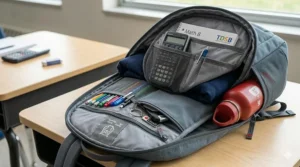
Grade 8 typically means at minimum: main compartment (books/binder), secondary compartment (laptop), front pocket (pencil case/charger), and side pocket (water bottle). If your student does extracurriculars, add a separate gym clothes compartment to the wish list.
Step 4: Prioritize water resistance over waterproofing.
Fully waterproof bags are heavier and stiffer — overkill for school use. A quality water-resistant coating (DWR or PU) handles Canadian rain, slush, and wet lockers without the weight penalty of fully sealed construction. Re-treat the coating with a spray-on DWR product once per year.
Step 5: Check the shoulder strap quality in person if possible.
The padding should be at least 1.5 cm thick with some firmness — if it compresses flat immediately under light pressure, it’ll compress to nothing under a full school load within two months. S-curved straps that follow the natural shoulder contour are meaningfully better than straight straps for daily all-day carrying.
Step 6: Measure the locker before you buy.
Standard Canadian school lockers are roughly 30–35 cm wide and 35–40 cm deep. A bag with depth over 22 cm may not close the locker door comfortably. Check the packed dimensions, not just the litre capacity — a slim 26L bag often fits better than a boxy 24L bag.
Step 7: Involve your student.
A backpack a teen actively dislikes will be dragged, tossed, and mistreated. Style genuinely matters at this age. Within the ergonomic and functional constraints you set, let them pick the colour, pattern, or brand. The best bag is the one that actually gets worn properly.
Common Mistakes Canadian Parents Make When Buying a Backpack for Grade 8 Students
Even well-intentioned parents fall into these traps. Here’s what to watch out for:
Buying too large “to grow into.” A 40L bag on a Grade 8 student invites overpacking. The bag gets filled to capacity, the weight exceeds safe limits, and posture suffers. Match the capacity to the actual school load — 22–28L is the sweet spot for most Grade 8 students.
Ignoring the empty bag weight. A heavily constructed bag with thick padding everywhere can weigh over 1.2 kg before anything goes in. On a student carrying a 5 kg safe limit, that’s 24% of the budget gone on the bag itself. Lightweight construction matters.
Buying winter without considering the coat. A backpack that fits perfectly over a t-shirt may feel binding over a heavy winter parka. If your student wears a puffy coat for half the school year (common in Saskatchewan, Manitoba, or northern Ontario), check that the shoulder straps have enough adjustment range to accommodate the extra bulk.
Overlooking warranty. JanSport’s lifetime warranty is exceptional and widely honoured in Canada. The North Face also offers a lifetime warranty on backpacks. Herschel provides a limited warranty. A bag without any warranty coverage is a risk — school bags endure enormous daily abuse, and zipper or strap failures are common by Year 2.
Assuming Amazon.ca pricing matches Amazon.com. Canadian prices are typically 15–25% higher than US equivalents after exchange rates and import considerations. This isn’t unique to backpacks — it’s the Canadian retail reality across most categories. The upside is that buying on Amazon.ca avoids cross-border shipping fees, customs delays, and warranty complications that arise when purchasing from American sellers.
Skipping the fit test. Load the bag with approximately what your student will carry, put it on their back, and check: does the bottom of the bag rest near the lower back (not hanging over the hips)? Are the straps adjusted so the bag sits 2.5–5 cm below the shoulders? Can they do up the chest clip without straining? A five-minute fit test prevents months of discomfort.
What to Expect: Real-World Backpack Performance in Canadian School Conditions
Canadian school conditions are uniquely demanding in ways that product listings rarely acknowledge. Here’s what actually happens to a backpack over a full school year in Canada:
September to October is the warm-up period. Rain is the main threat — light to moderate in most provinces. A standard DWR-coated bag handles this without issue. Focus on fit and organization habits during this period.
November to February is the proving ground. Salt from sidewalk treatments transfers to the base of the bag when it’s set on snowy ground outside. This attacks fabric coatings and zipper metal over time. Wipe the bag base down weekly during winter — a damp cloth takes 30 seconds and meaningfully extends the bag’s life. Temperatures can swing from -5°C to -25°C in provinces like Alberta, Ontario, and Quebec, and bags stored in cold cars overnight will feel stiff in the morning. This is normal and harmless for polyester construction.
March to April is the freeze-thaw damage period. Slush and wet snow are more penetrating than dry snow — a bag left sitting on a wet ground for 20 minutes during recess pickup will show whether the water-resistant coating is still active. Re-treat annually with a spray-on DWR product available at any Canadian Tire for around $15 CAD.
May to June closes the year. This is when zipper fatigue becomes visible. A zipper that’s been opened and closed twice daily for nine months (roughly 360 cycles per zipper) will show wear. The difference between a YKK zipper and a generic Chinese zipper becomes obvious here — YKK zippers typically survive 3–5 school years; generic zippers often fail in Year 2.
For more guidance on ergonomic back health for school-age children in Canada, MyKite.ca’s resources on safe backpack weight and ergonomic design offer detailed, Canadian-specific guidance written in consultation with ergonomic specialists.
Price Range & Value Analysis in CAD
| Tier | Price Range (CAD) | Best Options | Trade-offs |
|---|---|---|---|
| Budget | $35–$65 | JanSport Main Campus, Adidas Alliance II, MATEIN | Lighter features, shorter lifespan |
| Mid-Range | $65–$115 | Herschel Classic XL, North Face Borealis | Balance of durability + style |
| Premium | $115–$140+ | SwissGear ScanSmart, Kite Ergonomic | Max features, ergonomic engineering |
The mid-range tier offers the best overall value for most Canadian Grade 8 families. The $85–$120 CAD sweet spot gets you quality zippers, genuine water resistance, a real laptop sleeve, and enough organizational depth to last 2–3 school years. Budget bags under $65 CAD are a reasonable choice if you’re buying for a student who’s still growing rapidly or who has a history of losing/damaging bags — but budget up at least to mid-range if you’re planning to use the bag through high school.
✨ Don’t Miss These Exclusive Deals!
🔍 Ready to upgrade your student’s school year? Click through to Amazon.ca to check current pricing and availability on any of these top-rated backpacks. Prime members get free shipping — and with back-to-school inventory moving fast, it’s worth checking sooner rather than later!
FAQ: Backpacks for Grade 8 Students in Canada
❓ What size backpack is best for a Grade 8 student in Canada?
❓ Do backpacks for teens ship quickly on Amazon.ca to remote areas?
❓ Is a water-resistant backpack good enough for Canadian winters?
❓ How heavy should a Grade 8 student's backpack be?
❓ Are there Canadian backpack brands available on Amazon.ca?
❓ What size backpack is best for a Grade 8 student in Canada?
❓ Do backpacks for teens ship quickly on Amazon.ca to remote areas?
❓ Is a water-resistant backpack good enough for Canadian winters?
❓ How heavy should a Grade 8 student's backpack be?
❓ Are there Canadian backpack brands available on Amazon.ca?
Conclusion: Choosing the Best Backpack for Grade 8 Students in Canada
A backpack for grade 8 students isn’t just a bag — it’s a daily piece of gear that affects your child’s posture, organization habits, and honestly, their attitude toward school. A bag they love carrying is a bag they keep organized. A bag that hurts their shoulders by lunchtime is a bag that ends up dragged by one strap across wet hallway floors.
For most Canadian families, the JanSport Main Campus (budget), The North Face Borealis (mid-range), and Kite High School Ergonomic (premium) cover the full spectrum of genuine needs. If your student has a heavy tech load, the SwissGear ScanSmart is worth the investment. If they care deeply about aesthetic (as 13-year-olds do, and that’s legitimate), the Herschel Classic XL earns its place.
Whatever you choose, apply the 10–15% body weight rule, fit the bag properly, and do the monthly zipper check. Those three habits will do more for your student’s comfort than any single product feature.
Check availability and current pricing on Amazon.ca — and if you’re Prime-eligible, back-to-school shipping is reliably fast through July and August. Inventory on popular models like the North Face Borealis and JanSport Main Campus typically runs low by late August, so earlier is better.
✨ Don’t Miss These Exclusive Deals!
🔍 Found your perfect match? Click on any highlighted backpack to check current pricing and Prime shipping availability on Amazon.ca. Help your Grade 8 student start the school year right — with a bag built for Canadian classrooms, Canadian weather, and Canadian school lockers!
Recommended for You
- Best Combination Lock for School Locker in Canada 2026 — Top 7 Picks
- Best Locker Organizer for Middle School in Canada 2026 (Top 7)
- Best 5 Subject Binder for Grade 7 Canada 2026: Top 7 Picks
Disclaimer: This article contains affiliate links. As an Amazon Associate, I earn from qualifying purchases. If you purchase products through these links, we may earn a small commission at no additional cost to you.
✨ Found this helpful? Share it with your friends! 💬🤗
