
In This Article
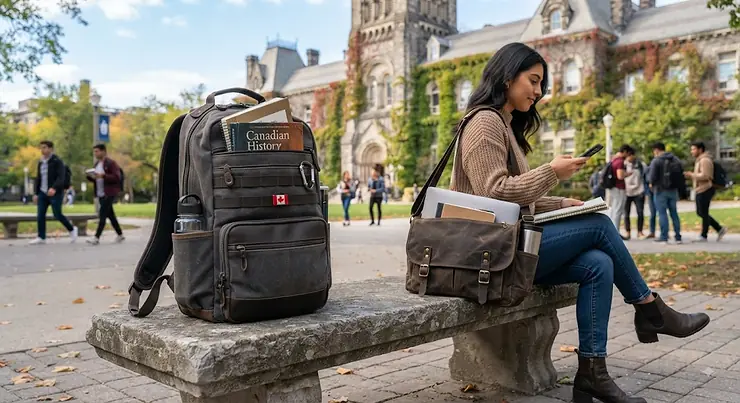
Somewhere between your first 8 a.m. lecture and your third campus building of the day, your bag either becomes an extension of your body or a low-grade enemy you’re stuck negotiating with for four years. That’s really what the laptop backpack vs messenger bag for university debate comes down to — not brand names, not colour options, but which shape of bag disappears into your routine and which one reminds you it exists every single time you sling it on. A laptop backpack is a two-strap, back-worn carrier built to distribute weight evenly across both shoulders, while a messenger bag is a single-strap, cross-body carrier designed for quick access and a leaner, more polished look. Both can protect a 13 to 17-inch laptop. Neither is universally “better” — the right one depends on your commute, your program, and how often you’re walking into a room where first impressions matter. This guide breaks down seven real, currently available bags, spanning budget to premium, backpacks and messenger bags alike, so you can match the bag to your actual semester instead of a marketing photo. We researched real specs, verified availability, and pulled honest aggregated review sentiment rather than inventing glowing testimonials — because a bag that looks good in a product shot but falls apart by reading week isn’t a real recommendation. According to the Canadian Chiropractic Association’s backpack guide, a fully loaded backpack should weigh no more than about 10% of the wearer’s body weight to avoid postural strain, a benchmark worth keeping in mind as we compare capacity against comfort below.

Quick Comparison: Laptop Backpack vs Messenger Bag for University
Before diving into all seven products, here’s the fast version for anyone skimming between classes.
| Bag Type | Best For | Comfort on Long Walks | Professional Look | Typical Price Range (CAD) |
|---|---|---|---|---|
| Laptop Backpack | Heavy daily loads, long commutes, cycling | High — weight on both shoulders | Moderate, varies by style | C$45–C$210 |
| Messenger Bag | Quick access, business school, internships | Moderate — one-shoulder strain on long hauls | High — reads as polished/professional | C$70–C$650 |
| Hybrid/Convertible | Students who switch contexts daily | High when worn as backpack | High when worn cross-body | C$80–C$150 |
Reading this table straight, backpacks generally win on raw carrying comfort, especially once you’re hauling a laptop, a water bottle, and three textbooks across a sprawling campus. Messenger bags win on polish and speed — you can swing one off your shoulder and pull out a laptop in a boardroom in about two seconds, which is exactly why they show up so often in business school circles. The “Best For” column is doing real work here: your actual daily distance and your actual dress code matter more than which style simply looks nicer online.
💬 Just one click — help other Canadian golfers make a smarter bag choice too!😊
Top 7 Laptop Backpacks and Messenger Bags for University: Expert Analysis
We shortlisted seven real, purchasable bags that cover budget, mid-range, and premium price points, plus a mix of backpacks and messenger bags so the comparison is actually fair. Availability and exact pricing shift constantly on Amazon.ca, so treat the ranges below as a starting point and check current pricing before you buy.
1. JanSport Cool Student Backpack — best lifetime-warranty budget backpack
The standout here isn’t the price, it’s the warranty: JanSport backs this bag for as long as you own it, which is a rare commitment at this price tier. The main compartment holds a padded 15-inch laptop sleeve alongside a roomy book compartment, and the 600-denier polyester shell is the same rugged fabric JanSport has used on its classic packs for decades. Based on the spec comparison with newer synthetic competitors, this bag trades novelty features like USB ports for straightforward durability — there’s nothing to break because there’s nothing complicated inside it. It’s built for first- and second-year students who want to stop thinking about their backpack entirely and just use it daily without babying it. Reviewers consistently report that the lifetime warranty program is genuinely honoured, with JanSport replacing zippers and straps years into ownership, though some note the single main compartment means less internal organization than pricier rivals offer.
Pros:
- ✅ Lifetime warranty actually gets honoured by JanSport
- ✅ Padded 15-inch sleeve protects against everyday bumps
- ✅ Durable 600D polyester shell resists daily wear
Cons:
- ❌ Minimal internal organization compared to newer designs
- ❌ No dedicated tablet or charging-cable pocket
At around C$55–C$70, the JanSport Cool Student Backpack is hard to beat for anyone who wants one bag to survive an entire undergraduate degree without a second purchase.

2. Targus Citysmart EVA Laptop Messenger Bag — best checkpoint-friendly professional messenger
The standout feature is the padded EVA laptop compartment that meets checkpoint-friendly airport screening standards, meaning it lays flat and separates cleanly for scanning — a small detail that also translates into fast access at a campus security desk or a crowded lecture hall. The bag fits laptops up to 15.6 inches, with a front organizer panel sized for pens, a phone, and a charger brick, and the shoulder strap includes a stabilizing pad that keeps it from sliding when you’re walking briskly between buildings. What most buyers overlook about a bag like this is that the boxy, structured silhouette reads more “meeting room” than “lecture hall,” which is exactly the point if you’re a business or commerce student who bounces between classes and networking events on the same day. Aggregated review sentiment on Targus messenger bags is generally positive around build quality and organization, with a recurring complaint being that the shoulder strap can dig in on longer cross-campus walks without a hip stabilizer.
Pros:
- ✅ Checkpoint-friendly laptop compartment speeds up screening
- ✅ Structured organizer panel keeps small items tidy
- ✅ Professional silhouette suits business and commerce students
Cons:
- ❌ Single-shoulder strap causes fatigue on long walks
- ❌ Less capacity for textbooks than a full backpack
Priced in the C$70–C$95 range, the Targus Citysmart EVA Laptop Messenger Bag is a smart pick for students who need to look put-together more often than they need to carry a full course load.
3. Amazon Basics 17-Inch Laptop Backpack — best budget backpack for oversized laptops
The standout feature is simple: it’s one of the few genuinely inexpensive backpacks that properly fits a 17-inch laptop, which matters enormously if you’re in engineering, computer science, or design and carrying a larger machine. The water-resistant polyester exterior sheds light rain, and the padded back panel with mesh venting keeps things from getting uncomfortable on a warm September afternoon. Here’s what to weigh: this is a no-frills bag, so you’re paying for capacity and basic protection rather than styling or organization — a reasonable trade if your laptop is the priority and your budget is tight. Reviewers consistently report solid value for the price, particularly praising the padded compartment for larger devices, while a recurring theme in feedback is that the zippers feel less premium than pricier alternatives and may need gentler handling over time.
Pros:
- ✅ Properly fits 17-inch laptops at a budget price
- ✅ Water-resistant shell handles light rain
- ✅ Ventilated back panel improves comfort in warm weather
Cons:
- ❌ Zippers feel less durable than premium competitors
- ❌ Sparse organization for a bag this size
At under C$60, the Amazon Basics 17-Inch Laptop Backpack is the practical choice for students whose main requirement is simply “fits my big laptop without costing a fortune.”
4. MATEIN Travel Laptop Backpack — best mid-range pick with built-in USB charging
The standout feature is the exterior USB charging port paired with a built-in charging cable, so a power bank tucked inside can top up your phone without you ever unzipping the bag — genuinely useful between back-to-back classes when there’s no outlet in sight. The anti-theft back-panel pocket sits flush against your body, making it harder for anyone to access on a crowded bus or train, and the bag fits laptops up to 17 inches with room left for a change of clothes if you’re heading straight to a weekend trip. On paper this means MATEIN is chasing the “one bag does everything” crowd, and based on the spec sheet, it mostly delivers: multiple organized compartments, a luggage strap that slides over a rolling suitcase handle, and water-resistant fabric. Aggregated customer sentiment is strongly positive on value for money and organization, with a common complaint being that the bag runs bulkier than sleeker backpacks once fully packed, which matters if your campus has tight lecture-hall seating.
Pros:
- ✅ Built-in USB port charges devices without unzipping
- ✅ Anti-theft back pocket protects valuables on transit
- ✅ Fits 17-inch laptops with room for extra gear
Cons:
- ❌ Bulkier profile than slimmer, minimalist backpacks
- ❌ USB port needs your own power bank to function
Priced around C$60–C$80, the MATEIN Travel Laptop Backpack is the strongest all-around value pick if you want tech-friendly features without paying premium-brand prices.
5. Timbuk2 Classic Messenger Bag — best iconic courier-style messenger for daily commutes
The standout feature is the cross-body courier design itself — Timbuk2 essentially popularized the modern messenger bag in the late 1980s, and the Classic still uses a rotating buckle closure that lets you cinch it down tight for cycling or loosen it for casual carry. The weather-resistant nylon body and reinforced base handle Canadian slush and rain far better than canvas alternatives, and the bag pivots to your back with a stabilizing strap so it doesn’t swing while you’re pedaling or jogging for a bus. What most buyers overlook about this model is that the single-strap design, when worn cross-body with the stabilizer clipped, actually distributes weight more evenly than a poorly adjusted messenger bag worn loose — the difference is almost entirely in how you wear it. Reviewers consistently note the bag’s durability over years of daily commuting, with a recurring theme being that the classic silhouette runs slightly boxier and less “corporate” than newer slimline messenger bags.
Pros:
- ✅ Rotating buckle closure cinches tight for cycling
- ✅ Weather-resistant nylon handles rain and slush well
- ✅ Stabilizer strap prevents swinging during commutes
Cons:
- ❌ Boxier silhouette reads more casual than corporate
- ❌ Single-strap carry still tires one shoulder on long days
At around C$120–C$150, the Timbuk2 Classic Messenger Bag is the pick for students who bike or walk long distances and want a messenger bag built to actually survive that commute.
6. Herschel Little America Backpack (30L) — best stylish backpack for daily campus life
The standout feature is the 30-litre capacity paired with a genuinely recognizable silhouette — the rounded top-lid pocket and canvas-style shell have made this one of the most-copied backpack designs on campuses worldwide, and it fits laptops up to 16 inches in a padded, fleece-lined sleeve. Dual expandable water bottle pockets, a magnet-fastened main compartment, and EVA-padded adjustable straps round out a bag that’s clearly designed for all-day wear rather than a quick commute. Based on the spec comparison with more utilitarian backpacks on this list, Herschel is selling design language as much as function, and reviewers back that up: aggregated sentiment praises the look and the amount of storage, but user reports suggest mixed feelings about strap comfort under a fully loaded main compartment, with some finding them supportive and others finding them thin under a heavy textbook load. If you’re carrying a laptop plus a light course load rather than four textbooks a day, that trade-off rarely becomes a problem.
Pros:
- ✅ Distinctive, recognizable design that doubles as everyday style
- ✅ 30L capacity with dedicated water bottle pockets
- ✅ Padded 16-inch laptop sleeve protects against knocks
Cons:
- ❌ Straps feel less supportive under very heavy loads
- ❌ Premium styling comes at a premium price point
In the mid-C$180s to C$210 range, the Herschel Little America Backpack suits students who want their bag to double as a style statement without sacrificing laptop protection.
7. Tumi Alpha Bravo Despatch Slim Brief — best premium business messenger for internships
The standout feature is the ballistic nylon construction — the same fabric family used in Tumi’s flagship luggage — combined with a slim, structured profile that looks entirely at home in a client meeting or a Bay Street internship. The padded laptop compartment fits up to a 15-inch machine, and a separate zippered pocket keeps a tablet or notebook protected from the laptop itself, while leather trim and reinforced corners signal quality at a glance rather than through logos. What the spec sheet won’t tell you, but reviewers note, is that the slim profile forces some discipline — this isn’t a bag for hauling four textbooks, it’s a bag for a laptop, a notebook, and the handful of items you’d actually bring into an interview. Based on the spec comparison with mid-range messenger bags, the Tumi’s hardware, stitching, and long-term durability genuinely justify a chunk of the price gap, and aggregated review sentiment consistently praises how the bag holds up after years of near-daily professional use, with the main critique being that the price puts it out of reach for most undergraduate budgets.
Pros:
- ✅ Ballistic nylon and leather trim built for years of use
- ✅ Slim, structured profile reads as genuinely professional
- ✅ Separate tablet pocket protects devices independently
Cons:
- ❌ Premium price is hard to justify on a student budget
- ❌ Slim design limits capacity for bulky course materials
At roughly C$500–C$650, the Tumi Alpha Bravo Despatch Slim Brief is squarely aimed at business and commerce students heading into internships or co-op placements where the bag itself becomes part of the first impression.
Top 7 Products at a Glance
| # | Product | Type | Best For | Price Range (CAD) |
|---|---|---|---|---|
| 1 | JanSport Cool Student Backpack | Backpack | Budget durability, lifetime warranty | C$55–C$70 |
| 2 | Targus Citysmart EVA Laptop Messenger Bag | Messenger | Checkpoint-friendly, professional look | C$70–C$95 |
| 3 | Amazon Basics 17-Inch Laptop Backpack | Backpack | Oversized laptops on a budget | Under C$60 |
| 4 | MATEIN Travel Laptop Backpack | Backpack | Tech features, anti-theft, USB charging | C$60–C$80 |
| 5 | Timbuk2 Classic Messenger Bag | Messenger | Cycling and daily commuting | C$120–C$150 |
| 6 | Herschel Little America Backpack | Backpack | Style-forward everyday campus carry | C$180–C$210 |
| 7 | Tumi Alpha Bravo Despatch Slim Brief | Messenger | Internships and business school polish | C$500–C$650 |
Laid out side by side, the spread makes the trade-off obvious: capacity and comfort trend toward the backpacks, while polish and speed-of-access trend toward the messenger bags, with price climbing steeply once you add premium materials like ballistic nylon or genuine leather trim. The MATEIN Travel Laptop Backpack stands out as the value sweet spot for students who want backpack comfort with a few smart features, while the Tumi Alpha Bravo Despatch Slim Brief only makes financial sense if a professional appearance is directly tied to your program or your co-op placements.
✨ Ready to compare a couple of these side by side? Check current pricing and availability on Amazon.ca before you commit to one.
Setting Up Your Bag for Semester Success
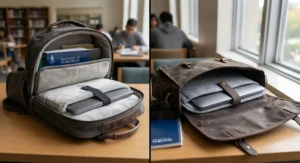
Buying the bag is the easy part — setting it up so it actually works for a 13-week semester takes a bit more thought. Start by doing a “week one” pack test: load exactly what you’d carry on your heaviest class day, then weigh it. If it’s pushing past roughly 10% of your body weight, per the chiropractic guidance cited earlier, it’s time to leave a textbook in your locker or switch to a digital copy. Next, assign every pocket a permanent job — chargers always go in the same slot, so you’re not digging through a bag in the two minutes before a lecture starts. For messenger bags specifically, adjust the stabilizer strap (if it has one) before your first real commute, not after your shoulder starts complaining; a loose messenger bag swinging against your hip for a semester is a bad habit that’s hard to unlearn. Finally, build a light maintenance routine: empty and wipe down the interior monthly, check zipper pulls for fraying before they snap entirely, and treat water-resistant coatings with a spray-on reproofer once a year if you’re commuting through Canadian winters. Common first-month mistakes include overpacking “just in case” items that never get used, ignoring a laptop sleeve that’s slightly too loose (which lets the device shift and scuff), and buying a bag before checking it actually fits your specific laptop model’s dimensions rather than just its screen size.
Real-World Scenarios: Matching the Bag to Your Program
Consider three fairly typical students. First, a first-year engineering student commuting 40 minutes by transit with a 16-inch laptop, a lab notebook, and safety glasses — for that load, a structured backpack like the MATEIN Travel Laptop Backpack or the budget-friendly Amazon Basics 17-Inch Laptop Backpack makes far more sense than any messenger bag, since two-shoulder support matters over a real daily distance. Second, a second-year business school student with three classes a week, a part-time consulting club role, and a habit of walking straight from lectures into networking mixers — here the backpack vs bag for business school students question tips toward a messenger bag, because the Targus Citysmart EVA Laptop Messenger Bag swings off in seconds and doesn’t scream “I just came from class” the way a stuffed backpack can. Third, a final-year student juggling a co-op placement two days a week and regular classes the other three — this is the split-use case, and it’s exactly why a bag like the Timbuk2 Classic Messenger Bag earns its keep: cinched tight, it survives a bike commute; loosened and worn structured, it looks appropriate walking into an office. If you can only afford one bag and your week looks like this student’s, prioritize the messenger bag that performs both roles rather than buying two separate bags you’ll forget to swap.
Laptop Backpack vs Messenger Bag: The Real Differences
The debate isn’t really about which shape is “better” — it’s about which trade-offs match your week. A backpack distributes weight symmetrically across both shoulders and the lower back, which matters enormously once you’re carrying more than about 6-7 kg, a threshold most students cross the moment a laptop, charger, water bottle, and one textbook go in together. A messenger bag concentrates that same weight on one shoulder and hip, which is fine for lighter loads and short distances but becomes noticeably uncomfortable on a 20-minute walk across a large campus. Where messenger bags win decisively is access speed and appearance: you can open one, grab a laptop, and close it again in the time it takes to unshoulder a backpack, and the structured, single-strap silhouette reads as more deliberate and professional in a business context — which is precisely why the professional-looking bag for university and internships conversation almost always lands on messenger-style bags or slim convertible hybrids.
| Factor | Laptop Backpack | Messenger Bag |
|---|---|---|
| Weight distribution | Even, across both shoulders | Uneven, single shoulder/hip |
| Access speed | Slower — must remove to open fully | Fast — swings forward easily |
| Professional appearance | Casual to moderate | Polished, business-appropriate |
| Cycling compatibility | Very good, stays centred | Good, with a stabilizer strap |
| Best load | Heavy, multi-item daily carry | Lighter, laptop-focused carry |
Reading across this table, the honest takeaway is that backpacks win on ergonomics and messenger bags win on optics, and very few students actually need to choose only one for four years — many end up owning a backpack for heavy days and a messenger bag for interview days, alternating based on what’s actually in the calendar that morning.
How to Choose a Laptop Backpack or Messenger Bag for University
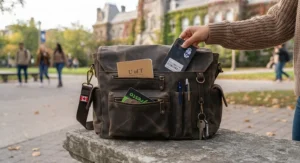
Choosing between a laptop backpack vs messenger bag for university comes down to five practical checks you can run through in a few minutes.
- Measure your typical daily load. Weigh what you actually carry on your heaviest day, not your lightest — this single number rules out entire categories of bag.
- Map your commute distance and mode. Anything over a 10-minute walk, or any regular cycling, strongly favours a backpack or a stabilized messenger bag over a loose one.
- Check your program’s dress expectations. Business, law, and co-op-heavy programs lean messenger or slim hybrid; STEM and arts programs with heavier daily loads lean backpack.
- Confirm your laptop’s exact dimensions. Match the sleeve size to your laptop’s height and width, not just its screen size, since chassis dimensions vary between brands.
- Decide your budget band before you shop. Knowing you’re looking at budget, mid-range, or premium up front prevents the scope-creep of upgrading features you won’t use.
Working through these five steps in order — load, commute, dress code, laptop fit, then budget — keeps the decision grounded in your actual routine instead of whichever bag happens to be trending.
Messenger Bags for University Students: Who They Actually Work For
Messenger bags get an unfair reputation as “just for professionals,” but a messenger bag for university students makes plenty of sense for specific routines, not just corporate ones. Students with short commutes — living in residence or a nearby off-campus rental — rarely hit the distance where single-shoulder carry becomes uncomfortable, which removes the biggest ergonomic downside entirely. Students who move between lecture halls, group study rooms, and part-time jobs on the same afternoon also benefit from the speed of a messenger bag: no unshouldering required to grab a laptop for a quick citation check. Reviewers of messenger-style bags consistently note that the format works best when the load stays light and focused — a laptop, a notebook, a charger, maybe a water bottle — rather than a full day’s worth of textbooks. Where messenger bags genuinely struggle is heavier science and engineering course loads with multiple physical texts, lab equipment, or art supplies, where the asymmetric weight adds up fast over a full day of back-to-back classes.
Building a Professional-Looking Bag Setup for University and Internships
A professional-looking bag for university and internships doesn’t need to be expensive, but it does need to follow a few consistent rules. Structured silhouettes read as more intentional than soft, slouchy ones — a bag that holds its shape on its own, rather than collapsing when it’s half-empty, immediately looks more put-together. Neutral colours (black, navy, grey, tan) travel across more settings than bright patterns, which matters if the same bag needs to work for a Tuesday lecture and a Thursday interview. Visible branding and logos matter less than most students assume; what recruiters and professors actually register is condition — scuffed corners, fraying straps, and half-broken zippers read as careless regardless of the brand name attached. According to the University of Toronto Mississauga career centre’s dress guidance, professional dress codes often focus on general recommendations like clean, well-kept attire rather than rigid rules, and that same “clean and well-kept” standard applies directly to whatever bag you’re carrying alongside that outfit — a well-maintained budget backpack beats a battered premium one every time.
Internship Dress Code and Your Bag: What Recruiters Notice
The internship dress code conversation almost always focuses on clothing, but your bag is walking into that same room and it’s not neutral. Career centres consistently draw a line between business formal and business casual expectations, and York University’s career centre notes that casual attire, while more relaxed, should still be neat and appropriate for the workplace — the same logic extends to bags: a beat-up gym backpack undercuts an otherwise polished outfit, while a clean, structured messenger bag or slim backpack reinforces it. If your internship or co-op placement leans business casual, a bag like the Targus Citysmart EVA Laptop Messenger Bag or the Timbuk2 Classic Messenger Bag worn structured (not slung loose) tends to land correctly. If the placement is genuinely business formal — think finance, law, or consulting — a premium option like the Tumi Alpha Bravo Despatch Slim Brief removes any doubt, though it’s worth noting that a clean, well-maintained mid-range bag rarely counts against you; recruiters are evaluating overall polish, not price tags.
Cycling Commute Practicality: Backpacks, Messenger Bags and Two Wheels
Cycling commute practicality changes this whole equation, because a bag that looks great standing still can become a genuine safety issue on a bike. Backpacks generally perform best while cycling since the weight sits centred and low against your back, keeping your centre of gravity stable through turns and stops. Messenger bags can work well too, but only when cinched tight and worn with the stabilizer strap clipped across the chest — worn loose, a messenger bag swings with every pedal stroke and can catch on a rear wheel or brake lever, which is a real hazard, not a theoretical one. Canadian road-safety guidance commonly flags loose backpack straps specifically as a chain-catch hazard, which is a useful reminder to tuck dangling straps before you clip in. Helmet laws also vary significantly by province: as CBC’s cycling safety guide explains, Alberta, Manitoba, and Ontario require helmets only for cyclists under 18, while British Columbia, New Brunswick, Nova Scotia, PEI, and Newfoundland and Labrador have all-age helmet laws — so check your provincial rules alongside your bag choice before you start commuting by bike. If your route includes real distance or hills, the MATEIN Travel Laptop Backpack or Timbuk2 Classic Messenger Bag (cinched) are the strongest picks on this list for two-wheeled commuting.
What to Expect: Real-World Performance on Campus
Specs on a product page rarely translate directly into a Tuesday-in-October experience, so here’s the practical version. A backpack rated for 30 litres feels roomy in a product photo but fills up fast once a laptop, a lunch, a water bottle, and one dense textbook go in — expect that “spacious” bags in this category comfortably fit a week’s worth of essentials, not a week’s worth of textbooks. Water-resistant fabric, common on the Amazon Basics 17-Inch Laptop Backpack and MATEIN Travel Laptop Backpack, handles a light drizzle walking between buildings but won’t survive a genuine downpour without some dampness getting through eventually; treat “water-resistant” as buying you five to ten minutes, not immunity. Messenger bags worn structured hold their shape through a full day, but the same bags worn overstuffed start to sag and lose the polished look that justified choosing one in the first place — overpacking undermines the exact advantage a messenger bag is supposed to provide. Zippers, more than any other component, tend to be the real-world failure point across every price tier; a slightly more expensive bag with smooth, well-anchored zipper pulls will usually outlast a cheaper bag with flashier features but scratchy hardware.
Common Mistakes When Choosing a University Bag
A handful of avoidable mistakes account for most of the buyer’s remorse in this category. The first is sizing a bag to the laptop’s screen size alone rather than its actual chassis dimensions — a “15-inch laptop sleeve” can still be too tight for a particular 15-inch model with a larger bezel or thicker chassis. The second is choosing style over ergonomics for a genuinely long commute, which is how students end up with a beautiful bag they quietly stop using by October because their shoulder is unhappy with them. The third is underestimating capacity needs in fields with heavier physical materials — architecture, fine arts, and some engineering programs regularly require binders, models, or equipment that a slim messenger bag simply can’t accommodate. The fourth is ignoring warranty and repair policies entirely; a lifetime-warranty bag like the JanSport Cool Student Backpack can outlast three cheaper bags bought back-to-back, which changes the real cost comparison significantly. The fifth is assuming a premium price guarantees comfort — the Herschel Little America Backpack‘s mixed strap-comfort feedback under heavy loads is proof that price and ergonomic fit don’t always move together.
Long-Term Cost & Maintenance: Backpack vs Messenger Bag ROI
Thinking in cost-per-year rather than sticker price changes which bag actually makes financial sense. A C$60 backpack that needs replacing every 18 months across a four-year degree costs roughly C$160 total, while a C$70 backpack with a genuine lifetime warranty, replaced zero times, is the cheaper option over the same stretch — which is exactly the trade-off the JanSport Cool Student Backpack is built around. Premium bags flip this logic at the high end: the Tumi Alpha Bravo Despatch Slim Brief costs roughly eight to ten times a budget backpack upfront, but for a student heading into a multi-year career in a field where the bag is a recurring professional accessory, the cost amortizes very differently than it does for someone who only needs a bag for four undergraduate years.
| Bag | Approx. Price (CAD) | Expected Lifespan | Rough Cost per Year |
|---|---|---|---|
| Amazon Basics 17-Inch Laptop Backpack | Under C$60 | 1–2 years | C$30–C$60 |
| JanSport Cool Student Backpack | C$55–C$70 | 4+ years (warrantied) | C$15–C$18 |
| MATEIN Travel Laptop Backpack | C$60–C$80 | 2–3 years | C$25–C$35 |
| Timbuk2 Classic Messenger Bag | C$120–C$150 | 4–5 years | C$25–C$35 |
| Tumi Alpha Bravo Despatch Slim Brief | C$500–C$650 | 8–10+ years | C$55–C$75 |
The math here is genuinely counterintuitive: the warrantied JanSport Cool Student Backpack posts the lowest cost per year on this entire list, while the premium Tumi lands closer to a mid-range bag’s annual cost once its much longer expected lifespan is factored in — it’s the bags replaced every year or two, not the cheapest or priciest options, that actually cost the most over time.

Frequently Asked Questions
❓ Is a messenger bag or backpack better for university?
❓ Can I use a messenger bag for job interviews and internships?
❓ What size laptop backpack do I need for university?
❓ Is it OK to bike to class with a messenger bag?
❓ How much should a laptop backpack weigh when full?
Conclusion
There’s no single right answer to laptop backpack vs messenger bag for university — there’s only the right answer for your specific week. If your days involve real distance, a heavy course load, or a bike commute, a backpack like the MATEIN Travel Laptop Backpack or the warrantied JanSport Cool Student Backpack will serve you better than any amount of styling could. If your program leans business, your commute is short, and your calendar regularly includes interviews or networking events, a messenger bag like the Targus Citysmart EVA Laptop Messenger Bag or, for a longer-term investment, the Tumi Alpha Bravo Despatch Slim Brief, earns its keep by looking as prepared as you actually are. Many students find the honest answer is “both,” rotating a backpack for heavy academic days and a messenger bag for placement or interview days — and given how differently these two formats perform on comfort versus polish, that split-use approach isn’t overkill, it’s just realistic. Whichever direction you lean, check current pricing and availability on Amazon.ca before buying, since both stock and prices shift regularly throughout the school year.
Recommended for You
- Backpack for University Students: 7 Best Picks for 2026 (Canada)
- Best Desk Organizer for CEGEP Study Groups: 7 Picks (2026)
- Presentation Folder for CEGEP Oral Exams: 7 Top Picks for 2026
Disclaimer: This article contains affiliate links. As an Amazon Associate, I earn from qualifying purchases. If you purchase products through these links, we may earn a small commission at no additional cost to you.
✨ Found this helpful? Share it with your friends! 💬🤗
