
In This Article
Every September, the same ritual plays out in kitchens from Victoria to St. John’s. A crumpled supply list comes home, somebody squints at line six, and the question lands: “What on earth is a wide ruled composition book — and why can’t I just buy the spiral one?”
Fair question. Short answer? Because the teacher has seen what a spiral notebook looks like in November.
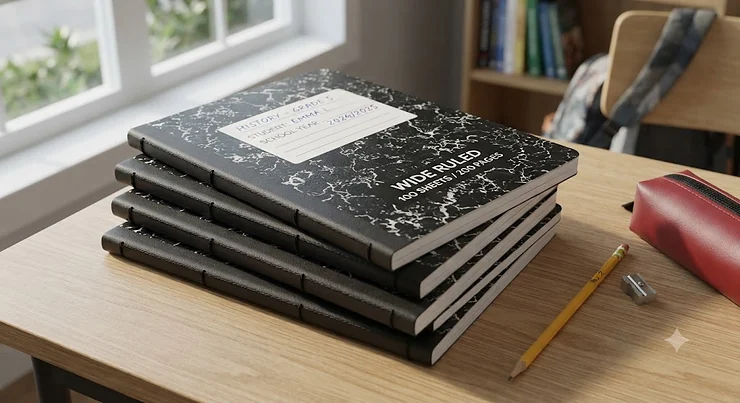
Wide ruled composition notebooks are the quiet workhorses of the elementary classroom. They’re stitched, not coiled. They lie flat on a tiny desk. They wear that famous black-and-white speckled cover that looks the same today as it did when your grandparents were practising cursive. And the generous line spacing gives small, still-developing hands room to form letters without cramming them into a space built for university lecture notes.
But here’s the catch Canadian parents run into: not every “composition book” on the shelf is wide ruled. Some of the best-known Canadian-market comp books are actually college ruled, and grabbing the wrong one is the single most common reason a notebook gets sent back home with a polite note.
This guide cuts through that. Based on real manufacturer specs, publicly available review sentiment, and a close read of how these notebooks are actually built, I’ve narrowed the field to seven wide ruled composition notebooks worth buying on amazon.ca in 2026 — from bulk classroom packs to a premium antimicrobial-cover option. You’ll also get a practical guide to making one last a full school year, a breakdown of marble cover design and sewn binding durability, and a translation of those cryptic elementary school supply lists.
Grab a coffee. Let’s make line six make sense.
What Are Wide Ruled Composition Notebooks?
Wide ruled composition notebooks are hard-cover, sewn-bound notebooks — usually 24.8 × 19 cm (9¾ × 7½ in) with 100 sheets — printed with horizontal lines spaced 8.7 mm (11/32 in) apart. That extra spacing, versus 7.1 mm college rule, makes them the standard choice for young writers and larger handwriting.
That definition matches the standard ruled-paper measurements documented on Wikipedia, which notes that wide (or “legal”) ruling is the format commonly used by children in grade school. The difference sounds tiny — 1.6 mm per line — but multiply it across a page and you get roughly 5-6 fewer lines per side. For a six-year-old still figuring out where a lowercase “g” is supposed to hang, that breathing room matters more than any cover colour ever will.
A few other traits define the category:
- ✅ Sewn (stitched) binding — thread runs through the centre fold, usually covered by a cloth or tape spine.
- ✅ Rigid pressboard or plastic covers — they double as a writing surface when there’s no desk.
- ✅ Fixed pages — no perforations, so pages don’t “accidentally” disappear.
- ✅ A left margin line — often red or pink, about 3 cm from the edge.
In other words, it’s a notebook designed to stay whole. That single design goal explains nearly everything else in this article.
Quick Comparison Table: 7 Best Wide Ruled Composition Notebooks
| Product | Sheets | Cover Type | Pack Size | Price Range (CAD) | Best For |
|---|---|---|---|---|---|
| Mead Composition Notebook, Wide Ruled (72368) | 100 | Pressboard | 5 | C$15-C$25 | Mead fans wanting a family-size pack |
| Amazon Basics Composition Notebook, Wide Ruled | 100 | Pressboard, assorted marble | 12 | C$25-C$40 | Budget bulk buying |
| Five Star Composition Book, Wide Ruled (Plastic Cover) | 100 | One-piece plastic | 1 or 6 | C$5-C$9 each | Kids who are rough on gear |
| Roaring Spring Composition Notebook, Wide Rule (77230) | 100 | Pressboard, black marble | 1 | C$5-C$10 | Classic look, made in the USA |
| Oxford Composition Book, Wide Rule (63795) | 100 | Pressboard, black marble | 12 | C$30-C$50 | Teachers stocking a class |
| BAZIC Marble Composition Notebook, Wide-Ruled | 100 | Pressboard, colour marble | 4 | C$10-C$18 | Colour-coding by subject |
| Five Star DuraShield Composition Book, Wide Ruled | Check listing | Antimicrobial-treated front | 4 | C$25-C$40 | Premium durability |
Prices are approximate ranges at the time of research — check current price on amazon.ca, as prices may vary.
Reading the table, the pattern is clear: the pressboard-cover options (Mead, Amazon Basics, Oxford, BAZIC) compete mostly on pack size and cost per book, while the two Five Star models charge more for tougher covers. If your child’s notebook lives in a backpack alongside a leaky water bottle, that premium is less “nice to have” and more insurance. For classroom bulk orders, the Oxford and Amazon Basics packs are where the per-book math gets most attractive.
💬 Just one click — help others make better buying decisions too!😊
Top 7 Wide Ruled Composition Notebooks: Expert Analysis
1. Mead Composition Notebook, Wide Ruled (72368) — the dependable classroom default
If a teacher writes “composition book” and nothing else, this is the notebook they’re picturing. The Mead Composition Notebook (72368) bundles five 100-sheet, wide ruled books with sewn binding — the textbook definition of the category.
Mead’s wide ruled marble line prints a class schedule, multiplication tables, conversion tables and grammar rules on the inside covers, according to the manufacturer. On paper that sounds like filler; in practice, a Grade 3 student checking “7 × 8” without leaving their desk is exactly the kind of quiet friction-reducer teachers appreciate. The 19 × 24.8 cm page is standard, so it slides into every classroom bin and book box designed around composition books.
Here’s the honest take: the Mead isn’t the most durable or the cheapest per book, but it’s the lowest-risk purchase. It matches supply lists exactly, it’s widely recognized, and the sewn binding means pages stay put. It’s for parents who want to buy once and not think about it again.
Aggregated review sentiment on Mead comp books is broadly positive around consistency and binding; the recurring complaint across retailers is that the thin paper shows ghosting with gel pens and markers — normal for this price tier.
Pros:
- ✅ Exactly matches most “composition book” supply-list requests
- ✅ Helpful reference tables printed on inside covers
- ✅ Sewn binding keeps all 100 sheets secure
Cons:
- ❌ Thin paper shows markers through to the back
- ❌ Pressboard corners fray with heavy daily use
Expect the 5-pack in roughly the C$15-C$25 range (check current price) — solid value for a one-child, one-year supply.
2. Amazon Basics Composition Notebook, Wide Ruled — best cost-per-book for bulk buyers
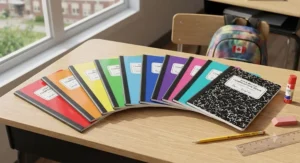
The Amazon Basics Composition Notebook earns its spot on sheer arithmetic: a 12-pack of 100-sheet wide ruled books in assorted marble colours, available directly on amazon.ca.
Specs are straightforward — 24.8 × 19 cm, 100 sheets (200 pages), sewn construction, standard wide ruling. What the spec sheet won’t tell you is why the assorted-colour marble matters: when a class is juggling a writing journal, a math journal and a science log, colour becomes the fastest way for a seven-year-old to grab the right one. Some Amazon Basics listings also add conversion charts inside the cover, so check the specific variant.
Who’s it for? Families with two or three kids in elementary school, teachers building a classroom stash, or anyone who’d rather buy notebooks once in August than three times by March. Based on the pack size, the per-book cost typically lands among the lowest in this roundup.
Broad review sentiment for this line centres on value; the common caveat is that paper and cover stock feel a touch lighter than name-brand options — fine for pencil, less so for felt markers.
Pros:
- ✅ Among the lowest per-notebook costs in this list
- ✅ Assorted marble colours simplify subject coding
- ✅ Easy to reorder mid-year on amazon.ca
Cons:
- ❌ Lighter paper struggles with markers and gel pens
- ❌ Twelve books is overkill for a single student
The 12-pack generally sits in the C$25-C$40 range — excellent value if you’ll actually use every book.
3. Five Star Composition Book, Wide Ruled (Plastic Cover) — toughest everyday cover for rough-and-tumble kids
The Five Star Composition Book swaps the traditional pressboard for a one-piece plastic cover, and that single change reshapes how the notebook ages.
Five Star describes the design as a durable one-piece plastic cover paired with sewn binding that keeps pages permanently bound, plus paper that resists ink bleed under normal writing. In real-world terms, a plastic cover shrugs off the spilled juice box, the wet mitten and the backpack crush that turn pressboard soft by February. The notebook still lies flat, and inside pages include a class schedule and conversion chart.
My analytical take: this is the upgrade pick for kids who are hard on their things — and, let’s be honest, that’s most kids. It’s slightly less “classic” looking than a black marble cover, which matters to some teachers who want uniform books. Check your list before you buy.
On Walmart’s listing for the Five Star wide ruled 6-pack, reviewers give it around 4.6 out of 5, with feedback centring on sturdiness and the notebooks matching their photos. The main complaint pattern is price relative to basic comp books.
Pros:
- ✅ Plastic cover survives spills and backpack crush
- ✅ Bleed-resistant paper makes double-sided writing practical
- ✅ Lies flat on small classroom desks
Cons:
- ❌ Costs more per book than pressboard options
- ❌ Solid-colour covers may not meet “marble” requests
Expect roughly C$5-C$9 per book (or better per-book pricing in multipacks) — worth it for kids who destroy notebooks.
4. Roaring Spring Composition Notebook, Wide Rule (77230) — the old-school original, still made in the USA
The Roaring Spring Composition Notebook is about as classic as the category gets: black marble, center-sewn, tape spine, and manufactured in Pennsylvania.
It carries 100 sheets of 15 lb white paper in the standard 24.8 × 19 cm format. That 15 lb figure is the key spec to interpret. It’s light — perfectly fine for pencil and ballpoint, which is what most elementary students use — but it’s not a paper for fountain pens or heavy markers. The independent reviewer at Notebook Stories found the regular 15 lb Roaring Spring paper showed “a lot of bleed” with fountain pens, while the brand’s premium 20 lb version handled ink far better.
So who should buy it? Families and teachers who value the authentic look and domestic manufacturing, and whose kids write mostly in pencil. It’s also a good variant choice if you want a single notebook rather than a pack.
Aggregated sentiment praises its build and nostalgia factor; the consistent knock is the thin paper with liquid ink.
Pros:
- ✅ Authentic black marble cover design, made in USA
- ✅ Center-sewn signature with durable tape spine
- ✅ Sold singly — no unwanted extras
Cons:
- ❌ 15 lb paper bleeds with markers and fountain pens
- ❌ Import availability on amazon.ca can fluctuate
Singles usually fall in the C$5-C$10 range — fair value for a well-made classic.
5. Oxford Composition Book, Wide Rule (63795) — best classroom-scale pack for teachers
The Oxford Composition Book (63795) is the notebook a teacher buys when 24 kids need identical books by Tuesday.
Sold in 12-packs under the Oxford/TOPS family, it offers 100 wide/legal-ruled sheets with a red margin, sewn binding, and a black marble hard cover in the standard 24.8 × 19 cm size. The red margin is a small but useful detail: it gives young writers a clear “start here” line, which helps with the indentation and alignment habits teachers work on in Grades 1-3.
Here’s the value logic: identical black marble covers make a classroom look orderly and let students personalize with a name label, while the 12-count box keeps per-book cost low. It’s less exciting for a single family, but for a teacher or a school council supply drive, it’s hard to argue with.
Distributor listings and retailer reviews generally describe it as a no-frills, reliable comp book. Individual Amazon review details weren’t accessible for verification during research, so treat it as a proven commercial workhorse rather than a standout performer.
Pros:
- ✅ Red margin guides early handwriting alignment
- ✅ Uniform covers suit whole-class ordering
- ✅ Low per-book cost in 12-count boxes
Cons:
- ❌ No reference tables or extras inside
- ❌ Plain look won’t excite younger students
The 12-pack usually runs C$30-C$50 — strong value for classroom quantities.
6. BAZIC Marble Composition Notebook, Wide-Ruled — most colourful way to colour-code subjects
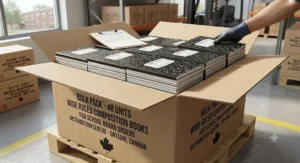
The BAZIC Marble Composition Notebook takes the familiar speckled pattern and gives it colour — a 4-pack of assorted marble covers, each with 100 wide ruled sheets.
The specs mirror the category standard: sewn binding, 24.8 × 19 cm, 200 pages. What’s different is the palette. When a Grade 2 class uses one notebook for journal writing and another for math, a red marble book and a blue marble book are instantly distinguishable — without abandoning the marble look many lists request. BAZIC also sells poly-cover variants with 70 sheets if you need something tougher and thinner.
My analysis: the BAZIC 4-pack sits in a sweet spot for a single student with multiple subjects. You get variety without buying 12 books, and the per-book cost stays below the brand-name options.
Retail review sentiment for BAZIC comp books tends to praise colours and price; the recurring caveat is thinner paper and occasional cover-print inconsistencies between batches.
Pros:
- ✅ Colour marble covers make subject-sorting effortless
- ✅ Four-pack fits one student’s full subject load
- ✅ Budget-friendly per-book pricing
Cons:
- ❌ Paper weight lighter than premium brands
- ❌ Colours may not suit “black marble only” lists
Expect the 4-pack around C$10-C$18 — excellent value for a one-kid setup.
7. Five Star DuraShield Composition Book, Wide Ruled — premium pick with an antimicrobial-treated cover
The Five Star DuraShield Composition Book is the premium end of the category: a 4-pack of wide ruled books with an antimicrobial-treated front cover.
Five Star lists the DuraShield 4-pack (950034A) at the standard 19 × 24.8 cm size with wide ruling and access to its study app. Understand what “antimicrobial” means here: the treatment is designed to protect the cover itself from odour- and stain-causing bacteria — it is not a health claim, and it doesn’t replace handwashing. The practical payoff is a cover that stays cleaner-looking through months of shared-table use. Sheet count varies by listing, so check before you buy.
Who is it for? Parents who want the longest-lasting cover possible and don’t mind paying for it — or students whose notebooks travel between home, school and daycare every day. For kids who treat notebooks gently, it’s more than you need.
Verified, detailed review sentiment for this specific wide ruled SKU is limited on the pages accessible during research, so weigh it on specs: it’s Five Star’s most protective composition cover.
Pros:
- ✅ Most protective cover in this roundup
- ✅ Cover resists stains and grime over time
- ✅ Sewn binding plus flat-lying design
Cons:
- ❌ Highest cost per notebook in this list
- ❌ Solid covers won’t satisfy marble-only lists
The 4-pack typically falls in the C$25-C$40 range — worth it only if durability is your top priority.
Top 7 Side-by-Side: Specs That Actually Matter
| Product | Paper Notes | Extras Inside | Durability Rating (analysis) | Best For |
|---|---|---|---|---|
| Mead Composition Notebook (72368) | Standard weight | Tables, grammar rules | Good | Supply-list accuracy |
| Amazon Basics Composition Notebook | Lighter | Some variants add charts | Fair-Good | Multi-kid families |
| Five Star Composition Book (Plastic) | Bleed-resistant | Schedule, conversion chart | Excellent | Rough-on-gear kids |
| Roaring Spring Composition Notebook (77230) | 15 lb | None | Good | Pencil writers, classic fans |
| Oxford Composition Book (63795) | Standard | Red margin | Good | Whole-class orders |
| BAZIC Marble Composition Notebook | Lighter | None | Fair-Good | Colour-coded subjects |
| Five Star DuraShield Composition Book | Five Star standard | Study app | Excellent | Maximum lifespan |
Looking at this data, the real divide isn’t paper or ruling — every notebook here is wide ruled and sewn — it’s the cover. The two Five Star models are the only ones likely to look respectable in June after a hard year, while the pressboard books win on price. If your child writes mainly in pencil, the lighter paper on Amazon Basics or BAZIC is a non-issue; if they love felt markers, lean toward Five Star or Mead.
✨ Don’t Miss These Top-Rated School Picks! 🔍
Take your back-to-school prep to the next level with these carefully selected notebooks. Click on any highlighted product to check current pricing and availability on amazon.ca. The right notebook helps your child build neat, confident handwriting habits you’ll love watching grow all year!
Practical Usage Guide: Making a Composition Book Last All Year
A comp book is only as durable as the way it’s handled. A few habits from day one can easily double its useful life.
Day One Setup
- ✅ Label the cover and first page. Use a permanent marker on the name box, and write the name inside too — covers get swapped.
- ✅ Add a table of contents. Reserve pages 1-2 and number the page corners. Kids learn organization, and teachers love it.
- ✅ Crease the spine gently. Open the book to the middle and press lightly so it lies flat. Don’t fold it back on itself — that’s how sewn threads loosen.
Everyday Handling
Store the notebook flat or upright in a book bin, never jammed diagonally in a backpack where the corners take all the pressure. A zip-lock freezer bag or a slim plastic folder is a cheap shield against water bottles — a C$2 fix that protects a pressboard cover from its biggest enemy.
Maintenance Schedule
- Monthly: Check the tape spine. If it’s lifting, a strip of clear packing tape along the edge extends its life by months.
- Mid-year (January): Inspect the corners. Frayed pressboard can be reinforced with corner stickers or clear tape.
- Spring: Count remaining pages. If the notebook will run out before June, buy the replacement now while stock is plentiful.
Common First-30-Day Mistakes
The biggest? Tearing out “mistake” pages. In a sewn book, each sheet is one half of a folded pair — rip one out and its partner on the other side of the stitching comes loose too. Teach kids to cross out with a single line instead. It’s also better practice: teachers often want to see the thinking, errors included.
Real-World Scenarios: Matching the Notebook to the Family
Theory’s nice. Here’s how the choice plays out in three common Canadian households.
Scenario 1: One Grade 1 Student in Ottawa, Budget Around C$20
A six-year-old writing mostly in pencil, with a supply list requesting “2 wide ruled composition books, marble.” The BAZIC Marble Composition Notebook 4-pack covers the request with two spares for January, and the colour marble helps the child tell the journal from the math book. If the list specifically says black marble, the Mead Composition Notebook (72368) 5-pack is the safer match.
Scenario 2: Three Kids in Surrey, Grades 2, 4 and 5
Three separate supply lists, all calling for multiple composition books. Here, the Amazon Basics Composition Notebook 12-pack wins on arithmetic: one order covers everyone, with a couple left over for mid-year replacements. Label covers with each child’s name in different coloured tape to prevent morning arguments.
Scenario 3: A Grade 3 Teacher in Halifax Stocking a Class of 22
The teacher wants uniform notebooks and some spares for students who arrive without supplies. Two boxes of the Oxford Composition Book (63795) give 24 identical black marble books with red margins. For the two or three students known to be hard on materials, a few Five Star Composition Book plastic-cover notebooks provide extra insurance.
The common thread: pack size should match how many books you’ll actually use, and cover toughness should match how rough the user is.

Problem → Solution Guide for Composition Book Headaches
Problem 1: Ink bleeds through, wasting the back of every page. Solution: Switch the pen, not the notebook. Most comp book paper is designed for pencil and ballpoint. If your child loves markers, the bleed-resistant paper in the Five Star Composition Book is the better match.
Problem 2: The cover is soggy and curling by November. Solution: Pressboard absorbs moisture. Either slip it into a plastic sleeve or move to a plastic-cover model such as the Five Star DuraShield Composition Book.
Problem 3: Pages are falling out. Solution: Almost always this is torn-out pages loosening their partners. Reinforce the centre fold with a strip of clear tape along the inside gutter and adopt a “no tearing” rule.
Problem 4: The teacher sent the notebook back. Solution: Check the ruling. Several composition books sold in Canada — including Hilroy’s popular 09924 model — are college ruled, not wide ruled. Look for “wide” or “legal” ruling on the label before checkout.
Problem 5: The book runs out in April. Solution: Buy packs with at least one spare per child. Replacement shopping in spring is harder than it sounds.
How to Choose Wide Ruled Composition Notebooks
Picking the right notebook takes about two minutes if you know what to look at. Here’s the order that matters:
- Confirm the ruling first. Wide rule is 8.7 mm between lines; college rule is 7.1 mm. Teachers are specific for a reason, and a mismatch is the top cause of returned supplies.
- Check the cover requirement. If the list says “marble,” a solid plastic cover may not qualify. If it says nothing, durability becomes your call.
- Look for sewn binding. Stitched binding keeps pages intact; glued or stapled budget books loosen much faster under daily use.
- Count the sheets. 100 sheets (200 pages) is standard. Lower counts (70-80) are thinner and lighter but may run out mid-year.
- Match paper to writing tools. Pencil-only writers can go budget. Marker and gel-pen fans need heavier or bleed-resistant paper.
- Calculate per-book cost, not pack price. A 12-pack that looks expensive can cost half as much per notebook as a single.
- Buy one or two spares. A spare notebook in the closet saves a panicked mid-year shopping trip.
The logic behind this order is simple: requirements set by the teacher come first, durability second, price third. Getting the first two right means the third one is a win instead of a waste.
Composition Notebooks for Elementary Students: What Kids Really Need
Composition notebooks for elementary students aren’t just a tradition — they solve specific developmental problems.
Why Wide Ruling Fits Young Writers
Children in Kindergarten through Grade 3 are still developing fine motor control. Their letters are large, uneven, and occupy more vertical space than an adult’s. Wide ruling gives each line enough height for a child to form ascenders (like “b” and “h”) and descenders (like “g” and “y”) without colliding with the line above. As handwriting becomes smaller and more controlled — usually around Grades 4-6 — many teachers begin transitioning to college ruled.
Why the Format Beats Loose-Leaf
A bound composition book keeps a child’s entire year of work in chronological order. That gives teachers a clear record of progress and gives parents a bit of joy at the end of June when they flip from September’s shaky letters to spring’s confident paragraphs. Loose-leaf paper, by contrast, disappears into backpacks and ends up as crumpled lunch-bag stuffing.
What to Skip
Composition notebooks for elementary students don’t need fancy extras. Perforated pages, fancy covers and ultra-thick paper add cost without helping learning. Focus on correct ruling, sewn binding, and a cover sturdy enough for a year of classroom life. The Mead Composition Notebook (72368) and Oxford Composition Book (63795) handle that brief well; the Five Star Composition Book adds toughness for kids who need it.
A quick tip for younger kids: put a small sticker at the start of the margin line on the first page. It becomes a visual anchor showing where every line begins.
Marble Cover Design: Iconic Look, Practical Payoff
That black-and-white speckle is so familiar it almost disappears. But the marble cover design has a surprisingly long history — and a practical logic.
Where It Came From
Marbling dates back centuries in East Asia, where pages were hand-dipped into floating pigments. As Mental Floss explains in its history of the marbled composition book, the “agate” pattern associated with composition books emerged from German industrial printing in the mid-1800s, once marbling could be reproduced by machine. The design reached North America in the late 19th and early 20th centuries and simply never left.
Why It Still Works
The marble cover design isn’t just nostalgia. The busy pattern hides scuffs, fingerprints and pencil smudges far better than a solid colour, which helps a notebook look presentable through a whole school year. It also serves as instant visual shorthand: teachers write “marble composition book” on elementary school supply lists precisely because it identifies a specific, sewn, hard-cover format.
Colour Marble vs Black Marble
Modern variants like the BAZIC Marble Composition Notebook and the assorted-colour Amazon Basics Composition Notebook apply the same pattern in red, blue, green and more. These are ideal for colour-coding, but check first — some teachers specifically request black marble for uniformity. When in doubt, the black marble Roaring Spring Composition Notebook (77230) or Oxford Composition Book (63795) is the safest bet.
The marble cover design, in short, is the rare example of a style choice that also happens to be a smart functional one.
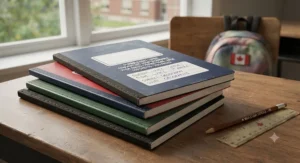
Sewn Binding Durability: Why Stitching Beats Staples and Spirals
If there’s one spec that separates a composition book from a cheap notebook, it’s the binding. Sewn binding durability is the reason teachers insist on this format.
How It’s Built
Composition books are made by stacking sheets, folding them in half, and stitching thread through the centre crease — a construction known as a single-signature sewn binding. A cloth or tape strip then covers the spine to protect the stitches. The result is a book where every page is physically anchored through the fold.
Why That Matters in a Classroom
Compare that with the alternatives:
- Spiral binding snags on backpack fabric, bends into sharp hooks, and lets pages tear out along the perforations with a tug.
- Glued (perfect) binding can crack when the book is opened flat repeatedly, releasing entire sections.
- Staples hold thinner exercise books well but can’t handle 100 sheets.
Sewn binding durability means a comp book survives being dropped, stuffed into desks, and opened flat hundreds of times without shedding pages. The Roaring Spring Composition Notebook (77230), for example, uses a centre-sewn signature with a taped spine — the classic construction.
The Only Real Weakness
The one thing that undermines sewn binding durability is torn-out pages. Because each sheet is half of a folded pair, removing one loosens its partner. Protect the binding and it will protect your child’s work all year long.
Elementary School Supply Lists: Decoding What’s Being Asked
Few documents cause more parental confusion than elementary school supply lists. They’re written in a shorthand teachers understand perfectly and parents often don’t.
Common Line Items, Translated
- “Composition book, wide ruled, marble” — a 100-sheet, sewn, hard-cover notebook with 8.7 mm lines and a speckled cover. Any product in this guide except the solid-cover Five Star models meets it exactly.
- “Exercise book, 8 mm ruled” — a thin, stapled Canadian-style notebook (such as Hilroy’s) — not a composition book.
- “Interlined” or “primary” — lines with a dashed midline for printing practice, used in Kindergarten and Grade 1. Different product entirely.
- “Duotang” — a Canadian term for a report cover with metal prongs, not a notebook.
Why the Costs Add Up
Supply lists have been getting longer and pricier. CBC News reported on Calgary parents looking for ways to save amid rising back-to-school costs, a pressure families across the country recognize. Composition books are rarely the most expensive item on elementary school supply lists, but buying the wrong type — and then buying again — is a cost you can avoid.
How to Save
Buy multipacks and share them between siblings or neighbours, shop before the August rush, and keep a “supply reserve” box at home for spares. If your school offers a pre-packaged supply kit, compare its composition book specs against the list before paying a convenience premium.
Wide Ruled vs College Ruled vs Canadian Exercise Books
Canadian parents face a unique twist: the classic Hilroy exercise book dominates many classrooms, and it looks nothing like an American-style composition book.
| Format | Line Spacing | Binding | Typical Size | Best For |
|---|---|---|---|---|
| Wide ruled composition book | 8.7 mm | Sewn, hard cover | 24.8 × 19 cm, 100 sheets | Grades K-4, year-long journals |
| College ruled composition book | 7.1 mm | Sewn, hard cover | 24.8 × 19 cm, 100 sheets | Grades 5+, smaller handwriting |
| Canadian exercise book (e.g. Hilroy) | 7 mm or 8 mm | Stapled, soft cover | ~27.6 × 21.3 cm, 16-40 sheets | Short units, single-subject work |
| Spiral notebook | Varies | Coil | Letter size | Older students, tear-out pages |
This comparison shows why the formats aren’t interchangeable. Exercise books are thin and meant to be finished in a unit or term, while composition books are built to hold an entire year. Wide ruled comp books suit younger writers; college ruled suits older ones; spirals mostly belong in middle school and beyond.
In practice, many Canadian elementary classrooms use both: exercise books for individual subjects and composition notebooks for journals and year-long logs. Always follow the specific list — if it says “exercise book, 8 mm,” a composition book won’t substitute, and vice versa.
Long-Term Cost & Value Analysis
The sticker price of a notebook matters less than its cost per school year. Here’s a practical view.
| Product | Approx. Pack Range (CAD) | Approx. Cost per Book | Expected Lifespan (analysis) | Best For |
|---|---|---|---|---|
| Amazon Basics Composition Notebook (12) | C$25-C$40 | ~C$2-C$3.50 | Full year with care | Multi-kid families |
| Oxford Composition Book (63795) (12) | C$30-C$50 | ~C$2.50-C$4 | Full year | Classrooms |
| BAZIC Marble Composition Notebook (4) | C$10-C$18 | ~C$2.50-C$4.50 | Full year with care | Single student |
| Mead Composition Notebook (72368) (5) | C$15-C$25 | ~C$3-C$5 | Full year | Supply-list accuracy |
| Five Star DuraShield Composition Book (4) | C$25-C$40 | ~C$6-C$10 | Full year, heavy use | Maximum durability |
Ranges are approximate at the time of research; prices may vary.
The takeaway is that bulk pressboard packs cost roughly a third as much per book as premium plastic covers. But value isn’t only price: if a C$3 notebook falls apart in January and needs replacing, the real cost doubles — plus the lost work. For careful writers, go budget; for rough handlers, the Five Star premium often pays for itself.
For families planning a full year of school costs, the Financial Consumer Agency of Canada’s budgeting guide is a useful framework for setting aside money for recurring expenses — school supplies included — so September doesn’t blow up the monthly budget.
Common Mistakes When Buying Composition Notebooks
A few repeat pitfalls, and how to avoid them:
- Buying college ruled by accident. The covers look identical. Always read the ruling on the label — and remember several Canadian-market comp books default to college rule.
- Choosing spiral because it’s cheaper. Many teachers explicitly reject spirals for young kids. You’ll end up buying twice.
- Ignoring the colour request. “Black marble” means black marble. Colour-coded packs are great — only when the list allows them.
- Buying exactly the number listed. Kids lose, soak and fill notebooks. One spare per child is cheap insurance.
- Overpaying for features kids won’t use. Pockets, perforation and premium paper add cost but rarely help a Grade 2 student.
- Waiting until the last week of August. Popular packs sell out and price ranges shift. Shop early.
Avoid these six and you’ve already outperformed most back-to-school shoppers.

FAQ: Wide Ruled Composition Notebooks
❓ Where can I buy wide ruled composition notebooks in Canada?
❓ How many composition books does a Grade 1 student need?
❓ Are Hilroy composition books wide ruled?
❓ Is a 12-pack of composition notebooks worth it for one child?
❓ Can you use gel pens in a composition notebook?
Conclusion
It’s easy to dismiss a composition book as the cheapest thing on the list. But open one in June and it tells a story — shaky September letters growing into confident paragraphs. That’s worth choosing carefully.
Here’s the short version. If you want the safe, list-matching default, grab the Mead Composition Notebook (72368). Buying for several kids? The Amazon Basics Composition Notebook 12-pack wins on cost per book. Teachers stocking a whole room should look at the Oxford Composition Book (63795). For a single student who likes to colour-code, the BAZIC Marble Composition Notebook is ideal. Traditionalists will love the Roaring Spring Composition Notebook (77230). And if your child treats notebooks like sporting equipment, the Five Star Composition Book or Five Star DuraShield Composition Book will outlast the rest.
Whatever you choose, check the ruling, confirm the cover requirement, buy a spare, and teach the no-tearing rule. Do those four things and your wide ruled composition notebooks will make it all the way to the last day of school.
✨ Ready to Check One More Item Off the List?
Take the stress out of back-to-school shopping with these carefully selected notebooks. Click on any highlighted product above to check current pricing and availability on amazon.ca — and give your young writer a notebook that’s built to go the distance!
Recommended for You
- Coil Notebooks For Planners: 7 Best Picks That Lie Flat (2026)
- Coil Notebooks With Hard Cover: 7 Best Sturdy Picks (2026)
- Multi-Subject Notebooks For University Students: 7 Best Picks
Disclaimer: This article contains affiliate links. As an Amazon Associate, I earn from qualifying purchases. If you purchase products through these links, we may earn a small commission at no additional cost to you.
✨ Found this helpful? Share it with your friends! 💬🤗
