

In This Article
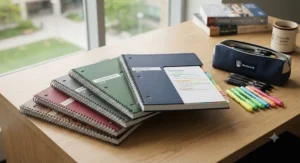
Somewhere between your third 8:30 a.m. lecture and the moment your backpack zipper finally gives out, every student learns the same lesson: five separate single-subject notebooks are really just five separate ways to lose your notes. That’s the entire case for multi-subject notebooks for university students — one spine, one system, and one less thing to leave behind on the bus. Whether you’re juggling four courses in your first semester or you’ve got a five-course course-load that spans two campuses, the notebook you carry ends up doing more organizational work than your actual planner.

This guide rounds up seven real, currently available options — from a C$7 spiral workhorse to a reusable smart notebook that syncs to the cloud — and breaks down what actually matters when you’re choosing between them: subject count, pocket design, paper weight, and how each one survives a full winter term stuffed into a backpack. We looked at real specs, real aggregated review sentiment, and the kind of everyday friction (spiral bending, pockets ripping, ink bleeding through thin pages) that Amazon listings tend to gloss over. Research from UBC’s Graduate School consistently points to organized, consistent note systems as one of the simplest levers for better study outcomes — and the notebook itself is where that system starts.
By the end, you’ll know which multi-subject notebooks for university students actually hold up to a full course-load, which ones are worth the extra few dollars for pockets and dividers, and which type fits your specific program, whether that’s three humanities seminars or a five-subject science schedule with labs attached.
Quick Comparison Table
| Notebook | Subjects | Standout Feature | Price Range (CAD) | Best For |
|---|---|---|---|---|
| Five Star Spiral Notebook + Study App (73635) | 5 | Water-resistant, ink-bleed-resistant cover | Around C$12–C$16 | Best all-around durability |
| Oxford 3-Subject Notebooks, 2-Pack (10386) | 3 (x2) | 3 divider pockets per notebook | Around C$14–C$19 | Best for pocket folders for handouts |
| Roaring Spring 5-Subject Notebook | 5 | 5 double storage pockets | Around C$9–C$13 | Best for heavy handout volume |
| Five Star Flex Hybrid NoteBinder | Unlimited (refillable) | Binder + notebook hybrid with tabs | Around C$20–C$28 | Best for course-load organization |
| Rocketbook Multi-Subject Reusable Smart Notebook | 4 dividers | Wipes clean, scans to cloud | Around C$45–C$60 | Best eco-friendly / digital pick |
| Mintra Office Durable Spiral Notebook, 5 Subject | 5 | Reinforced durable cover | Around C$7–C$10 | Best budget pick |
| National Brand 3-Subject Notebook | 3 | Pressboard covers, pocket dividers | Around C$6–C$9 | Best budget classic pick |
Looking at the spread above, the pattern across these multi-subject notebooks for university students is pretty clear: paying more usually buys you either pockets and dividers (Oxford, Roaring Spring) or a completely different format (the Five Star Flex Hybrid NoteBinder‘s binder rings, the Rocketbook Multi-Subject Reusable Smart Notebook‘s reusability), not just “better” paper. If your course-load is light and your budget is tight, the Mintra Office Durable Spiral Notebook or National Brand 3-Subject Notebook options cover the basics without complaint. If you’re the type who accumulates handouts, syllabi, and lab sheets faster than you can file them, the pocket-heavy options earn their extra few dollars fast.
💬 Just one click — help others make better buying decisions too! 😊
Top 7 Multi-Subject Notebooks for University Students: Expert Analysis
1. Five Star Spiral Notebook + Study App (73635) — best all-around durability for daily carry
The standout here is the water-resistant, ink-bleed-resistant cover, which sounds like marketing copy until you’ve had a plain paper cover disintegrate in a sudden October rainstorm on the walk to class. This 5-subject notebook packs 200 college-ruled sheets across 8.5″ x 11″ (21.6 cm x 27.9 cm) pages, with a poly cover that survives being crammed into a backpack pocket next to a water bottle. The perforated pages tear cleanly along a clean edge instead of leaving the ragged fringe you get from cheaper wire-bound notebooks, which matters more than it sounds like when you’re submitting handwritten problem sets.
Based on the spec comparison against the rest of this list, this is the notebook for students who want one reliable option that just works across every subject without thinking about it — first-years especially, since it removes a decision from an already overloaded first month. Reviewers consistently report that the wire binding holds up better than typical multi-subject notebooks over a full semester, though a handful note the plastic dividers between sections can tear if handled roughly. The “Study App” tie-in (a scan-to-digital feature some Five Star lines include) is a nice bonus but not the reason to buy it — the cover and paper quality are.
Pros:
- ✅ Ink-bleed-resistant paper handles fountain pens and heavy markers
- ✅ Water-resistant cover survives backpack spills and rain
- ✅ Clean-tear perforated pages for handing in assignments
Cons:
- ❌ Only one small storage pocket, thin for handout-heavy courses
- ❌ Five subject dividers can tear with rough daily handling
At around C$12–C$16 depending on retailer promotions, it’s a solid mid-range value pick — not the cheapest notebook on this list, but arguably the one least likely to need replacing before December exams.
2. Oxford 3-Subject Notebooks, 2-Pack (10386) — best for pocket folders for handouts
The standout feature is the three built-in divider pockets per notebook, which is exactly what you want if your professors hand out readings, rubrics, and problem sets on paper every single week. Each notebook in this 2-pack holds 150 college-ruled sheets on a durable plastic cover, and the pockets sit between subject dividers rather than only at the front, so a handout from week three doesn’t get buried under six weeks of notes.
What most buyers overlook about this model is that the pocket folders for handouts feature effectively turns one notebook into a lightweight filing system — you’re not carrying a separate duo-tang for every course. That makes it a strong option for students in reading-heavy programs (history, English, poli-sci) where loose paper accumulates faster than binder space. Aggregated reviewer sentiment describes the plastic covers as noticeably sturdier than paperboard alternatives, though a few buyers note the wire binding can snag on backpack zippers if the notebook is stored loose rather than in a sleeve or folder.
Pros:
- ✅ Three divider pockets per notebook for handout organization
- ✅ Durable plastic cover resists creasing and cracking
- ✅ Comes as a 2-pack, covering six subjects total
Cons:
- ❌ Only 3 subjects per notebook, less useful for a 5-course term
- ❌ Wire binding can snag on loose items in a backpack
Priced around C$14–C$19 for the pair, the per-notebook cost lands in the middle of this list — reasonable given you’re effectively buying two organizational systems in one purchase.
3. Roaring Spring 5-Subject Notebook — best for heavy handout volume
Five double storage pockets is the headline feature, and it’s not a small detail: this notebook is built around the assumption that you’ll accumulate paper faster than you can process it. Across 200 perforated sheets on 11″ x 9″ (27.9 cm x 22.9 cm) pages with eco-conscious “Eco Press” covers, it’s sized slightly larger than the standard letter format, which gives a bit more margin room for annotations during lecture hall note-taking.
Here’s what to weigh: the extra pocket capacity is genuinely useful for STEM programs with weekly lab sheets or heavy handout courses, but the larger footprint means it won’t slide into every backpack sleeve designed for standard 8.5″ x 11″ binders. Reviewers consistently note the paper quality holds up well to both pencil and pen, and the double-pocket design (one pocket per divider, front and back) means handouts from different weeks don’t get shuffled together. A recurring complaint is that the covers, while sturdy, show wear faster than the Five Star or Oxford equivalents if the notebook rides loose in a bag rather than in a sleeve.
Pros:
- ✅ Five double storage pockets for high handout volume
- ✅ Larger page size gives more annotation room
- ✅ Perforated sheets tear cleanly for submissions
Cons:
- ❌ Larger 11″ x 9″ size doesn’t fit every backpack sleeve
- ❌ Covers show wear faster under loose daily carry
At around C$9–C$13, this is one of the better value plays on the list if pocket capacity matters more to you than compact size.
4. Five Star Flex Hybrid NoteBinder — best for course-load organization
This one breaks the mould entirely: it’s a 3.8 cm (1.5-inch) ring binder built to feel and function like a notebook, with a built-in tab system and a refillable design that swaps the “multi-subject notebook” concept for genuine course-load organization. Because pages clip into rings rather than a fixed spiral, you can add, remove, and reorder sections mid-semester — useful when a syllabus changes or you switch a lab section three weeks into term.
Based on the spec comparison, this is the pick for students managing five or more courses who’ve outgrown fixed-subject notebooks entirely; the tabs let you dedicate a full section to a single class and expand it as the term gets heavier, which a spiral notebook simply can’t do once its sheet count is fixed. Aggregated review sentiment is generally positive on flexibility and tab organization, though a recurring theme is that the rings add bulk and weight compared to a standard spiral notebook, and pages can occasionally snag or tear at the ring holes if forced in unevenly.
Pros:
- ✅ Fully refillable and reorderable, adapts mid-semester
- ✅ Built-in tab dividers for true course-load organization
- ✅ Doubles as a binder, reducing separate binder purchases
Cons:
- ❌ Bulkier and heavier than any spiral notebook on this list
- ❌ Ring-punched pages can tear with rough handling
Running around C$20–C$28, it’s the priciest paper-based option here, but for a five-subject term it can replace both a notebook and a binder, which changes the value math.
5. Rocketbook Multi-Subject Reusable Smart Notebook — best eco-friendly, digital-first pick
The standout feature is that the entire notebook wipes clean and gets reused indefinitely — 70 lined pages behind 4 adjustable dividers that you write on with special erasable pens, scan to cloud storage through an app, then wipe down with a damp cloth once you’re done with the term. It’s the only genuinely different format on this list: part notebook, part scanner, part filing cabinet.
What most buyers overlook is that this isn’t really competing with paper notebooks on cost-per-page — it’s competing on total years of use. One Rocketbook, treated reasonably, can replace years of disposable notebooks, and the companion app can route scanned pages straight to Google Drive, Dropbox, or OneDrive by page, which is a genuine advantage for lecture hall note-taking when you want searchable notes without retyping anything. Reviewers consistently report that the pages need to be scanned or wiped within roughly a week for the best results, since ink left too long can be harder to fully erase, and it only works properly with Pilot FriXion-style erasable pens — an ordinary ballpoint won’t wipe off.
Pros:
- ✅ Fully reusable, drastically cuts long-term paper waste
- ✅ Scans directly to cloud storage by labelled destination
- ✅ Durable synthetic pages resist tearing and water damage
Cons:
- ❌ Requires specific erasable pens, not standard pens
- ❌ Higher upfront cost than any other notebook here
At around C$45–C$60 (sometimes bundled with pens for a bit more), it’s a genuine investment rather than a semester consumable — the value case depends on whether you’ll actually use the scanning workflow consistently.

6. Mintra Office Durable Spiral Notebook, 5 Subject — best budget pick
The standout feature here is simply value: a reinforced, durable cover on a 5-subject notebook at a price point closer to what you’d expect from a 1-subject notebook elsewhere. It comes in both college-ruled and wide-ruled versions across a range of solid cover colours, which makes colour-coding by course genuinely easy if you’re managing four or five different classes.
Based on the spec comparison, this is squarely aimed at budget-conscious students and anyone buying multiple notebooks at once — first-years stocking up before a semester, or anyone replacing a notebook mid-term without wanting to spend Flex Hybrid NoteBinder money to do it. Aggregated reviewer sentiment is generally positive on durability for the price, with the cover holding up better than expected against daily backpack wear; the more common critique is that the interior paper is noticeably thinner than premium options like the Five Star Spiral Notebook, which can mean slight bleed-through with wetter pens on both sides of a page.
Pros:
- ✅ Reinforced cover well above its price point
- ✅ Available in both college-ruled and wide-ruled versions
- ✅ Solid single colours make course colour-coding simple
Cons:
- ❌ Interior paper thinner, some bleed-through with wet pens
- ❌ Fewer built-in pockets than the Oxford or Roaring Spring picks
At around C$7–C$10, it’s genuinely one of the best cost-per-subject ratios on this list, and a smart pick if you’re buying more than one at a time.
7. National Brand 3-Subject Notebook — best budget classic pick
The standout feature is the pressboard cover — heavier and stiffer than the plastic or poly covers used elsewhere on this list, giving it a rigid, old-school durability that holds its shape even after months in a bag. It includes pocket dividers front and back on each subject divider, plus 120 sheets of 97-brightness paper that resists ghosting from double-sided writing.
Here’s what to weigh: the pressboard cover means this notebook won’t crack or peel the way some plastic covers do after a semester of use, and reviewers consistently describe it as a reliable, no-frills option that “just works” the same way it has for decades of students before laptops existed. The trade-off is capacity — three subjects is on the lower end for a typical course-load, so it suits students with a lighter term or those pairing it with a second notebook for extra subjects, rather than a five-course science schedule.
Pros:
- ✅ Rigid pressboard cover resists bending and cracking
- ✅ Pocket dividers built into every subject section
- ✅ High-brightness paper reduces ghosting from ink
Cons:
- ❌ Only 3 subjects, limiting for a heavier course-load
- ❌ Plainer design with fewer colour options
At around C$6–C$9, it’s the most affordable option here and a dependable pick if your term genuinely fits into three subjects.
Top 7 Notebooks at a Glance: Specs & Build Quality
| Notebook | Sheet Count | Pockets | Cover Material | Price Range (CAD) |
|---|---|---|---|---|
| Five Star Spiral Notebook + Study App | 200 | 1 | Water-resistant poly | Around C$12–C$16 |
| Oxford 3-Subject Notebooks (2-Pack) | 150 each | 3 per notebook | Durable plastic | Around C$14–C$19 |
| Roaring Spring 5-Subject Notebook | 200 | 5 (double) | Eco Press cover | Around C$9–C$13 |
| Five Star Flex Hybrid NoteBinder | Refillable | Tabs + zip pocket | Poly binder | Around C$20–C$28 |
| Rocketbook Multi-Subject Reusable Smart Notebook | 70 (reusable) | 4 dividers | Synthetic, wipeable | Around C$45–C$60 |
| Mintra Office Durable Spiral Notebook | Varies (5-subj) | 1 | Reinforced cover | Around C$7–C$10 |
| National Brand 3-Subject Notebook | 120 | Pocket per divider | Pressboard | Around C$6–C$9 |
The spec table makes the trade-offs obvious once you line them up: sheet count and pocket count rarely peak in the same notebook, so a student prioritizing capacity (Roaring Spring, Five Star Spiral Notebook) is usually trading away either pockets or price. The pressboard on the National Brand 3-Subject Notebook is the outlier for rigidity at its price point, while the Rocketbook Multi-Subject Reusable Smart Notebook‘s low sheet count is irrelevant given its wipe-and-reuse design — it isn’t meant to be compared on sheet count at all.
✨ Don’t Miss These Exclusive Deals! 🔍
Take your course-load organization to the next level with these seven picks. Click on any highlighted notebook above to check current pricing and availability before the next term starts — the right system now saves real headaches by finals!
3 Subject Spiral Notebooks vs 5-Subject (and Beyond): Which Course-Load Fits You?
| Format | Typical Sheet Count | Best Course-Load | Weight/Bulk | Best For |
|---|---|---|---|---|
| 3 subject spiral notebooks | 120–150 sheets | 3 courses | Light | Lighter terms, humanities-heavy schedules |
| 5-subject notebooks | 150–200 sheets | 4–5 courses | Medium | Standard full-time course-loads |
| Refillable binder-hybrids | Unlimited (add pages) | 5+ courses, changing syllabi | Heaviest | Heavy STEM/lab schedules, long-term use |
The math here is straightforward once you lay it out: 3 subject spiral notebooks make sense when your term is genuinely three courses, or when you’re deliberately splitting a heavier load across two lighter notebooks instead of one bulky one. Five-subject notebooks are the default recommendation for most full-time Canadian undergrads carrying four to five courses per term, since they hit the sweet spot between capacity and portability. Refillable binder-hybrids like the Five Star Flex Hybrid NoteBinder earn their extra bulk only if your course-load regularly exceeds five subjects or changes mid-term — otherwise you’re carrying weight you don’t need.
Setting Up Your Multi-Subject Notebook System for Course-Load Organization
Getting course-load organization right starts before the first lecture, not after your notes are already a mess. Start by assigning subjects to dividers in the order your classes actually meet during the week, not alphabetically — it sounds trivial, but flipping to the right section on autopilot between back-to-back lectures saves real time. Label the front cover with the course code and term, not just the subject name, since “PSYC 101” is far easier to spot at a glance in a stack of notebooks than “Psychology.”
For the first 30 days, resist the urge to switch systems if week one feels chaotic — most organizational friction in a new notebook comes from unfamiliarity, not a bad notebook. A common mistake is cramming a syllabus and every handout into the front pocket instead of distributing them behind each subject’s own divider; by week four the front pocket becomes an unsortable pile. If you’re using a pocket-heavy option like the Oxford 3-Subject Notebooks or Roaring Spring 5-Subject Notebook, file handouts behind their matching subject the same day you receive them — it takes fifteen seconds and saves an hour before exams.
Within each subject section, it also helps to pick a structured note format rather than freeform scribbling. The University of Waterloo’s student success office recommends the Cornell method specifically for course-load organization, since it splits each page into cues, notes, and a summary — a format that works identically whether you’re using a spiral notebook or the tabbed sections of a binder hybrid. Set a recurring weekly reminder to scan or photograph key pages as a backup, especially with paper-based notebooks that don’t have the Rocketbook Multi-Subject Reusable Smart Notebook‘s built-in cloud sync.
Real Student Scenarios: Matching Your Notebook to Your Program
If you’re a first-year commuting between two campus buildings with four courses and a tight budget, the Mintra Office Durable Spiral Notebook or National Brand 3-Subject Notebook covers the basics without overspending before you know your actual study habits. If you’re in a reading-and-writing-heavy program — English, sociology, political science — where professors hand out weekly readings on paper, the Oxford 3-Subject Notebooks or Roaring Spring 5-Subject Notebook earn their price through pocket folders for handouts that keep those readings from turning into loose paper chaos in your backpack.
If you’re an upper-year student managing five overlapping courses with labs, tutorials, and shifting TA schedules, the Five Star Flex Hybrid NoteBinder gives you the course-load organization flexibility to add pages mid-term without buying a new notebook. And if you’re environmentally conscious, tech-comfortable, and want searchable digital notes without retyping anything after lecture hall note-taking, the Rocketbook Multi-Subject Reusable Smart Notebook is worth the higher upfront cost — it’s the only option here designed to last through your entire degree rather than one term.

What Is a Multi-Subject Notebook for University Students?
Put simply, multi-subject notebooks for university students are single bound notebooks divided into separate sections — typically 3, 5, or more — that let one student track notes for multiple courses without carrying a stack of individual notebooks. Each section is usually marked with a tab or divider, and better models add storage pockets for handouts, syllabi, or loose worksheets between subjects.
The appeal is mostly logistical: fewer items to pack, fewer items to lose, and one place to check for any class rather than five. Where it gets more specific is subject count and pocket design — a notebook built for a light 3-course term looks and feels different from one built to survive a 5-course STEM schedule with weekly lab handouts.
How to Choose Multi-Subject Notebooks with Pockets
Not all multi-subject notebooks with pockets are built the same, and the difference usually shows up around week six rather than on the shelf. Here’s the order to weigh your options in when shopping for multi-subject notebooks for university students:
- Count your actual course-load first. Match subject dividers to the number of courses you’re taking this specific term — buying a 5-subject notebook for 3 classes just adds unused bulk.
- Check pocket placement, not just pocket count. Pockets between every divider (like the Roaring Spring 5-Subject Notebook) organize handouts far better than a single front pocket.
- Weigh cover material against your daily carry. Poly and plastic covers (Five Star, Oxford) resist moisture; pressboard (National Brand) resists crushing — pick based on whether rain or a crowded bag is your bigger risk.
- Consider paper weight if you use fountain pens or markers. Ink-bleed-resistant paper, like the coating on the Five Star Spiral Notebook, matters more than most students expect until they’ve ruined a page.
- Decide if your term is fixed or likely to change. If your schedule shifts mid-semester, a refillable option like the Five Star Flex Hybrid NoteBinder avoids buying a replacement notebook.
- Factor in long-term use, not just one term. If you’ll reuse the same system across multiple years, the Rocketbook Multi-Subject Reusable Smart Notebook‘s higher price spreads out over far more use than a single-term paper notebook.
- Test the binding in-store or check reviewer notes if buying online. Wire binding that bends or catches on backpacks is one of the most common complaints across nearly every brand on this list.
Pocket Folders for Handouts: The Feature That Separates Good Notebooks from Great Ones
Pocket folders for handouts sound like a minor add-on until week six, when every professor has handed out a rubric, a reading, or a lab sheet, and you’re holding a fistful of loose paper with nowhere to put it. The difference between a front-only pocket and a pocket behind every subject divider is the difference between an organized notebook and a notebook with a junk drawer taped to the front.
What most buyers overlook is that pocket quality varies more than pocket quantity. A flimsy paper pocket tears within weeks under the weight of a stapled handout packet, while the reinforced poly pockets on the Oxford 3-Subject Notebooks and the double-pocket design on the Roaring Spring 5-Subject Notebook hold up through a full term of near-daily use. If your program is genuinely handout-heavy — labs, case studies, weekly readings — pocket design should weigh as heavily in your decision as subject count, because a five-subject notebook with weak pockets will still leave you shuffling loose paper by exam season.
Lecture Hall Note-Taking: What to Expect from Your Notebook in a 300-Person Class
Lecture hall note-taking has its own set of demands that a notebook either handles well or doesn’t: writing fast without the page shifting, flipping to the right subject one-handed while a slide changes, and surviving being propped on a tiny fold-down desk. Larger-format notebooks, like the Roaring Spring 5-Subject Notebook at 11″ x 9″ (27.9 cm x 22.9 cm), give more margin room for the abbreviated, fast-handwriting style most students fall into during a 50-minute lecture, while standard letter-size options keep things more compact for smaller desks.
There’s also a real research angle here: a widely cited study published via the National Institutes of Health’s PMC archive found measurable advantages to handwriting over typing for word learning and retention. On paper, this means the choice of notebook isn’t purely cosmetic — a notebook that makes structured handwriting easier (clear margins, tear-resistant pages, a stable cover to write against) genuinely supports the note-taking method research suggests works best.
Common Mistakes When Buying Multi-Subject Notebooks for University
When shopping for multi-subject notebooks for university students, the most common mistake is buying subject count based on total classes rather than actual notebook use — some courses (labs, seminars) barely fill ten pages a term while others fill sixty, so a flat 5-subject split often wastes space in some sections and overflows in others. A second frequent error is prioritizing price per notebook without checking cost-per-semester: a C$7 notebook that needs replacing at midterm isn’t cheaper than a C$14 one that lasts the full year.
Overbuying is another quiet cost, both financially and environmentally — grabbing a multi-pack “just in case” often means unused notebooks and unnecessary paper waste sitting in a drawer come April; the simplest fix is buying closer to what you’ll actually use. Finally, students frequently skip checking pocket placement and binding quality entirely, focusing only on cover colour or brand recognition — two factors that matter far less than how the notebook survives daily handling.
If This Sounds Like You, Choose This Notebook
If you want the safest, most balanced option for a standard 4–5 course term, choose the Five Star Spiral Notebook + Study App because its durable, water-resistant build handles daily carry without extra cost for features you might not use. If you’re drowning in weekly handouts, choose the Oxford 3-Subject Notebooks or Roaring Spring 5-Subject Notebook because their pocket dividers are specifically built into the design rather than added as an afterthought.
If your schedule changes mid-semester or spans five-plus courses, choose the Five Star Flex Hybrid NoteBinder because its refillable, reorderable format adapts without a replacement purchase. If you’re working with a tight budget and buying more than one notebook at once, choose the Mintra Office Durable Spiral Notebook or National Brand 3-Subject Notebook because they deliver the best cost-per-subject on this list. And if you want a system that lasts your entire degree rather than one term, choose the Rocketbook Multi-Subject Reusable Smart Notebook because its reusable pages and cloud-scanning workflow are built for years of use, not one semester.

Frequently Asked Questions
❓ What are the best multi-subject notebooks for university students for a tight budget?
❓ How many subjects should one notebook cover?
❓ Do multi-subject notebooks with pockets cost more than plain spiral notebooks?
❓ Are pocket folders for handouts worth it if my professors mostly post materials online?
❓ Is a reusable smart notebook better than paper for lecture hall note-taking?
Conclusion
Choosing between these seven multi-subject notebooks for university students really comes down to three questions: how many courses are you actually tracking, how much paper handout volume do you expect to manage, and how long do you want this system to last. The Five Star Spiral Notebook + Study App remains the safest all-around pick for most standard course-loads, while the Oxford 3-Subject Notebooks and Roaring Spring 5-Subject Notebook earn their keep specifically through pocket folders for handouts that keep loose paper under control.
For students juggling heavier or shifting schedules, the Five Star Flex Hybrid NoteBinder offers course-load organization that a fixed spiral notebook can’t match, and for anyone thinking beyond a single term, the Rocketbook Multi-Subject Reusable Smart Notebook is a genuine long-term investment rather than a semester consumable. On a tighter budget, the Mintra Office Durable Spiral Notebook and National Brand 3-Subject Notebook both prove that a lower price doesn’t have to mean a flimsier build.
Buying only what you need is also the simplest sustainability move available here — the Forest Stewardship Council’s Canadian resources note that certified, responsibly sourced paper is a meaningful step, but avoiding unnecessary multi-packs matters just as much. Whichever you choose, the right notebook is the one that matches your actual course-load — not the one with the most features you’ll never use.
Recommended for You
- 7 Best Multi-Subject Notebooks For High School In Canada (2026)
- Single Subject Notebook 5 Pack: 7 Best Deals For Canada 2026
- 7 Best Single Subject Spiral Notebooks In Canada 2026 (Ranked)
Disclaimer: This article contains affiliate links. As an Amazon Associate, I earn from qualifying purchases. If you purchase products through these links, we may earn a small commission at no additional cost to you.
✨ Found this helpful? Share it with your friends! 💬🤗
