
In This Article
Somewhere between the third ripped page and the fourth exploded coil, most students figure out that not all spiral notebooks for students are built the same. A notebook seems like the most boring purchase on the entire list — cheaper than the calculator, less exciting than the backpack — right up until the one you bought unravels in your locker in October and takes half your chemistry notes with it. That’s the moment it stops being boring and starts being personal.
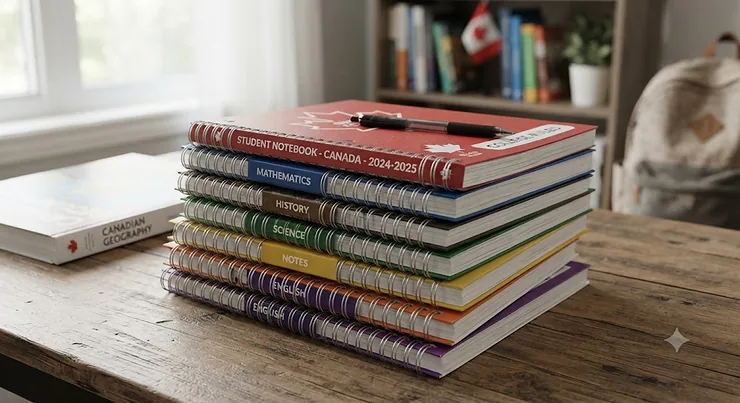
A spiral notebook is a bound writing pad held together by a continuous coil of wire or plastic threaded through punched holes, a design that lets pages lie flat and rotate a full 360 degrees — a small mechanical trick, borrowed from the coil-binding technique that’s been standard in classrooms since the 1930s. What’s changed since then isn’t the concept; it’s the details — the coil metal, the paper weight, the pockets, the perforation — and those details are exactly where a good notebook and a garbage one part ways.
That gap matters more this year than it used to. Back-to-school costs in Canada have climbed sharply enough to strain family budgets, with one school secretary noting that a simple box of pencils can now run C$40 to C$50 for a hundred pieces, and paper goods haven’t been spared. Buying the wrong notebook three times a semester costs more, in dollars and sanity, than buying the right one once. This guide walks through seven real, currently available options across every price tier, breaks down the wire-vs-plastic coil debate that quietly decides how long a notebook survives a backpack, and covers the secondary essentials — pockets, perforation, and building a classroom supply list — that most buying guides skip entirely.
Quick Comparison: Best Spiral Notebooks for Students at a Glance
Before the deep dive, here’s the shortcut version for anyone who needs to grab something before first period.
| Category | Notebook | Why It Wins |
|---|---|---|
| Best Overall | Five Star 5-Subject Wirebound Notebook | Toughest coil, reinforced pockets, built for a full semester |
| Best for Pockets | Oxford 1-Subject Poly Notebook with Pockets | Double-sided storage, water-resistant poly cover |
| Best Budget | Hilroy 1-Subject Coil Notebook | Canadian classroom classic, lowest cost per notebook |
| Best Durability | Blueline Duraflex Notebook | Twin-wire binding, made in Canada, professional-grade poly cover |
| Best Premium/Tech | Rocketbook Core Smart Reusable Notebook | Reusable pages, cloud scanning, zero paper waste after year one |
Looking at the snapshot above, the pattern that jumps out is that price and durability don’t move in a straight line — the Hilroy 1-Subject Coil Notebook costs a fraction of the Rocketbook Core, but for a student who fills three or four notebooks a term, the math on which one actually saves money isn’t as obvious as it looks. We’ll unpack exactly that trade-off in the Long-Term Cost section further down.
💬 Just one click — help others make better buying decisions too!😊
Top 7 Spiral Notebooks for Students: Expert Analysis
We shortlisted these seven after digging through real listings, manufacturer specs, and aggregated customer feedback across budget, mid-range, and premium tiers — including one homegrown Canadian brand most back-to-school lists overlook.
1. Hilroy 1-Subject Coil Notebook — the classic Canadian classroom staple
If you grew up going to school anywhere in Canada, you’ve held one of these, whether you clocked the brand name or not. The Hilroy 1-Subject Coil Notebook has been manufactured in Mississauga, Ontario for a company that’s been supplying Canadian classrooms for more than a century, and that legacy shows up less in nostalgia and more in the fact that the formula hasn’t needed much fixing. It ships as an 8″ x 10.5″ notebook with roughly 80 pages of wide- or college-ruled paper, wire coil binding, and full 3-hole punching so it can migrate straight into a binder once a unit wraps up. In practice, that 3-hole punch detail matters more than it sounds — it means a single Hilroy 1-Subject Coil Notebook can serve as a temporary notebook and a permanent binder insert, cutting down on the number of separate supplies a parent has to track. Based on the spec sheet, this is squarely an entry-level, single-subject option: it’s not going to survive four years of daily abuse, but nobody’s asking it to. Reviewers consistently note that the paper takes pencil and ballpoint cleanly with minimal show-through, though a few mention the covers are thin enough to bend in a backpack pocket.
Pros:
- ✅ Lowest price point of any notebook on this list
- ✅ 3-hole punched for binder compatibility
- ✅ Trusted, decades-old Canadian manufacturing pedigree
Cons:
- ❌ Thin paper cover can crease or dent in a packed bag
- ❌ Wire coil can bend if the notebook is stored flat under heavy books
Expect to pay under C$5 per notebook, sometimes less in multi-packs, which makes the Hilroy 1-Subject Coil Notebook the easiest one on this list to buy in bulk without flinching at checkout.

2. Five Star 5-Subject Wirebound Notebook — toughest coil for a full course load
The Five Star 5-Subject Wirebound Notebook is the one to reach for if a student is trying to consolidate multiple classes into a single binder-sized object instead of hauling five separate notebooks. It packs roughly 200 double-sided, college-ruled sheets behind a water-resistant plastic front cover and a coated kraft back, with four built-in pocket dividers separating the subjects. What most buyers overlook about this model is the “Spiral Lock” wire treatment — the coil ends are capped so they don’t catch on backpack zippers or hoodie sleeves, which sounds minor until you’ve had a notebook literally attached to your jacket sleeve mid-hallway. The perforated “Neat Sheet” pages tear out clean, without the ragged fringe that turns a homework hand-in into a small confetti explosion. Reviewers consistently praise the pocket dividers for surviving a full semester of loose handouts, though a recurring complaint in more recent production runs flags thinner paper than older versions, with some users noticing pen imprints bleeding faintly through to the next page.
Pros:
- ✅ Five full subjects consolidated into one notebook
- ✅ Reinforced, tear-resistant pocket dividers
- ✅ Spiral Lock coil resists snagging on bags and clothing
Cons:
- ❌ Bulkier and heavier than single-subject alternatives
- ❌ Some recent batches use noticeably thinner paper stock
Priced in the C$15-C$20 range, the Five Star 5-Subject Wirebound Notebook costs more upfront than five loose Hilroys, but consolidating five subjects into one spine is exactly the kind of value trade-off we’ll walk through in the cost-per-use breakdown later in this guide.
3. Oxford 1-Subject Poly Notebook with Pockets — best pocket storage for loose handouts
Pockets sound like a small feature until the first time a teacher hands back a stack of graded worksheets with nowhere to put them. The Oxford 1-Subject Poly Notebook with Pockets solves that with a double-sided storage pocket built into the front cover, wrapped in a wear- and moisture-resistant plastic shell that noticeably outlasts the paper-covered budget notebooks on this list. It runs about 100 college-ruled sheets at roughly 8.5″ x 11″, with the same 3-hole punch and snag-resistant coil found across the rest of the Oxford line. Here’s what the spec sheet won’t tell you outright: a poly cover doesn’t just resist rain and spilled water bottles, it also resists the slow curling and softening that cardboard covers pick up after a few months riding around in a backpack. That translates into a notebook that still looks presentable at report card time, not just at Labour Day. User reports suggest the pocket seams hold up well under moderate use, though a handful of reviewers note the pocket can bulge and distort the notebook’s shape if it’s stuffed past its intended capacity.
Pros:
- ✅ Double-sided pocket keeps loose worksheets organized
- ✅ Water- and wear-resistant poly cover outlasts paper covers
- ✅ Snag-resistant coil binding for smooth page turns
Cons:
- ❌ Pocket can distort if overstuffed with papers
- ❌ Single subject only, so heavier course loads need multiples
Available in the C$4-C$7 per-notebook range (often sold in 3-packs for C$10-C$15), the Oxford 1-Subject Poly Notebook with Pockets earns its keep for anyone whose backpack doubles as a filing cabinet.
4. Mead Spiral Notebook 6-Pack — best bulk value for multi-class stocking
When the classroom supply list calls for six or eight notebooks by September, buying them one at a time is how a C$40 shopping trip turns into a C$70 one. The Mead Spiral Notebook 6-Pack is built for exactly this scenario: six single-subject, college-ruled notebooks at roughly 7.5″ x 10.5″ with 70 sheets each, in assorted bright covers so siblings — or subjects — don’t get mixed up. On paper this means a cost-per-notebook that undercuts almost everything else on this list once the multi-pack discount kicks in. The honest trade-off is that Mead doesn’t try to be fancy here: no reinforced pockets, no water-resistant cover, just a dependable wire-bound notebook that does the one job it’s asked to do. Reviewers consistently describe it as “exactly what’s on the list and nothing more,” which, for a parent working through a September supply run for two or three kids, reads less like faint praise and more like the entire point.
Pros:
- ✅ Six notebooks per pack lowers cost-per-unit significantly
- ✅ Assorted colours make subject or sibling sorting easy
- ✅ College-ruled paper suits notes across most grade levels
Cons:
- ❌ No pockets or reinforced covers included
- ❌ Thinner paper than premium alternatives on this list
Expect a 6-pack to land in the C$12-C$18 range, which works out to some of the lowest per-notebook pricing of any option here — a genuinely useful fact for anyone building a classroom supply list from scratch.
5. Blueline Duraflex Notebook — most durable twin-wire build, made in Canada
For students who are hard on their supplies — the ones whose backpacks get thrown, not set down — the Blueline Duraflex Notebook is the sturdiest single-subject option on this list, and it happens to be a genuinely Canadian product line. It uses a twin-wire binding through a flexible, textured poly cover, wrapped around roughly 160 pages of acid-free, ruled paper with a margin and a dated header space on every sheet. Based on the spec comparison with the plastic-coil notebooks earlier on this list, the twin-wire construction is the standout: it flexes without deforming and lets the notebook lay genuinely flat, rather than the shallow curl you get from lighter coil-bound options. What most buyers overlook is that Blueline builds this with a minimum of 30% post-consumer recycled paper and vegetable oil-based ink, which matters for anyone weighing the sustainability angle we cover later in this guide. Reviewers, including several who specifically call out left-handed use, note the wire spine flips over cleanly without catching notes underneath it — a small but real accessibility win.
Pros:
- ✅ Twin-wire binding lays flatter and flexes without warping
- ✅ Acid-free paper resists yellowing over the school year
- ✅ Made with recycled content and vegetable oil-based ink
Cons:
- ❌ Priced higher than comparable single-subject notebooks
- ❌ Only available in single-subject format, not multi-subject packs
At roughly C$8-C$12 per notebook, the Blueline Duraflex Notebook sits in the mid-range, but the wire-versus-plastic durability question it raises is significant enough that it gets its own full breakdown below.
6. Rocketbook Core Smart Reusable Notebook — best tech-forward, paperless-friendly pick
Not every student wants a stack of notebooks accumulating in a closet by June. The Rocketbook Core Smart Reusable Notebook takes the physical spiral-bound format and pairs it with reusable, wipeable synthetic pages — roughly 32 to 36 pages depending on size — that scan to cloud services through a companion app before being erased with a damp cloth and used again. On paper this means a single physical notebook can functionally replace dozens of paper ones across an entire school year, provided the student actually uses the app step consistently. Here’s what most spec sheets skip: this only works well with the specific Pilot FriXion-style pens the system is designed around, and skipping that detail is the single biggest reason new users report frustration. The honest analytical take is that this isn’t a fit for every subject — heavy math or diagram-based note-taking can feel cramped on a reusable page designed primarily for text — but for lecture notes, to-do lists, and anything destined to be typed up later anyway, it genuinely earns the “no more notebooks” pitch. Reviewers who stick with the correct pen report high satisfaction, while a recurring complaint from others traces back to using the wrong ink entirely.
Pros:
- ✅ Fully reusable — one notebook replaces a year of paper ones
- ✅ Scans and organizes notes automatically to cloud storage
- ✅ Genuinely reduces long-term paper waste and clutter
Cons:
- ❌ Requires specific compatible pens to erase properly
- ❌ Noticeably higher upfront price than any paper notebook here
Priced around C$45-C$60, the Rocketbook Core Smart Reusable Notebook is the most expensive item on this list by a wide margin, and whether that premium pays off depends almost entirely on how a student’s course load and study habits line up with it.
7. UIRIO A5 Spiral Notebook 4-Pack — best compact sleeper pick for note-taking on the go
This is the option that doesn’t show up on most “best of” lists, and that’s a genuine miss, because the UIRIO A5 Spiral Notebook 4-Pack solves a problem the bigger 8.5″ x 11″ notebooks don’t: portability for students who are moving between classes, study rooms, or a part-time job and don’t want to haul a full-size binder everywhere. Each notebook in the pack runs A5-sized, around 5.7″ x 8″, with roughly 160 lined pages, flexible poly covers, and a 180-degree lay-flat design that makes it comfortable to use balanced on a knee or a narrow desk. What the spec sheet won’t tell you is how much a smaller page size changes actual in-class behaviour — students tend to write more concise, better-organized notes on a smaller page simply because there’s less room to sprawl, which lines up with what university learning centres generally recommend for effective note-taking. Reviewers consistently mention the four-pack’s colour variety as a practical way to colour-code subjects without buying four separate products, and several highlight the flexible cover surviving repeated tossing into bags without cracking.
Pros:
- ✅ Compact A5 size is easier to carry between classes
- ✅ Four-pack colour variety supports simple subject coding
- ✅ Flexible poly covers resist cracking from daily bag use
Cons:
- ❌ Smaller page size holds less writing per sheet
- ❌ Less common brand, so availability can vary by season
A 4-pack typically runs C$15-C$20, putting the UIRIO A5 Spiral Notebook 4-Pack in the same territory as the Five Star option, just aimed at a completely different use case — quick capture over comprehensive subject consolidation.
Spiral Notebooks with Pockets: What to Look For
Not all “pockets” are created equal, and this is one of those features where the marketing copy and the real-world experience can drift apart fast. A genuinely useful pocket needs three things: reinforced seams (so it doesn’t tear the first week), enough depth to hold a standard 8.5″ x 11″ sheet without folding, and placement that doesn’t interfere with the coil binding when the notebook is closed. The Five Star 5-Subject Wirebound Notebook and Oxford 1-Subject Poly Notebook with Pockets both handle this well because their pockets are built from the same durable material as the cover, not a thin paper insert glued in as an afterthought.
Here’s the honest analytical take most product listings skip: pockets add real value for students dealing with a lot of loose handouts — permission slips, worksheets, graded quizzes — but they’re closer to unnecessary bulk for a student whose teacher runs everything digitally through a learning platform. Before paying extra for a pocketed notebook, it’s worth checking how much paper actually comes home in a given class. A notebook like the Mead Spiral Notebook 6-Pack, with no pockets at all, is often the smarter buy for a purely lecture-and-notes class, freeing up budget to get a pocketed option specifically for the class that generates the most loose paper.
Wire vs Plastic Coil Durability: Which One Actually Lasts?
This is the debate that decides whether a notebook survives September or needs replacing by Thanksgiving, and it’s rarely explained clearly on the packaging. Wire coils — like the ones on the Five Star 5-Subject Wirebound Notebook and Blueline Duraflex Notebook — are typically thicker-gauge metal, resistant to permanent bending, and better at holding a large page count without sagging. Plastic coils, more common on budget single-subject notebooks, flex more easily under pressure, which sounds like a downside but actually makes them less prone to snapping outright; they bend rather than break, though repeated bending eventually leaves them permanently misshapen.
| Feature | Wire Coil | Plastic Coil |
|---|---|---|
| Durability under heavy backpack pressure | Holds shape well | Prone to permanent bending |
| Snag resistance on clothing/bags | Depends on coating (Spiral Lock helps) | Generally smoother, less snag-prone |
| Weight | Slightly heavier | Lighter |
| Best For | Five Star, Blueline Duraflex, multi-subject use | Hilroy, single-subject, lighter daily use |
| Recyclability | Requires separation from paper | Requires separation from paper |
Based on the spec comparison, wire coil is the better call for any notebook that’s going to spend the school year buried under textbooks in a backpack — that’s real pressure over many months, and metal simply holds its shape longer than plastic under sustained load. Plastic coil isn’t a bad choice, though; it’s a perfectly reasonable trade-off for a lighter-use, single-subject notebook where cost matters more than year-long structural integrity. The coil-binding format itself, regardless of material, has stayed the dominant approach for notebooks for nearly a century precisely because both variants outperform stapled or glued bindings for repeated, flat-open use.
Spiral Notebooks for Note-Taking in Class: What Actually Works
There’s a reason paper notebooks haven’t disappeared from lecture halls despite a decade of laptops and tablets in every classroom: the physical act of handwriting appears to help. A survey-based study of note-taking methods among students found no clear across-the-board winner between longhand, laptop, and tablet note-taking for recall, but it built directly on earlier, widely-cited research on longhand versus laptop note-taking showing that longhand note-takers demonstrated stronger conceptual understanding and performance than laptop note-takers. The theory, roughly, is that handwriting forces a student to paraphrase and condense information in real time, rather than transcribing it verbatim — and that extra processing step is what sticks in memory later.
Practically, that means the notebook itself matters less than the habit, but a few features genuinely help. A notebook that lays fully flat — like the twin-wire Blueline Duraflex Notebook or the smaller UIRIO A5 Spiral Notebook 4-Pack — reduces the friction of flipping pages mid-lecture, which keeps a student’s attention on the material instead of the mechanics of writing. Reviewers consistently mention that a notebook which fights back against being written in, curling shut or catching a wrist on a rough coil, becomes a notebook that gets used less carefully over time. If handwritten note-taking is the goal, it’s also worth borrowing a structure from the academic side of this — most university learning centres teach a simple heading-and-summary system for organizing lecture notes, and that structure works just as well on a Hilroy 1-Subject Coil Notebook as it does on anything fancier.
Tear-Out Perforated Pages: Why This Small Detail Matters
Perforation seems like a footnote until an assignment needs to be handed in on paper and the only options are ripping a jagged edge free by hand or turning in a page still trapped in the spiral. Clean perforation — sometimes branded as “Neat Sheet” on the Five Star 5-Subject Wirebound Notebook — uses closely spaced micro-cuts along the binding edge so a page detaches in one motion without leaving the ragged fringe that catches on binders and looks sloppy in a teacher’s hands.
Here’s the practical interpretation most students never think about until it’s too late: cheaper perforation, often found on ultra-budget multi-packs, is spaced further apart, which means the tear line wanders and can rip pages that weren’t meant to come out. For any notebook likely to have pages handed in regularly — homework, quizzes, worksheets — checking for tight, even perforation before buying saves a surprising amount of frustration. It’s a five-second check at the store: fold the corner of a sample page along the perforation line and see whether it separates cleanly or tears diagonally into the next sheet.

Building a Classroom Supply List: A Grade-by-Grade Guide
Every classroom supply list reads a little differently, but the notebook section tends to follow predictable patterns by grade level, and shopping to that pattern avoids both overbuying and last-minute September scrambling.
Elementary grades (K-6) typically call for wide-ruled, single-subject notebooks, often in specific quantities per subject. This is where a bulk option like the Mead Spiral Notebook 6-Pack shines — teachers often want plain, no-frills notebooks in assorted colours for easy subject sorting, and pockets or premium paper add cost without adding classroom value at this stage.
Middle school (7-8) is where multi-subject and pocketed notebooks start earning their keep, since students are managing more classes and more loose handouts without a locker at every doorway. The Oxford 1-Subject Poly Notebook with Pockets or a single Five Star 5-Subject Wirebound Notebook covering several classes at once both fit this stage well.
High school and beyond is where durability and portability start to matter more than raw quantity, since a student might be carrying the same notebook across a full semester rather than replacing it monthly. This is where the Blueline Duraflex Notebook, the compact UIRIO A5 Spiral Notebook 4-Pack, or even the Rocketbook Core Smart Reusable Notebook make the most financial and practical sense — fewer, better notebooks instead of a pile of disposable ones.
A simple rule of thumb: match notebook count to actual subject count, buy one tier above the cheapest option for any subject with heavy handout volume, and resist the urge to buy identical notebooks for every class just because it’s simpler at checkout — mismatched colours are a small price for faster locker sorting.
Real-World Scenarios: Which Notebook Fits Which Student
The commuting high schooler juggling six classes. Bouncing between six periods with a locker that’s rarely convenient calls for consolidation over quantity. A single Five Star 5-Subject Wirebound Notebook covering multiple related subjects, backed up by a compact UIRIO A5 Spiral Notebook 4-Pack for quick capture between classes, covers both the heavy-duty and the grab-and-go use cases without doubling the backpack weight.
The budget-conscious parent shopping for three kids. When the math is about stretching a fixed school-supplies budget across multiple children, cost-per-unit wins over features every time. The Hilroy 1-Subject Coil Notebook and Mead Spiral Notebook 6-Pack both deliver the lowest per-notebook pricing on this list, and buying assorted colours from either lets siblings sort their own supplies without labeling every cover by hand.
The university student taking dense lecture notes daily. Frequency of use changes the calculus entirely — a notebook used for two hours a day, five days a week, needs to survive real wear. The twin-wire Blueline Duraflex Notebook holds up to that pace better than lighter plastic-coil options, and a student comfortable with a phone-scanning workflow might pair it with, or eventually replace it entirely with, a Rocketbook Core Smart Reusable Notebook once the habit of digitizing notes is established.
How to Choose the Right Spiral Notebook for Students
Cutting through the marketing, these seven criteria cover what actually determines whether a notebook holds up for the year:
- Match paper ruling to grade level. Younger students generally need wide-ruled paper for larger handwriting; from roughly middle school onward, college-ruled paper fits more content per page without cramping.
- Check the coil material against expected wear. Wire coil for anything getting daily heavy use; plastic coil is fine for lighter, single-subject use.
- Weigh pockets against actual paper volume. Only pay extra for pockets if the class in question regularly hands out or collects loose sheets.
- Inspect perforation quality before buying. Tight, even perforation prevents ragged tears on pages meant to be handed in.
- Confirm 3-hole punching if binder integration matters. This lets a notebook double as binder-ready paper once a unit is finished.
- Consider paper weight for pen type. Thicker paper (closer to 90-100 GSM) resists ink bleed-through better for students using gel pens or highlighters.
- Buy one tier of durability above the cheapest option for any “everyday carry” notebook. The price difference is usually a dollar or two; the durability difference over a semester is significant.
Common Mistakes When Buying Spiral Notebooks for School
The single most common mistake is buying purely on price without checking page count, which means a “cheaper” notebook with 40 pages can actually cost more per sheet than a pricier one with 100. A close second is ignoring coil material entirely — a beautiful notebook with a flimsy plastic coil that snaps by November isn’t actually a bargain, it’s a notebook that needs replacing mid-semester.
Reviewers across multiple listings also flag a mistake worth noting here: buying multi-subject notebooks for classes that don’t need them, which adds unnecessary bulk and weight to a backpack for no organizational benefit. And finally, a subtler error — skipping the perforation check and only discovering the tear line is uneven the first time an assignment is due, usually at the worst possible moment. None of these mistakes are expensive individually, but they compound across a school year and a family with multiple kids.
Long-Term Cost & Value: What Notebooks Actually Cost Per Semester
| Notebook | Approx. Price Range (CAD) | Sheets | Approx. Cost per 100 Sheets | Best Value For |
|---|---|---|---|---|
| Hilroy 1-Subject Coil Notebook | Under C$5 | ~80 | Lowest on this list | Single-class, budget-first buyers |
| Mead Spiral Notebook 6-Pack | C$12-C$18 | ~420 total | Very low per-sheet | Bulk, multi-child households |
| Oxford 1-Subject Poly Notebook with Pockets | C$10-C$15 (3-pack) | ~300 total | Low-moderate | Handout-heavy single classes |
| Blueline Duraflex Notebook | C$8-C$12 | ~160 | Moderate | Daily heavy use, longevity |
| Five Star 5-Subject Wirebound Notebook | C$15-C$20 | ~200 | Moderate | Multi-subject consolidation |
| UIRIO A5 Spiral Notebook 4-Pack | C$15-C$20 | ~640 total | Low | Portability, colour-coded subjects |
| Rocketbook Core Smart Reusable Notebook | C$45-C$60 | Reusable (effectively unlimited) | Highest upfront, lowest over time | Long-term, tech-comfortable users |
The table makes the trade-off obvious once it’s laid out: the Hilroy 1-Subject Coil Notebook wins on sticker price, but the Rocketbook Core Smart Reusable Notebook wins on true multi-year cost if a student actually replaces paper refills with it consistently. For most families, though, the sweet spot sits in the middle — something like the Blueline Duraflex Notebook or Five Star 5-Subject Wirebound Notebook, where durability keeps the notebook from needing early replacement without asking for premium-tech pricing. Statistics Canada data shows school textbook and supply prices have climbed 24 percent between June 2015 and June 2026, which makes this kind of cost-per-use math more relevant to Canadian households than it’s been in years.
Comparing these numbers against your own supply list? A quick tally now can save a repeat trip to the store in November. 📝
Setting Up and Maintaining Your Notebook System
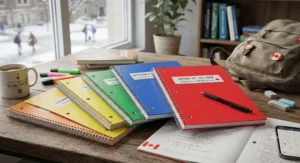
A new notebook lasts longer with about two minutes of setup on day one. Start by labeling the cover and, if it’s 3-hole punched, the first page too, so a stray notebook found on a classroom floor makes it back to the right backpack. If the notebook includes pockets, dedicate one side to “keep” documents like syllabi or rubrics and the other to “hand in” items, rather than tossing everything into one pocket and sorting later — the sorting rarely happens.
For maintenance, the biggest threat to any spiral-bound notebook isn’t daily writing, it’s how it’s stored. Stacking heavy textbooks directly on top of a notebook flattens and bends the coil far faster than regular use does; standing notebooks upright in a backpack section, spine down, avoids that pressure entirely. Common first-30-days mistakes include over-stuffing the pocket until it distorts the cover shape, and tearing out pages by pulling sideways instead of along the perforation line, which is the single fastest way to rip a page that wasn’t meant to come out. For students following structured note-taking methods, a solid note-taking and study skills framework — headings, summaries, and consistent formatting — gets significantly easier to maintain when the physical notebook itself isn’t fighting back with a curling cover or a snagging coil.
Sustainability and Recycled Paper: What Canadian Parents Should Know
Notebooks are a genuinely renewable school supply purchase decision, and a few of the options on this list make that easier than others. The Blueline Duraflex Notebook is manufactured with a minimum of 30% post-consumer recycled paper content and vegetable oil-based ink, which is a meaningfully higher bar than most budget notebooks clear. Look for language like “post-consumer recycled” or FSC certification on packaging — these indicate the paper came from genuinely reclaimed sources rather than pre-consumer manufacturing scrap, which is a much lower environmental bar to clear despite sounding similar.
The honest trade-off worth naming here: fully recycled paper notebooks sometimes run a touch more expensive than standard virgin-paper options, and for families working with a tight back-to-school budget, that’s a real consideration, not a moral failing. The Rocketbook Core Smart Reusable Notebook offers a different sustainability angle entirely — since the same physical pages get reused indefinitely, the paper-waste reduction over a school year can outpace even a fully recycled paper notebook, provided the student sticks with the scan-and-erase habit consistently.
Frequently Asked Questions
❓ What size spiral notebook is best for students?
❓ How many pages should a school spiral notebook have?
❓ Are spiral notebooks with pockets worth the extra cost?
❓ Is wire or plastic coil better for a spiral notebook?
❓ How much should families budget for notebooks on a classroom supply list?
Conclusion
The right spiral notebook for students isn’t the flashiest one on the shelf — it’s the one that matches how a specific student actually works. A commuter juggling six periods needs something different than a university student filling pages every single day, and a parent shopping for three kids needs different math entirely than someone buying one premium notebook meant to last a full year. What separates a good pick from a wasted purchase usually comes down to a handful of details this guide covered in depth: coil material, pocket usefulness relative to actual handout volume, and perforation quality that won’t turn a homework hand-in into a jagged mess.
Of the seven covered here, the Five Star 5-Subject Wirebound Notebook remains the most broadly useful pick for most students, the Hilroy 1-Subject Coil Notebook is the smartest budget-first buy, and the Rocketbook Core Smart Reusable Notebook is worth serious consideration for anyone ready to commit to a paperless habit. Whichever direction fits best, buying with these specifics in mind — rather than grabbing whatever’s closest to the classroom supply list bin — tends to be the difference between a notebook that survives June and one that’s held together with tape by Halloween.
✨ Ready to stock up smart this year? Check current prices on today’s picks before heading out — a few minutes of comparison now beats a repeat trip to the store in October! 🎒📓
Recommended for You
- Premium Notebooks for Gifting: 7 Best Picks for 2026
- Notebooks for University Students: 7 Best Picks (2026)
- Notebook Multi-Packs for Back to School: 7 Great Picks (2026)
Disclaimer: This article contains affiliate links. As an Amazon Associate, I earn from qualifying purchases. If you purchase products through these links, we may earn a small commission at no additional cost to you.
✨ Found this helpful? Share it with your friends! 💬🤗
