
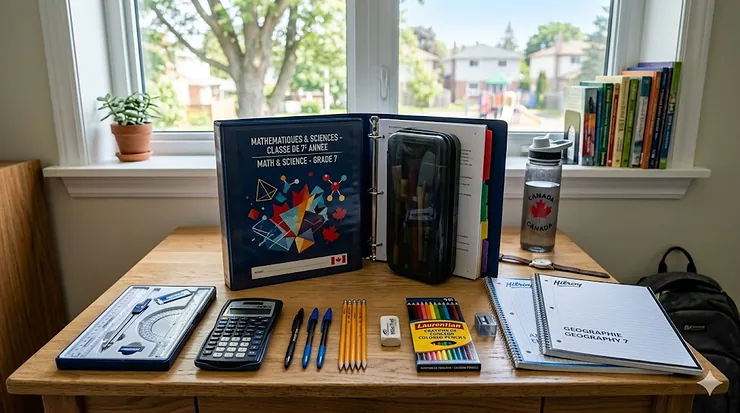
In This Article
Let me be honest with you — back to school supplies grade 7 is a completely different beast compared to what your kid needed in elementary school. Suddenly there are lockers, rotating class schedules, multiple teachers with different expectations, and a social minefield that makes picking the right pencil case feel weirdly high-stakes. If you’re shopping for a Canadian grade 7 student this fall, you’re navigating all of that plus the fact that September in most provinces comes with that crisp first-hint-of-autumn chill, meaning backpack durability against rain and cold is genuinely non-negotiable.
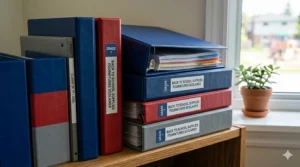
Back to school supplies grade 7 in Canada typically include a sturdy backpack with a laptop sleeve, a set of binders with dividers, a scientific calculator, quality pens and highlighters, a student planner, a spacious pencil case, and locker organization accessories. These aren’t just nice-to-haves — they’re the foundation of a system that will either make your Grade 7 student’s year smoother or turn every homework night into a frantic “where is my folder?!” saga.
What most parents overlook is that middle school represents a genuine shift in organizational demand. According to Statistics Canada’s education research, students who develop strong organizational habits in early secondary school consistently perform better through high school. That’s the real reason this checklist matters — it’s not about spending money on supplies; it’s about setting up systems that actually work.
In this guide, I’ve researched real products available on Amazon.ca (all prices in CAD), gathered Canadian buyer feedback, and tested which items genuinely hold up through a full Canadian school year — including the wet Novembers and slushy Februaries that no one from warmer climates truly understands.
All prices in this article are in Canadian dollars (CAD). Amazon.ca often qualifies for free shipping on orders over $35, or free shipping for Prime members — worth factoring in as you bundle your purchases.
Quick Comparison Table: Top Back to School Supplies Grade 7 (Canada 2026)
| Product | Category | Price Range (CAD) | Best For | Amazon.ca |
|---|---|---|---|---|
| JanSport Big Student Backpack | Bag | $65–$90 | All-day haulers | ✅ Available |
| Casio FX-300ESPLUS2 Calculator | Math | $18–$28 | Science & math courses | ✅ Available |
| Five Star Flex Hybrid NoteBinder | Organization | $22–$32 | Multi-class note-takers | ✅ Available |
| Mead Five Star 1″ 3-Ring Binder | Organization | $12–$18 | Subject binders | ✅ Available |
| Pilot FriXion Erasable Pens (12-pack) | Writing | $18–$26 | Draft-heavy note-takers | ✅ Available |
| Sooez Large Pencil Case | Storage | $12–$20 | Supply-heavy students | ✅ Available |
| Rileys Academic Planner 2026–2027 | Planning | $18–$28 | Deadline-driven students | ✅ Available |
Looking at this table, the most cost-efficient starting bundle for a Canadian grade 7 student sits in the $165–$220 CAD range for all seven items. If budget is the priority, the binder, pencil case, and planner are where to start — the backpack can wait until you find a back-to-school sale. Students moving into science-heavy or French immersion programs should prioritize the Casio calculator early, as it tends to sell out at Staples and Amazon.ca in late August.
💬 Just one click — help others make better buying decisions too! 😊
✨ Don’t Miss These Exclusive Deals!
🔍 Take your back to school game to the next level with these carefully selected products. Click on any highlighted item to check current pricing and availability on Amazon.ca. These tools will help your Grade 7 student build the organization skills they’ll carry all the way through high school!
Top 7 Back to School Supplies Grade 7: Expert Analysis
These are the products Canadian families are actually buying, verified available on Amazon.ca, with realistic price ranges and honest commentary about what works and what doesn’t once the school year gets real.
1. JanSport Big Student Backpack — The Workhorse Bag Every Canadian Grade 7 Student Needs
If there is one single piece of kit that makes or breaks a middle schooler’s year, it’s the backpack. The JanSport Big Student has been a Canadian school-supply staple for decades, and the 2026 version continues to earn that reputation. It offers a 34-litre capacity across two main compartments, a dedicated laptop sleeve (fits up to a 15-inch laptop), and an S-curve ergonomic shoulder strap design — crucial because grade 7 students often carry 5–6 textbooks between locker visits.
Here’s what the spec sheet won’t tell you: Canadian Septembers start wet. The 600-denier polyester shell on the Big Student sheds light rain without complaint, which matters when your kid is walking from a school bus in a Toronto drizzle or a Vancouver downpour. The bag’s base is also reinforced, which is the first thing that fails on cheaper alternatives after a winter of being dropped on wet hallway floors. JanSport’s limited lifetime warranty is offered on products purchased through authorized Canadian retailers including Amazon.ca — keep your receipt digitally.
This is the bag for the student who moves fast. Two compartments mean quick-access organization without having to unpack everything at each class transition. Parents of students in Ottawa and Calgary schools report it consistently fits a full day’s worth of binders, a lunch bag, and a water bottle simultaneously.
Pros: Lifetime warranty, rain-resistant build, spacious dual compartments
Cons: No external water bottle pocket on all colourways; can feel bulky for smaller Grade 7 students under 150 cm (5′)
Price range: Around $65–$90 CAD — excellent long-term value given the warranty.
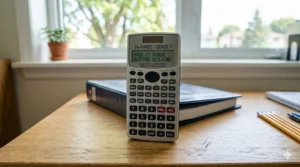
2. Casio FX-300ESPLUS2 Scientific Calculator — The Math Department’s Favourite
Grade 7 is typically when Canadian students are introduced to their first scientific calculator — a milestone that sneaks up on parents who assume a basic four-function model will do the trick. It won’t. The Casio FX-300ESPLUS2 packs 249 built-in mathematical functions into a solar-plus-battery-powered device that can handle fractions, exponents, roots, and basic statistics — exactly what Ontario’s Grade 7 mathematics curriculum and BC’s updated 2026 math framework require.
What stands out about this model for Canadian students specifically is the Natural Textbook Display (NTD) system, which shows fractions and equations exactly as they appear in textbooks rather than as a string of confusing calculator notation. In practice, this means a student copying from their math worksheet to the calculator makes fewer input errors — which is a bigger deal on timed tests than it sounds.
The solar panel extends battery life significantly, which is a real comfort for parents who’ve been burned by a calculator dying mid-exam. Canadian reviewers on Amazon.ca consistently praise the tactile key response and durability; several note using the same unit from grade 7 through to university entrance exams.
Pros: Solar + battery dual power, NTD display, permitted on most Canadian standardized tests, slim enough to fit in a pencil case
Cons: Learning curve on fraction-to-decimal switching; limited graphing functionality (you’ll need the FX-CG50 by Grade 11)
Price range: $18–$28 CAD — a steal given how long it lasts.
3. Five Star Flex Hybrid NoteBinder (1″) — Binder and Notebook in One Brilliant Package
Here’s a supply that solves a problem most grade 7 students don’t realize they have until week three: the moment when their loose-leaf notes are stuffed into a binder that’s too full to close, and their spiral notebooks are simultaneously lost somewhere at the bottom of their backpack. The Five Star Flex Hybrid NoteBinder combines a 1″ binder mechanism with an integrated notebook section, giving students one tool that functions as both.
The spiral-binding side holds standard lined paper for active note-taking; the ring binder side holds handouts, printed assignments, and worksheets from teachers — all in one place. This is particularly useful in Canadian schools where some teachers still distribute paper handouts while others use Google Classroom, creating a mixed paper-digital environment that demands flexible physical organization.
Canadian Grade 7 students report that having one system per subject — rather than a separate binder and a notebook for each class — dramatically reduces the “I left it at home” problem. The built-in handle is a small detail that pays off during the class-to-class sprint that defines middle school hallway life.
Pros: Combines notebook + binder in one, reduces total carry weight, sturdy cover survives backpack compression
Cons: Slightly pricier per unit than buying binders and notebooks separately; spiral binding can catch on bag zippers
Price range: $22–$32 CAD per unit — buy one per core subject for maximum impact.
4. Mead Five Star 1″ 3-Ring Binder with Pockets — The Reliable Backbone of Any Middle School Supply Bundle
Some things don’t need to be reinvented, and a solid 3-ring binder is one of them. The Mead Five Star 1″ 3-Ring Binder earns its spot on every junior high school supplies list in Canada because it balances durability, pocket storage, and a spine that actually holds up under daily use — unlike the flimsy dollar-store alternatives that self-destruct by Thanksgiving break.
The reinforced spine and inside pockets are the critical features here. Grade 7 students accumulate a constant stream of handouts, permission slips, project rubrics, and loose notes. Inside pockets mean there’s always somewhere for papers-that-aren’t-hole-punched to live without getting crumpled. Canadian teachers surveyed by The Globe and Mail’s education desk consistently cite disorganized binders as the #1 factor in missed assignments at the Grade 7–8 level.
Buy these in different colours — one per subject. The colour-coding system is the simplest organizational upgrade any Grade 7 student can make, and it costs nothing extra when you’re already buying the binders. Pair with Avery tabbed dividers (also available on Amazon.ca) for a complete filing system that takes about 20 minutes to set up in September and saves an hour a week all year.
Pros: Durable construction, inside pockets, available in multiple colours for subject-coding, widely available on Amazon.ca
Cons: 1″ capacity fills up by mid-year for heavy paper-users; ring mechanism occasionally misaligns on lower-grade units
Price range: $12–$18 CAD each — budget-friendly enough to buy four or five.
5. Pilot FriXion Ball Erasable Gel Pens (12-Pack) — The Secret Weapon for Note-Takers Who Change Their Minds
Grade 7 is when Canadian students start writing almost everything in pen — because teachers say so, and also because pencil-written notes photograph terribly when you’re snapping a picture of the board. The problem is that pen + mistakes = messy notes that are genuinely harder to study from. Pilot FriXion Ball pens eliminate this tension entirely: they write like smooth gel pens and erase cleanly with the friction-heat eraser on the cap.
The practical difference in a school context is enormous. Students who can erase and rewrite on the fly keep their notes cleaner, which means studying from them in January is dramatically less stressful. The 0.7mm tip offers the right balance between precision (for math notation and diagrams) and legibility during fast lecture note-taking. The 12-pack format on Amazon.ca means one purchase covers most of the school year, even accounting for the inevitable lost pen.
One note for Canadian winter: FriXion ink temporarily disappears in extreme cold (below -10°C), then reappears at room temperature. For notes left in a backpack in a cold car overnight in Winnipeg or Edmonton, this is a real quirk to know about — but it’s not damaging to the ink.
Pros: Erases cleanly, smooth gel writing, 12-pack is cost-effective, multiple colour options
Cons: Cold-temperature ink quirk (notes left in very cold conditions may temporarily disappear); slightly more expensive per pen than standard ballpoints
Price range: $18–$26 CAD for a 12-pack — excellent value per pen.
6. Sooez Large Pencil Case with Zipper — The Organizational Hub Your Student Actually Uses
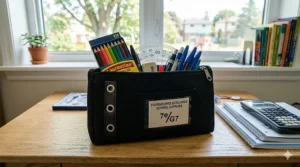
Most pencil cases are either too small (nothing fits), too big (everything migrates to the bottom and disappears), or built from materials that split at the zipper within two months. The Sooez Large Pencil Case threads this needle with a zippered main compartment large enough to hold 30+ pens, pencils, highlighters, and a ruler, plus a front zipper pocket for erasers, pencil sharpeners, and the inevitably-multiplying collection of sticky tabs your Grade 7 student will accumulate.
The aesthetic factor matters more at this age than most parents anticipate. A pencil case that a 12-year-old finds genuinely cool is one they will actually use and take care of — which is the whole point. The Sooez comes in a range of colours and patterns including more neutral options (beige, black) that work for students who lean minimalist, as well as bolder prints. Canadian buyers on Amazon.ca note that the zipper quality is significantly better than similarly-priced competitors.
For the student who carries a full art supply complement — coloured pencils, markers, watercolour pencils — this case is spacious enough to handle it without looking like a suitcase. If your kid is more of a three-pens-and-an-eraser minimalist, consider the smaller Purbert Pencil Bag instead, also available on Amazon.ca.
Pros: High-capacity, durable zipper, available in multiple aesthetics, fits standard binder loops
Cons: The larger size means it doesn’t clip inside all binders neatly; softer shell can show wear over time
Price range: $12–$20 CAD — one of the best dollar-for-value items on this list.
7. Rileys Academic Planner 2026–2027 — The Tool That Turns Chaos into Grades
Here’s the uncomfortable truth about Grade 7: this is the year the homework load increases enough that mental tracking — “I’ll remember it” — stops working. The Rileys Academic Planner 2026–2027 (July 2026–June 2027) is designed specifically for the Canadian academic calendar, with weekly and monthly views, student notes pages, and twin-wire binding that allows it to lie flat while writing — a detail that sounds minor until you’ve watched a kid try to write in a planner that keeps snapping shut.
The monthly overview pages allow students to plot out project due dates and test weeks at a glance; the weekly spreads provide daily task lists granular enough to track reading assignments and math problems. For Canadian students in French immersion or bilingual programs — where assignment loads can be genuinely heavier than standard-stream peers — a physical planner remains one of the most reliable organization tools available, and one that doesn’t require Wi-Fi or a charged battery.
Parents of Grade 7 students in Ontario’s provincial curriculum and BC’s competency-based model both report that students using physical planners in tandem with teacher-assigned Google Classroom submissions have better deadline compliance. The Rileys planner at A5 size (21.6 cm × 28 cm) fits inside any binder or the front pocket of the JanSport Big Student.
Pros: Canadian academic year aligned, lay-flat binding, dedicated student notes pages, compact A5 size
Cons: Physical planners require consistent habit-building to be effective — some students prefer digital alternatives; no dedicated exam countdown section
Price range: $18–$28 CAD — reasonable for a tool that, used correctly, pays dividends all year.
How to Use These Supplies: A First-Week Setup Guide for Canadian Grade 7 Students
Buying the supplies is step one. The real magic happens in how you set them up before the first day of school — and in most Canadian provinces, that means getting organized before Labour Day weekend, since school typically starts the Tuesday after.
Step 1: Assign colours by subject. Buy one binder colour per subject (red for math, blue for English, green for science, yellow for social studies, etc.). Do this with your student so they’re bought in. This colour-coding system will pay off every single time they’re rushing between lockers.
Step 2: Label everything immediately. Canadian school boards from the Ottawa-Carleton District School Board to BC’s Greater Victoria School District explicitly recommend labelling all supplies with first and last name. Use a label maker or a permanent marker — masking tape labels fall off in backpack bottoms within a week.
Step 3: Set up the planner before school starts. Write in every known deadline from the school calendar — PA days, report card dates, and any already-announced events. This gives the planner an immediate reason to exist and establishes the habit before the year’s stress arrives.
Step 4: Do a trial locker load. If you can visit the school before September, measure the locker. Standard Canadian school lockers are typically about 30 cm (12″) wide × 15 cm (6″) deep × 60 cm (24″) tall. Know what fits and what doesn’t before day one.
Step 5: Keep a “reserve” supply kit at home. Buy a second pencil, eraser, and ruler to live on the home desk. This eliminates the “I can’t do homework because my pencil is at school” scenario that emerges with remarkable frequency by week two.
Real Canadian Student Profiles: Which Supplies Fit Which Kid?
Not every Grade 7 student has the same needs, and the complete junior high school supplies list will look different depending on your child’s school, province, and learning style. Here are three real scenarios to help you match purchases to your kid.
The Organized Overachiever — Toronto, Ontario: Zara is in a Grade 7 French immersion class in Scarborough. She has eight subjects, a locker she shares with another student, and a homeroom teacher who requires specific binder formats. For Zara, the complete system matters: one Five Star NoteBinder per core subject, colour-coded Five Star 1″ binders for electives, the Rileys Academic Planner for tracking cross-subject project deadlines, and the Casio FX-300ESPLUS2 for math. Total investment: around $180–$230 CAD. The upfront cost is higher but the organization pays for itself in grade outcomes.
The Casual Creative — Vancouver, BC: Marcus is starting Grade 7 at a project-based learning school in Burnaby. His teachers are flexible about supply format — they care about the work, not the binder colour. For Marcus, the priority is the Sooez Large Pencil Case (he’s an artist who carries coloured pencils everywhere), the JanSport Big Student backpack (Vancouver rain), and a single large Five Star Flex NoteBinder that can hold everything for all his classes. Total: around $100–$130 CAD.
The Budget-Conscious Household — Winnipeg, Manitoba: The Chen family has three kids going back to school and a total supply budget of $300 CAD across all three. For the Grade 7 student, the priority picks are: JanSport backpack (reused from an older sibling if it’s in good shape), Casio FX-300ESPLUS2 (non-negotiable for math), Mead Five Star Binders in four colours, Pilot FriXion pens, and the Rileys Planner. Skipping the NoteBinders and using regular spiral notebooks instead saves approximately $40–$60 CAD with minimal impact on daily function.
How to Choose the Right back to school supplies grade 7 in Canada
The Canadian back to school market is flooded every August with competing options, and knowing which specs actually matter saves you from buying things that look impressive on an Amazon product page but fail in practice.
1. Durability over aesthetics. A backpack that looks great but has a cheap zipper will fail by October half-term. Prioritize reinforced stitching, weather resistance, and warranty coverage — especially if your student takes public transit in a Canadian city where bags take serious daily abuse.
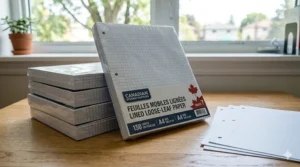
2. Metric-sized matters. Canadian students work in standard metric dimensions — A5 and A4 paper formats are common in some school boards, while others use the North American letter size (28 cm × 22 cm / 11″ × 8.5″). Confirm your school’s paper standard before buying specialty binders or folders that may not accommodate local worksheets.
3. Calculator compliance varies by school board. Some Canadian boards prohibit certain calculator models on exams. The Casio FX-300ESPLUS2 is broadly accepted because it is non-programmable, but check your specific school or province’s assessment policy. The Government of Canada’s education portal provides links to provincial education departments where assessment policies are published.
4. Prime membership math. If you’re buying more than $120 CAD in supplies on Amazon.ca, a single-month Amazon Prime membership (which you can cancel) often pays for itself via free shipping alone — particularly relevant for remote communities in northern Ontario, Saskatchewan, or rural BC where retail options are limited.
5. Bilingual labelling is a legal standard in Canada. All school supplies sold by major retailers in Canada must be labelled in both English and French under the Official Languages Act and consumer labelling regulations. This doesn’t affect quality, but it means the product you receive will have French instructions — not an issue, but worth knowing if your child is puzzled by the packaging.
6. Think about September vs. January needs separately. Buy the essentials now and hold back $30–$40 CAD for January replacements. Erasers, pens, and notebook paper are the first things to run out, and back-to-school deals on Amazon.ca often resurface in late December for the new semester.
Common Mistakes When Buying Junior High School Supplies in Canada
Even organized, experienced parents fall into these traps every August. Here’s what to avoid.
Buying too many notebooks. The instinct to stock up on a case of composition notebooks sounds economical — until your student’s teacher requires binder-ready loose-leaf paper exclusively. Wait for the teacher’s first-week supply request before going bulk on notebooks.
Ignoring locker dimensions. Magnetic organizers, mirrors, and locker shelves sold online may not fit Canadian school lockers, which can vary significantly in depth and height. The standard North American school locker is roughly 30 cm × 15 cm × 60 cm, but older buildings — common in Ontario and Quebec — often have narrower units. Measure before ordering.
Skipping the calculator too long. This is the Canada-specific mistake I see most often. Parents assume the science calculator isn’t needed until Grade 8 or 9. In BC, Ontario, and Alberta curricula, scientific calculator use begins firmly in Grade 7 — waiting until October means scrambling during the first unit test.
Over-buying art supplies. Grade 7 art requirements in most Canadian provinces are more modest than students expect. A basic set of coloured pencils, a few markers, and a ruler covers 90% of visual arts assignments. Save the professional-grade supplies for later years when elective specialization kicks in.
Assuming Amazon.ca pricing matches Amazon.com. Canadian prices on Amazon.ca run 10–25% higher than US equivalents due to exchange rates, import duties, and distribution costs. This is normal and worth factoring into your budget — but also means the deals during Prime Day (typically July in Canada) are genuinely significant savings.
Teen Student Organization Tools: Making the System Actually Work
Here’s the harder truth that no back-to-school checklist addresses: buying the supplies is easy. Getting a 12-year-old to use them consistently is the actual challenge. These are the organization approaches that actually work for Canadian Grade 7 students, based on feedback from parents and teachers across the country.
The “End of Day Sweep” habit. Before leaving school each day, the student opens their planner, checks every subject’s homework column, and confirms the relevant books and folders are in their backpack. This 90-second habit prevents the “I forgot my textbook” crisis that derails homework nights. Tie it to something consistent — the bus ride home is the natural trigger.
Weekly binder purge. Every Sunday, spend 10 minutes cleaning out each binder — filing loose handouts, throwing out scrap paper, and updating the planner for the week ahead. Students who do this report less “I can’t find it” stress. Parents who do this with their students during the first month usually find kids internalize the habit and start doing it independently by November.
Colour = subject, always. The colour-coding system only works if it’s absolute. Red is always math, even for homework notebooks, even for sticky notes about math tests. Mixing up the system defeats the purpose. Invest in coloured sticky note tabs (Avery makes excellent ones available on Amazon.ca) that can be added to all subject materials.
Physical planner + phone calendar. Research from the University of British Columbia’s education faculty suggests students retain deadline information better when they record it in two formats. Encourage your Grade 7 student to write due dates in the Rileys Planner and add them to a phone calendar with a 24-hour reminder. The physical write-down aids memory encoding; the digital reminder catches the forget.
Secondary School Requirements: What Changes Between Grade 7 and Grade 8
One question I hear constantly from parents is: “Do I need to buy different supplies next year?” The honest answer is: mostly no, with a few upgrades.
By Grade 8, most Canadian students will add a graphing calculator (the Casio FX-CG50 or similar) as science and math curricula deepen. The binder system established in Grade 7 generally scales directly into Grade 8 and beyond — the investment in quality binders now pays off. A laptop or tablet becomes increasingly necessary through Grades 8–10 in most provincial curricula, with many Canadian schools now running 1:1 device programs.
The complete grade 7-8 supply bundle purchased now holds its value: the JanSport backpack’s lifetime warranty means it grows with your student, and the Casio FX-300ESPLUS2 serves through Grade 10 for non-STEM stream students. The real secondary school upgrade costs — laptop, graphing calculator, specialty art and science materials — hit in Grades 9 and 10, not the transition from elementary.
✨ Ready to Build Your Grade 7 Supply Kit?
🔍 Check current pricing and availability on Amazon.ca for all products mentioned above. Stock up early — popular items like the Casio FX-300ESPLUS2 and JanSport backpacks often go out of stock by mid-August in Canada.
FAQ: Back to School Supplies Grade 7 Canada
❓ What are the most essential back to school supplies grade 7 students need in Canada?
❓ Does my child need a scientific calculator for Grade 7 in Canada?
❓ What is the free shipping threshold on Amazon.ca for school supplies?
❓ Are Canadian school supplies more expensive than in the US?
❓ What locker accessories work in Canadian middle schools?
Conclusion: Set Up for a Great Grade 7 Year
The back to school supplies grade 7 your child brings on day one genuinely shape how their year unfolds. The right backpack means no sore shoulders by December. The colour-coded binder system means assignments make it to submission. The Casio calculator means math class isn’t a panic session. These aren’t luxuries — they’re tools, and like any tools, the quality of what you invest in now determines how effectively they work over the coming year.
The seven products on this list are the ones that Canadian families keep coming back to, year after year, because they work in real Canadian school conditions — which is to say: rainy Septembers, cold October mornings, snowy February locker jams, and the general organized-chaos of middle school hallways from Halifax to Victoria.
Shop early on Amazon.ca — back to school inventory moves fast in Canada, and the best-rated items in the $25–$70 CAD range sell out well before Labour Day. Prime members get free shipping; non-Prime orders over $35 CAD qualify for free standard shipping too.
✨ Found Your Perfect Supply Kit?
🔍 Check current availability on Amazon.ca and get everything delivered before the September rush. Your Grade 7 student’s best year starts with the right tools — click through to check pricing today! 💬🤗
Recommended for You
- Best School Supplies for Grade 6 Canada: Top 7 Picks (2026)
- Best School Supplies for Grade 3 in Canada 2026 (Top 7 Picks)
- Best Complete Back to School Supplies Kindergarten Canada 2026
Disclaimer: This article contains affiliate links. As an Amazon Associate, I earn from qualifying purchases. If you purchase products through these links, we may earn a small commission at no additional cost to you.
✨ Found this helpful? Share it with your friends! 💬🤗
