

In This Article
Somewhere in a junk drawer at home, there’s probably a half-used notebook with three pages of chemistry notes, a doodle of a Bunsen burner, and a coffee ring. A lab notebook for high school chemistry is supposed to prevent that fate — it’s a dedicated, durable record book used to log hypotheses, procedures, observations, and conclusions for every experiment a student runs over the semester. Done right, it becomes the single place a student can flip back to when a teacher asks “what did you actually measure in week 4?”

Here’s what most families get wrong: they assume any notebook will do, so they grab whatever’s cheapest at the drugstore till. Based on the spec comparison across a dozen real options sold to Canadian students, the paper weight, ruling type, and binding style all quietly determine whether a notebook survives a full semester of spilled solutions and rushed note-taking or falls apart by October. A composition notebook for science lab Canada shoppers pick up should hold up to daily handling, resist ink bleed-through, and use a ruling that actually supports the kind of work a chemistry class demands — usually quad ruled graph paper rather than plain lines, since it’s far easier to sketch titration curves, molecular diagrams, and data tables on a grid.
This guide walks through seven real notebooks, from a Canadian-made budget option under C$10 to a hardbound, professional-grade lab book, with honest analysis of who each one suits. We’ll also cover setup routines, common mistakes, and how Ontario’s science curriculum and WHMIS safety training actually shape what belongs in that notebook.
Quick Comparison Table
| Product | Format | Best For | Price Range (CAD) |
|---|---|---|---|
| Hilroy 1-Subject Coil Notebook (Quad Ruled) | Coil-bound, quad ruled | Budget-conscious Canadian students | under C$10 |
| Amazon Basics Quad Ruled Graph Paper Notebook | Perfect-bound, quad ruled | Backup or second-subject notebook | C$10-C$15 range |
| Mead Composition Notebook (Quad Ruled) | Sewn composition book | Classic, teacher-approved format | C$10-C$18 range |
| Hilroy Neatbook Wireless Quad Ruled Notebook | Wireless coil, perforated, 3-hole punched | Tear-out lab report pages for binders | C$8-C$14 range |
| Chemistry Lab Notebook by CO Journals | Softcover, subject-specific layout | Diagram-heavy organic chemistry work | C$12-C$20 range |
| Better Office Products Quad Ruled Composition Book | Hardcover composition book | Daily heavy use, durability | C$15-C$25 range (multi-pack) |
| BookFactory Lab Notebook (Professional Grade) | Sewn hardbound, laminate cover | Serious record-keeping, science fair, IB labs | C$25-C$40 range |
Looking at the table above, the Hilroy 1-Subject Coil Notebook and Amazon Basics Quad Ruled Graph Paper Notebook dominate the budget end and work fine for a single-semester chemistry course, while the BookFactory Lab Notebook justifies its higher price only if a student needs archival-quality record keeping for a science fair project or an IB extended essay. Most Grade 11 and 12 chemistry students land somewhere in the middle, where the Mead Composition Notebook and Better Office Products hardcover options balance durability against cost without over-buying features a typical semester never uses.
💬 Just one click — help others make better buying decisions too!😊
Top 7 Lab Notebooks for High School Chemistry: Expert Analysis
1. Hilroy 1-Subject Coil Notebook (Quad Ruled) — best budget pick for Canadian classrooms
The Hilroy 1-Subject Coil Notebook is about as close to a default choice as Canadian office supply shelves get, and that standout comes from its price rather than any fancy feature. Specs first: 8″ x 10.5″ quad ruled graph paper, roughly 200 pages (100 sheets), coil-bound so it lays flat on a lab bench — which matters more than it sounds, since a notebook that won’t stay open while a student’s hands are full of test tubes is a genuine hazard, not just an annoyance. The quad rule (4 squares per inch) gives just enough grid to sketch a titration curve or line up a data table without the boxes feeling cramped.
Based on the spec comparison with pricier alternatives, this notebook is built for one thing: getting a semester of chemistry notes down on paper without ceremony. It suits students who want a low-stakes notebook they won’t stress over losing, and parents buying supplies for multiple kids across multiple courses. Reviewers consistently note the coil binding holds up better than perfect-bound alternatives under daily backpack abuse, though a recurring theme in feedback is that the coil can bend if the notebook is crammed into an overstuffed bag.
Pros:
- ✅ Coil binding lies flat for easier writing during experiments
- ✅ Canadian-made brand widely stocked and easy to reorder
- ✅ Quad ruling supports graphs, tables, and diagrams equally well
Cons:
- ❌ Coil can warp if packed tightly with heavy textbooks
- ❌ Thinner paper than premium options, some bleed-through with wet-ink pens
At under C$10, this is one of the easiest supply-list boxes to check without a second thought — check current price and availability on Amazon.ca before term starts, since coil notebooks tend to sell out during back-to-school weeks.

2. Amazon Basics Quad Ruled Graph Paper Notebook — best simple backup notebook
The Amazon Basics Quad Ruled Graph Paper Notebook takes a different binding approach than the Hilroy above: it’s perfect-bound (glued spine, no coil), 8.5″ x 11″, with 200 pages of quad ruled graph paper on 60lb/90 GSM acid-free stock. That paper weight matters more than most students realize — it’s roughly 20-30% heavier than typical loose-leaf, which is the difference between ink sitting cleanly on the page and ghosting through to the next one when a student is scribbling notes during a fast-moving demonstration.
What most buyers overlook about this model is that the larger 8.5″ x 11″ page size gives noticeably more room per experiment entry than the smaller 8″ x 10″ format common in cheaper notebooks — useful when a lab write-up needs a full diagram plus a data table plus written observations on one page rather than spilling awkwardly across two. It’s a solid pick for students who want a spare notebook to keep at home for review notes while a coil-bound version rides in the backpack, or as the second notebook when a teacher requires separate books for pre-lab and post-lab work.
Pros:
- ✅ Heavier acid-free paper resists ink bleed-through
- ✅ Full letter-size pages give more room per lab entry
- ✅ Widely available with consistent quality across print runs
Cons:
- ❌ Perfect binding doesn’t lay as flat as coil-bound notebooks
- ❌ No hard cover, so corners can bend in a backpack
For a notebook in the C$10-C$15 range, the paper quality here punches above its price tag — worth checking current price on Amazon.ca if bleed-through has been a complaint with a student’s current notebook.
3. Mead Composition Notebook (Quad Ruled, Black Marble) — best classic composition-book format
Ask any teacher what a lab notebook should look like and a fair number will picture exactly this: the black-and-white marbled cover of the Mead Composition Notebook, now available in a quad ruled 5×5 grid version rather than the traditional wide-ruled lines. The sewn (not stapled) binding is the real story here — sewn composition books are far less likely to shed pages than the cheap stapled versions sold as “composition notebooks” but built more like a magazine.
Here’s what the spec sheet won’t tell you, but reviewers note repeatedly: the classic composition format signals “this is a serious school notebook” to teachers in a way a spiral or coil notebook sometimes doesn’t, which matters if a rubric specifically calls for a composition book for science lab Canada classrooms often standardize on. The sewn binding also means loose pages can’t be slipped in or torn out unnoticed, which some teachers specifically require for academic integrity reasons on lab work. On the flip side, the fixed binding means there’s no tearing out a messed-up page cleanly — mistakes get crossed out, not removed, which is actually standard lab-notebook practice anyway.
Pros:
- ✅ Sewn binding resists page loss far better than stapled notebooks
- ✅ Format matches what many teachers explicitly require for labs
- ✅ Quad ruled 5×5 grid works well for data tables and graphs
Cons:
- ❌ Can’t remove pages cleanly if a teacher wants tear-out submissions
- ❌ Slightly smaller trim size than full letter-size notebooks
Priced in the C$10-C$18 range depending on pack size, this is the safe default pick when a course outline says simply “composition notebook” without further detail — check current price before assuming a single-unit or multi-pack listing is cheaper per book.
4. Hilroy Neatbook Wireless Quad Ruled Notebook — best for tear-out lab report pages
The Hilroy Neatbook Wireless Quad Ruled Notebook solves a specific problem the Mead composition book above can’t: some teachers want lab reports submitted as loose sheets, not read out of a bound notebook. This model uses a wireless (perfect-bound but perforated) construction, 8.5″ x 11″, with pages ruled 4 squares per inch on one side and 5 squares per inch on the reverse, and comes 3-hole punched so torn-out sheets slide straight into a binder without needing a hole punch.
The dual ruling is a genuinely clever detail most competitors skip. On paper this means a student can use the 4×4 side for looser sketching and the 5×5 side for denser data tables, all within the same notebook, without buying two different products. Reviewers frequently mention the perforation tears cleanly without the ragged edge that cheaper perforated notebooks leave behind — a small thing, but it matters when a torn page is going into a binder a teacher will actually flip through.
Pros:
- ✅ Clean perforation for submitting tear-out lab reports
- ✅ Pre-punched for 3-ring binders, no extra hole punch needed
- ✅ Dual ruling density (4×4 and 5×5) on opposite page sides
Cons:
- ❌ Perforated pages are more prone to accidental tearing in a backpack
- ❌ Not ideal if a teacher requires a permanently bound notebook
In the C$8-C$14 range, this is the notebook to reach for the moment a syllabus mentions binder submissions rather than a bound lab book — worth checking current price on Amazon.ca alongside a compatible binder.
5. Chemistry Lab Notebook by CO Journals — best subject-specific chemistry layout
Most notebooks on this list are general-purpose quad ruled books that happen to work for chemistry. The Chemistry Lab Notebook by CO Journals was actually designed around the subject: it’s a 100-page, 8.5″ x 11″ softcover book built specifically for high school and introductory college chemistry, with dedicated diagram space for each of roughly 22 experiments, a printed periodic table, a table of contents, and — the standout feature — several pages of pre-printed hexagonal and octagonal shapes near the back that can be cut out and used for sketching chemical structures.
Based on the spec comparison with the general notebooks above, the built-in diagram sections are the real differentiator. A generic quad ruled notebook forces a student to freehand every apparatus sketch and structural diagram from scratch, while this format allocates space so drawings and written observations don’t compete for room on the page. That said, honest analysis has to flag a real limitation: with only 22 experiment slots, a two-semester chemistry course with more than 22 labs will run out of dedicated space before the year ends, so it suits a single-term course better than a full-year program.
Pros:
- ✅ Purpose-built diagram sections for each experiment
- ✅ Includes periodic table and cut-out hexagon/octagon shapes for structures
- ✅ Table of contents makes it easy to find past experiments
Cons:
- ❌ Only enough space for about 22 experiments per book
- ❌ Less flexible than a blank quad ruled notebook for non-lab notes
At around C$12-C$20, it’s a strong value if a course is genuinely organic-chemistry-diagram-heavy — check current price and confirm the page count matches how many labs the course syllabus actually plans to run.
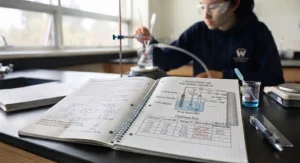
6. Better Office Products Quad Ruled Composition Book (Hardcover, 4-Pack) — best durable hardcover for daily lab use
The Better Office Products Quad Ruled Composition Book takes the classic composition format from option #3 and adds a genuinely sturdy hardcover — a detail that matters more in a chemistry lab than in a regular classroom, where notebooks get set down on benches near sinks, spill zones, and shared equipment. Specs: 9.75″ x 7.5″ thread-bound pages, quad ruled 4×4 graph paper, 80 sheets (160 pages) per book, sold as a 4-pack with assorted cover colours, plus a printed class schedule grid inside the front cover and a metric conversion table inside the back.
What most buyers overlook here is the multi-pack structure: buying four hardcover notebooks at once effectively locks in a lower per-unit price than buying hardcover composition books individually, and it means a family with more than one science course — or more than one student — doesn’t need to reorder mid-year. The thread-bound (not glued) construction is also a genuine upgrade in durability over the cheaper stapled composition books that dominate drugstore shelves; reviewers note the hardcover survives being tossed into a backpack alongside heavier textbooks noticeably better than softcover alternatives.
Pros:
- ✅ Hardcover survives daily backpack wear better than softcover books
- ✅ 4-pack means lower cost per notebook across multiple courses
- ✅ Built-in metric conversion table useful for chemistry calculations
Cons:
- ❌ Smaller trim size (9.75″ x 7.5″) than full letter-size options
- ❌ Assorted colours mean no control over which colour arrives
In the C$15-C$25 range for the full 4-pack, the per-notebook cost often beats single hardcover composition books sold individually — worth comparing the per-unit price on Amazon.ca before assuming the pack costs more upfront.
7. BookFactory Lab Notebook (Professional Grade, Sewn Hardbound) — best premium sewn-bound notebook
The BookFactory Lab Notebook is the outlier on this list, and it’s worth including precisely because some students genuinely need it: an IB Diploma extended essay in chemistry, a regional science fair project, or any lab work a student might eventually want to reference as proof of original work benefits from a notebook built the way professional research labs actually document experiments. Specs: section-sewn hardbound construction (not glued, not stapled), a durable imitation-leather-style cover, numbered pages, a table of contents, and typically 96-168 pages depending on the specific edition, in either quad ruled grid or ruled format.
Here’s the honest trade-off: this is meaningfully more expensive than every other notebook on this list, and a standard single-semester Grade 11 chemistry course does not need this level of durability or formality. Reviewers consistently praise the section-sewn binding for lying genuinely flat and lasting years of daily use without pages loosening — a level of construction quality closer to what’s used in university and industry research labs than typical school supplies. Based on the spec comparison, the value case rests entirely on whether a student needs archival-quality, tamper-evident record keeping (numbered pages make it obvious if a page was removed) rather than simply needing somewhere to write chemistry notes.
Pros:
- ✅ Section-sewn hardbound construction built for years of daily use
- ✅ Numbered pages support academic integrity for science fair or IB work
- ✅ Lies genuinely flat when open, even one-handed
Cons:
- ❌ Noticeably pricier than every other option on this list
- ❌ More formal construction than a typical semester course requires
Priced roughly C$25-C$40 depending on page count and cover style, this one’s worth it specifically for science fair entrants and IB students — check current price on Amazon.ca and compare page counts before choosing an edition, since options vary from under 100 to over 300 pages.
How to Choose a Lab Notebook for High School Chemistry
Picking the right notebook comes down to matching a handful of practical criteria to how a specific course actually runs its labs, rather than grabbing whatever’s on sale. Here’s the short version, with reasoning behind each step:
- Check the teacher’s format requirement first. Some courses require a bound composition book specifically so pages can’t be added or removed; others are fine with any quad ruled notebook, and some want tear-out sheets for a binder.
- Choose quad ruled over wide-ruled or plain paper. Grid paper supports graphs, molecular diagrams, and neatly aligned data tables far better than lined paper built for prose.
- Match page count to the number of labs planned. A single-semester course with 15-20 experiments needs far less capacity than a full-year IB or AP chemistry course running 30+ labs.
- Weigh binding type against how the notebook travels. Coil and wireless bindings lie flatter for writing during an actual experiment; sewn hardbound options survive rougher daily handling.
- Consider paper weight if pen bleed-through has been an issue before. Heavier stock (60lb or higher) resists ghosting on the reverse side of the page.
- Decide whether subject-specific layout adds real value. A dedicated chemistry notebook with diagram space helps in organic-chemistry-heavy courses but wastes structure in a general science class.
- Set a budget band before shopping, not after. Most students do fine in the C$10-C$20 range; only science fair or IB-level record-keeping justifies premium hardbound options.
Common Mistakes When Buying a Lab Notebook for High School Chemistry
A recurring theme in Canadian parent forums and back-to-school threads is buying the notebook that looks most “sciencey” rather than the one that fits how the course is actually taught — a costly hardbound lab book bought for a single-term intro chemistry class often ends up half-empty. Another common misstep is ignoring the ruling type entirely and grabbing a wide-ruled notebook already in the house, which then forces awkward freehand graphs and crooked data tables all semester. Reviewers across multiple listings also flag a subtler problem: buying a notebook sized for a backpack rather than a lab bench, when in reality an 8.5″ x 11″ page gives meaningfully more usable space for diagrams than a smaller 8″ x 10″ alternative, at almost no cost in portability.
Parents shopping for younger students sometimes also overlook binding durability, assuming any notebook will survive a school year — but a stapled, non-sewn “composition book” can shed its cover by November if it’s carried daily in a crowded backpack. Finally, a mistake specific to Canadian shoppers: assuming a listing on Amazon.ca ships the exact same edition as its U.S. counterpart, when page counts, cover colours, and even ruling density sometimes differ between regional listings for the same product line.
Quad Ruled vs Composition vs Spiral: Notebook Formats Explained
The format debate matters more than it looks on the surface, because each binding style trades off differently against how a chemistry lab actually functions. A quad ruled page (whether in a spiral, coil, or bound book) is defined by its grid rather than its binding — it’s the ruling pattern, not the format, and virtually every notebook on this list uses it for good reason: grids make it dramatically easier to plot titration curves, sketch molecular geometry, and keep multi-column data tables aligned than lined paper does.
Composition notebooks, like the Mead Composition Notebook and Better Office Products hardcover, use sewn or thread-bound pages that can’t be removed cleanly, which many teachers specifically require because it makes it obvious if a page was pulled out — a small academic-integrity safeguard that matters when a lab notebook doubles as graded coursework. Spiral and coil notebooks, like the Hilroy 1-Subject Coil Notebook, trade that tamper-resistance for a page that lies genuinely flat when open, which is a real ergonomic advantage while actively running an experiment with both hands occupied. Wireless/perforated notebooks, like the Hilroy Neatbook, split the difference by allowing clean tear-out for binder submission while still keeping a bound spine for the pages that stay in.
The practical takeaway: check what the course actually requires before choosing a format, since a beautifully bound composition book is the wrong purchase if the teacher wants loose-leaf submissions, and a tear-out notebook is the wrong purchase if the teacher explicitly bans removable pages.
✨ Don’t Miss These Exclusive Deals!
🔍 Take your lab notebook shopping to the next level with these carefully selected picks. Click on any highlighted item to check current pricing and availability on Amazon.ca. The right notebook makes an entire semester of chemistry data easier to track — and easier to hand in with confidence.
What to Expect: Real-World Performance in the Chemistry Lab
On paper, every quad ruled notebook looks roughly the same — a grid, a cover, a page count. In practice, performance differences show up fast once ink, spills, and rushed handwriting enter the picture. Reviewers across the products above consistently describe heavier paper stock (60lb and up, like the Amazon Basics notebook) resisting bleed-through from felt-tip and gel pens far better than the thinner paper common in bargain-bin coil notebooks — a real difference when a student is scribbling down a fast-moving colour change during a titration and doesn’t have time to blot the page.
Binding performance also plays out differently than the spec sheet suggests. Coil and wireless notebooks like the Hilroy 1-Subject Coil Notebook and Hilroy Neatbook genuinely do lie flatter on a lab bench, which matters when a student needs both hands free for glassware. Sewn hardbound notebooks like the BookFactory Lab Notebook, by contrast, hold up far better over a full year of daily backpack transport, at the cost of not lying quite as flat when first opened. What the spec sheet won’t tell you, but reviewers note repeatedly, is that page count estimates on the box sometimes run slightly conservative — many students report getting a few more usable pages than advertised once front-matter pages (schedule grids, conversion tables) are accounted for separately from the ruled experiment pages.
Notebooks for Biology Lab Reports vs Chemistry Lab Reports
A quick note for anyone shopping across subjects: a notebook for biology lab reports and a lab notebook for chemistry class overlap far more than most school supply lists suggest, but the details diverge in useful ways. Biology labs often lean more heavily on labelled diagrams — cell structures, dissection sketches, ecosystem maps — where a slightly larger blank or lightly-gridded space works better than a dense quad ruled grid. Chemistry labs, by contrast, tend to need the grid itself for plotting data (titration curves, reaction rate graphs) and for keeping stoichiometry calculations aligned in columns, which is exactly why quad ruled notebook for science class listings dominate the chemistry-specific search results.
Practically speaking, general-purpose quad ruled notebooks like the Mead Composition Notebook or Better Office Products hardcover handle both subjects reasonably well, since the grid doesn’t prevent freehand diagrams — it just adds structure where structure helps. The Chemistry Lab Notebook by CO Journals, on the other hand, is genuinely chemistry-specific thanks to its hexagon and octagon cut-out shapes for molecular structures, and offers little extra value for a biology course. Students taking both subjects in the same semester often do better buying one general quad ruled notebook per course rather than trying to force a single notebook to serve two very different kinds of lab work.
Long-Term Cost & Maintenance
Total cost of ownership for a school lab notebook looks different than it does for electronics or furniture, but it’s still worth working out before assuming the cheapest option wins. A single Hilroy 1-Subject Coil Notebook at under C$10 covers roughly one semester of chemistry labs for most courses, meaning a full school year (two semesters) runs to roughly C$15-C$20 in notebooks if replaced once mid-year. Compare that to the Better Office Products 4-pack in the C$15-C$25 range, which — spread across a family with two science students, or across chemistry plus another lab science in the same year — often works out cheaper per notebook while adding hardcover durability that a single coil notebook doesn’t offer.
The BookFactory Lab Notebook flips this math: at C$25-C$40 for one book, it costs more than an entire year’s worth of budget notebooks, but it’s designed to survive far longer than a school year, which matters if a student plans to keep the same notebook across multiple related courses or reference it later for a portfolio or science fair archive. Maintenance-wise, none of these notebooks require anything beyond keeping them dry and out of direct spill zones — but a genuinely useful long-term habit is dating every entry and never tearing out a used page, since both practices preserve the notebook’s value as an actual record rather than a disposable scratch pad, regardless of which notebook a student ends up buying.
Safety, Regulations & WHMIS Compliance for Canadian Science Students
Canadian high school chemistry courses don’t operate in a regulatory vacuum, and a lab notebook plays a small but real role in that framework. Under the Workplace Hazardous Materials Information System (WHMIS), the national standard for labelling and handling hazardous products used in Canadian workplaces and educational labs, students are generally expected to record safety-relevant details — chemical names, hazard symbols observed, and any incidents — as part of their lab documentation, not just the experiment’s results. A notebook that includes even a simple page for safety notes or incident logging, as several of the products above do inside their front or back matter, supports that habit without requiring a separate logbook.
Ontario’s own curriculum framework reinforces this directly: the Ontario Curriculum for Grades 11 and 12 Science explicitly lists safe and ethical scientific investigation as a core skill area alongside data collection and analysis, meaning a teacher may reasonably expect safety observations to appear in the same notebook as experimental data rather than as an afterthought. Practically, this doesn’t change which notebook a family should buy — any of the seven options above works — but it’s worth choosing one with enough spare pages or a dedicated notes section to record safety data sheet references and hazard observations alongside the main experiment write-up, rather than assuming that information belongs somewhere else entirely.
Setting Up Your Lab Notebook: Practical Usage Guide
Getting a new lab notebook set up correctly in the first week saves real frustration later in the semester. Start by numbering every page if the notebook doesn’t already come pre-numbered — many teachers require this specifically so missing or reordered pages are obvious at a glance. Next, reserve the first two or three pages for a table of contents, even in notebooks like the BookFactory Lab Notebook that include one, since students often need more entries than the pre-printed template anticipates by year’s end.
A common mistake in the first 30 days is inconsistent dating — some students date only the first entry of a lab, forgetting that a multi-day experiment needs a date on every session’s notes. Build the habit early: date, title, and a one-line purpose statement at the top of every new entry, mirroring the format taught in most Canadian university-level lab report guides, which apply just as well to a Grade 11 chemistry notebook as to an undergraduate course. For maintenance, keep the notebook away from sink areas and reagent storage, and if a page gets a chemical spill, note the incident rather than trying to hide or discard the page — a documented mistake is worth more, academically and safety-wise, than a suspiciously missing one.
Real-World Scenarios: Matching Students to the Right Notebook
Consider three different Grade 11 chemistry students to see how notebook choice actually plays out. A budget-conscious student taking a single-semester intro chemistry course with roughly 15 planned labs does perfectly well with the Hilroy 1-Subject Coil Notebook — low cost, quad ruled, and more than enough pages for the term, with the coil binding making it easy to keep flat while working through titrations at the lab bench.
A student in a full-year IB or AP-stream chemistry course running 30+ labs across two semesters needs more capacity and durability than a single budget coil notebook offers; the Better Office Products hardcover 4-pack or a single BookFactory Lab Notebook better matches that workload, since either option survives a full year of daily handling without the notebook physically wearing out before the course does. Finally, a student heading into an organic-chemistry-heavy unit that involves drawing a lot of molecular structures benefits specifically from the Chemistry Lab Notebook by CO Journals, whose built-in hexagon and octagon cut-out shapes save real time compared to freehanding every ring structure by hand.
Common Lab Notebook Problems and Practical Fixes
Problem: Ink bleeds through to the next page mid-experiment. Solution: switch to a heavier-stock notebook like the Amazon Basics Quad Ruled Graph Paper Notebook, or simply use a fine-tip ballpoint instead of a felt-tip pen for data entries.
Problem: Pages keep tearing loose from a cheap notebook. Solution: move to a sewn-bound option — either the Mead Composition Notebook or the BookFactory Lab Notebook — since sewn construction resists page loss far better than stapled or glued bindings.
Problem: A teacher wants loose-leaf lab reports, but the notebook is bound. Solution: the Hilroy Neatbook Wireless Quad Ruled Notebook is built exactly for this, with clean perforation and pre-punched holes for direct binder insertion.
Problem: Diagrams and data tables feel cramped on the page. Solution: move up to a full 8.5″ x 11″ page size, like the Amazon Basics or Better Office Products options, rather than a smaller 8″ x 10″ format.
Problem: The notebook runs out of pages before the course ends. Solution: check page count against the syllabus before buying — a 22-experiment book like the Chemistry Lab Notebook by CO Journals suits a single term, but a full-year course needs the 150+ page range the BookFactory option offers.
Price Range & Value Analysis
| Product | Price Range (CAD) | Best Value For |
|---|---|---|
| Hilroy 1-Subject Coil Notebook | under C$10 | Single-semester courses on a tight budget |
| Amazon Basics Quad Ruled Notebook | C$10-C$15 range | Backup or second-subject notebook |
| Mead Composition Notebook | C$10-C$18 range | Teacher-required composition format |
| Hilroy Neatbook Wireless | C$8-C$14 range | Binder-based lab report submission |
| Chemistry Lab Notebook by CO Journals | C$12-C$20 range | Diagram-heavy organic chemistry units |
| Better Office Products 4-Pack | C$15-C$25 range | Multi-student or multi-course households |
| BookFactory Lab Notebook | C$25-C$40 range | Science fair, IB, or archival record-keeping |
Cost per page tells a slightly different story than sticker price alone: the BookFactory Lab Notebook looks expensive up front, but spread across 150-300+ pages of section-sewn, tamper-evident paper, its per-page cost isn’t wildly out of line with premium composition books — it simply concentrates that cost into a single, longer-lasting purchase. Budget picks like the Hilroy 1-Subject Coil Notebook win on upfront cost but assume a student will replace the notebook every semester rather than using one book across a full year.
Frequently Asked Questions
❓ What kind of notebook is best for a high school chemistry lab?
❓ Does a chemistry lab notebook need to be hardcover?
❓ Can I use a regular quad ruled composition book Amazon.ca sells instead of a specialty chemistry notebook?
❓ How many pages does a lab notebook need for a full year of chemistry?
❓ Is a spiral notebook or a bound composition book better for chemistry class?
Conclusion
Choosing a lab notebook for high school chemistry isn’t really about finding the “best” notebook in some universal sense — it’s about matching a handful of practical factors (ruling type, binding style, page count, and any specific teacher requirement) to how a particular course actually runs its labs. For most students, a straightforward quad ruled notebook like the Hilroy 1-Subject Coil Notebook or Mead Composition Notebook covers a semester’s worth of chemistry work without fuss, while students in longer or more demanding programs — full-year IB chemistry, science fair projects, diagram-heavy organic units — genuinely benefit from stepping up to options like the BookFactory Lab Notebook or the Chemistry Lab Notebook by CO Journals.
Whichever notebook a family lands on, the habits matter more than the product: numbering pages, dating every entry, and recording safety observations alongside experimental data turn any of these seven notebooks into a genuinely useful academic record, not just a stack of paper. Check current price and availability on Amazon.ca before the semester starts, since back-to-school demand tends to move quickly on the more affordable options.
✨ Ready to Stock Up for the Semester?
🔍 Browse the full lineup above and pick the notebook that actually matches your course load — whether that’s a budget coil notebook for a single term or a hardbound option built to last the whole year. Click through to check current pricing on Amazon.ca before supplies run low!
Recommended for You
- 7 Best Mechanical Pencils for High School Students in 2026
- Pens for Writing Essays High School: 7 Picks for 2026
- Study Tools for High School Students: 7 Picks That Work (2026)
Disclaimer: This article contains affiliate links. As an Amazon Associate, I earn from qualifying purchases. If you purchase products through these links, we may earn a small commission at no additional cost to you.
✨ Found this helpful? Share it with your friends! 💬🤗
