
In This Article
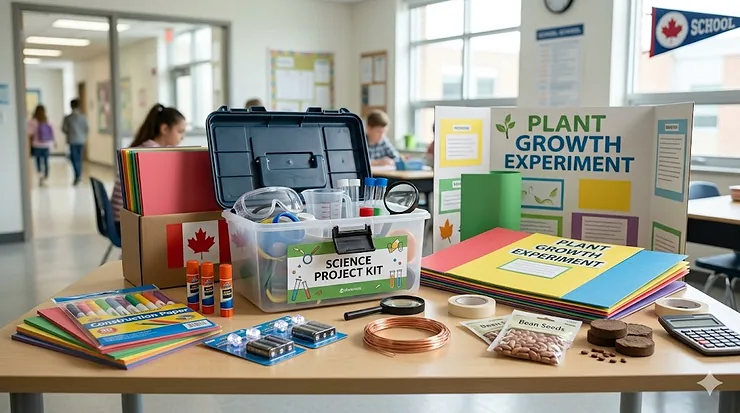
Every spring, thousands of Canadian students across every province and territory haul their carefully constructed display boards, lab notebooks, and experiment materials into school gymnasiums and community halls — all in pursuit of that judge’s nod of approval. If you’ve ever scrambled the night before a fair looking for masking tape, a missing beaker, or realizing your safety goggles fogged up during the demo, you already know: the right science fair project supplies aren’t a luxury. They’re a strategy.

Science fair project supplies, broadly defined, are the combination of presentation materials, laboratory equipment for students, safety gear, and documentation tools that take a student’s idea from hypothesis to a polished, judge-ready display. In Canada, the stakes have never been higher. Youth Science Canada runs 98 regional STEM fairs across every province and territory, with top participants advancing to the Canada-Wide Science Fair (CWSF) — a national celebration of youth scientific achievement dating back to 1962.
What makes shopping for science fair project supplies in Canada uniquely challenging? A few things: our school year peaks in late winter and spring, meaning you’re often ordering supplies during February or March when budgets are tight and cold weather limits last-minute runs to the store. Amazon.ca is the most convenient one-stop shop for Canadian families, but product availability can differ significantly from Amazon.com, and prices are naturally in CAD — which runs slightly higher than US equivalents due to exchange rates and import costs. That said, buying domestically means you skip customs delays, cross-border warranty headaches, and surprise brokerage fees.
In this guide, I’ve researched and compiled the 7 best science fair project supplies available on Amazon.ca in 2026, with honest analysis of what each product actually delivers for Canadian students — from budget-conscious families to kids gunning for the CWSF podium.
Quick Comparison Table: Top Science Fair Project Supplies on Amazon.ca
| Product | Category | Price Range (CAD) | Best For | Amazon.ca Available |
|---|---|---|---|---|
| SATTRON Safety Goggles (CSA Z94.3) | Eye Protection | ~$15–$25 | All science experiments | ✅ Yes |
| Bekith 18-Pack Graduated Cylinder & Beaker Set | Glassware/Lab Equipment | ~$25–$40 | Chemistry & biology projects | ✅ Yes |
| Discover Lab Quadrille Graph Paper Lab Notebook | Documentation | ~$12–$20 | Middle school & high school | ✅ Yes |
| PerKoop Tri-Fold Science Fair Display Board | Presentation | ~$15–$30 | All fair participants | ✅ Yes |
| Rngeo Graduated Cylinder Set (4 Sizes) | Lab Measurement | ~$15–$25 | Liquid measurement experiments | ✅ Yes |
| Science Fair Notebook by Mary Ann McAllister | Project Journal | ~$10–$18 | Grades 5–10 project tracking | ✅ Yes |
| LANON 3-Pack Safety Glasses Over Glasses (ANSI Z87.1) | Eye Protection | ~$20–$35 | Students with prescription glasses | ✅ Yes |
What does this table tell us? The most versatile starting point for any Canadian student is a combination of certified safety goggles, a proper lab notebook, and a sturdy display board — together covering the three core pillars of a strong science fair project: safety, documentation, and presentation. Budget shoppers will find solid options under $30 CAD in every category, while mid-range picks in the $30–$50 range offer better durability for multi-year use or classroom sharing.
💬 Just one click — help others make better buying decisions too! 😊
✨ Don’t Miss These Exclusive Deals!
🔍 Take your science fair projects to the next level with these carefully selected products. Click on any highlighted item to check current pricing and availability on Amazon.ca. These tools will help you create authentic, impressive results your family and judges will love!
Top 7 Science Fair Project Supplies: Expert Analysis
1. SATTRON Safety Goggles Over Glasses — CSA Z94.3 & ANSI Z87.1 Certified
If there is one non-negotiable item in any student’s science fair project supplies kit, it’s a pair of certified safety goggles — and the SATTRON model stands out as one of the few goggles on Amazon.ca that carries both CSA Z94.3 (Canada’s own standard for eye and face protectors) and ANSI Z87.1 certification simultaneously. That dual certification isn’t a marketing sticker — it means these goggles have been independently tested against Canadian Standards Association protocols, which govern eye and face protection in occupational and educational settings across Canada. For parents, that’s genuine peace of mind.
The panoramic lens design gives students a wide field of vision during demos and experiments — critical when you’re tracking a reaction happening in real time. The over-glasses-friendly interior means students who wear prescription eyeglasses don’t have to choose between seeing and being safe. The anti-fog treatment on the lens is genuinely effective for the moderate-temperature environments you’d encounter in a school gym or science lab, though it’s worth noting that in very cold Canadian classrooms (hello, January in Winnipeg), there can be brief fogging when moving from outdoors to indoors.
In my expert opinion, this goggle is the best all-rounder for middle school and high school Canadian students. The adjustable strap fits a wide range of head sizes, making it perfect for sharing across siblings or within a classroom setting. Canadian buyers frequently note the comfortable TPR frame seal doesn’t leave pressure marks after 20–30 minutes of wear — a detail that matters enormously when a student is presenting to judges for an extended period.
✅ CSA Z94.3 certified — meets Canadian educational safety standards
✅ Over-glasses friendly — works with prescription eyewear
✅ Anti-fog panoramic lens — stays clear during demonstrations
❌ Can fog briefly in extreme cold-to-warm transitions
❌ Bulkier than basic safety glasses — takes up more space in a kit
Price range: around $15–$25 CAD. For CSA-certified eye protection, this represents excellent value in Canada.
2. Bekith 18-Pack Plastic Graduated Cylinders and Measuring Beakers Set
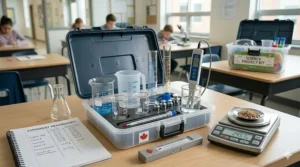
When I think about the science experiment materials that cause the most scrambling the night before a fair, measurement tools are always near the top of the list. The Bekith 18-Pack is a comprehensive set that includes graduated cylinders in 10 ml, 25 ml, 50 ml, and 100 ml sizes, plus beakers ranging from 50 ml to 1,000 ml. For context: that’s essentially a small school lab’s worth of glassware in a single Amazon.ca order.
The plastic construction (rather than borosilicate glass) is actually the right call for student use. Glass graduated cylinders are beautiful and precise, but a dropped glass cylinder in a school gym or on a kitchen table is a dangerous mess. The food-grade polypropylene used in the Bekith set is impact-resistant, won’t shatter, and is dishwasher-safe — making cleanup after a project much less stressful. The measurement markings are raised and dual-sided, meaning you can read volumes from either face without squinting. For metric-native Canadian students, the millilitre markings are crisp and intuitive.
For Canadian families doing chemistry, biology, or environmental science projects, this set covers almost every liquid measurement scenario you’ll encounter. Whether you’re testing soil pH across different Ontario regions, comparing the surface tension of various household liquids, or observing plant transpiration rates through controlled water measurements, you have the right vessel for the job.
✅ 18-piece set covers all common student experiment volumes
✅ Shatter-resistant polypropylene — safe for home and classroom
✅ Raised dual-sided metric markings — precise and easy to read
❌ Polypropylene less accurate than glass at very small volumes (under 5 ml)
❌ May stain with strongly pigmented substances
Price range: $25–$40 CAD. An exceptional value for the volume of equipment you receive — far cheaper than buying pieces individually.
3. Discover Lab Quadrille Graph Paper Lab Notebook
Here’s what most students (and their parents) underestimate: judges at Canadian regional and national STEM fairs assess your scientific process as much as your results. A well-maintained lab notebook for middle school is not just a nice-to-have — it is documented evidence of your scientific rigour. The Discover Lab Quadrille Graph Paper Lab Notebook on Amazon.ca provides the classic quad-ruled (5 mm grid) format that science teachers across Canada have standardized for a reason. The grid paper lets students plot graphs by hand directly in their notebook, sketch apparatus diagrams to scale, and record tabular data neatly without pre-ruling separate pages.
The quadrille format is especially valuable for students doing measurements in metric — since Canadian students work in millimetres, centimetres, and metres by default, graph paper in a 5 mm grid lets you create 1:1 scale diagrams of small experiments without any conversion gymnastics. The logbook format (with headers for date, experiment name, hypothesis, observations, and conclusions) helps students build good documentation habits that will serve them through high school and beyond.
What the spec sheet doesn’t tell you: the binding and paper quality in this notebook is noticeably better than school-issue composition books. Pages don’t tear easily when you’re erasing forcefully (something every student does), and the cover stands up to backpack abuse — a real consideration for Canadian students who may be carrying gear through rain, slush, or snow between home and school.
✅ Quadrille grid perfect for metric graphs and diagrams
✅ Lab logbook format builds scientific documentation habits
✅ Durable cover and pages — stands up to daily backpack use
❌ No spiral binding — can’t fold flat easily for field notes
❌ Pages are not waterproof
Price range: $12–$20 CAD. An essential, low-cost purchase that could meaningfully improve your judging score.
4. PerKoop Tri-Fold Science Fair Display Board
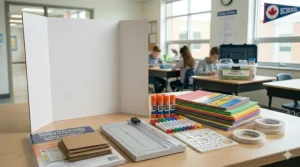
Science fair project supplies live and die by the display board — it’s the first thing judges see before they’ve read a single word of your research. The PerKoop Tri-Fold display board available on Amazon.ca is a strong standard choice: 36″ × 48″ when fully open, with a sturdy corrugated cardboard structure that doesn’t buckle under heavy printouts, photographs, or mounted graphs. The white surface takes adhesive letters, printed labels, and marker annotations without bleed-through.
What makes the PerKoop stand out practically is its self-standing stability. Display boards that flop or lean are a nuisance during judging and can actually disadvantage your presentation — judges stepping back to assess your layout shouldn’t be fighting a tipping board. This model holds its shape well on standard gymnasium tables. The thickness of the corrugated walls is meaningful: it’s substantial enough that push pins, thumbtacks, and double-sided tape all grip firmly without tearing through.
For Canadian students competing at CWSF-affiliated regional fairs, it’s worth checking your fair’s specific board size requirements before ordering. Most regional fairs align with standard tri-fold dimensions, but some provincial competitions have specific rules. Standard tri-fold boards like this one satisfy the vast majority of Canadian fair requirements.
✅ Standard 36″×48″ tri-fold — fits most Canadian regional fair guidelines
✅ Sturdy corrugated structure — self-standing and stable
✅ Smooth white surface — accepts all adhesive and printing methods
❌ Corrugated board (not foam-core) — slightly heavier to transport
❌ May dent at corners if not packaged carefully after the fair
Price range: $15–$30 CAD depending on single vs. multi-pack. Buying a 3-pack if you have multiple kids (or school years) ahead is the better value.
5. Rngeo 4-Size Graduated Polypropylene Cylinder Set (10 ml, 25 ml, 50 ml, 100 ml)
Where the Bekith 18-pack is the all-in-one bulk solution, the Rngeo 4-Size set is the precision-focused choice for students whose projects revolve specifically around controlled liquid measurements. Each cylinder comes with a matching plastic dropper — a small detail that makes a surprisingly large difference when you’re adding reagents drop by drop to a solution and need to be exact. The polypropylene construction is food-grade and chemical-resistant, which matters if you’re working with mild acids (vinegar), saline solutions, or household bleach in diluted concentrations.
In terms of measurement accuracy: these cylinders have Class B tolerances — standard for student-grade equipment — meaning the 100 ml cylinder is accurate to ±1 ml. For most science fair project experiments, this is more than sufficient. If your project requires pharmaceutical-grade precision, you need a different tool, but for chemistry experiments comparing reaction rates, environmental water quality tests, or osmosis demonstrations, Class B is exactly right.
The Rngeo set is also a thoughtful gift for Canadian families who homeschool or run after-school STEM clubs. Four cylinders cover the standard range of volumes you encounter in middle school and early high school curriculum across all provinces, and the included droppers save you a separate purchase.
✅ Matched dropper for each cylinder — enables precision liquid addition
✅ Chemical-resistant polypropylene — suitable for mild acidic/basic solutions
✅ Class B accuracy — meets student science experiment standards
❌ 4 cylinders only — no beakers included (buy separately for full lab setup)
❌ Not suitable for heating directly on a hot plate
Price range: $15–$25 CAD. A focused, affordable set for measurement-intensive projects.
6. Science Fair Notebook: Scientific Project Journal, Lab Tracker and Record Book by Mary Ann McAllister
Sometimes students need less of a blank-grid lab notebook and more of a structured project guide that walks them through the scientific method from start to finish. That’s exactly what the McAllister Science Fair Notebook delivers, and it’s available directly on Amazon.ca. This 8.5″ × 11″ softcover notebook provides structured sections for brainstorming, research notes, hypothesis writing, experimental data recording, results analysis, and final report drafting — essentially an end-to-end guided scientific process in a single book.
For middle school students — especially those doing their first or second science fair project — this structure is genuinely valuable. The scientific method isn’t intuitive at first, and having a notebook that literally asks “What is your hypothesis?” and “What variables will you control?” scaffolds the thinking in a way that blank-page journals don’t. Teachers across Canada have incorporated structured science notebooks into inquiry-based learning frameworks, and the McAllister journal aligns well with how modern Canadian science curricula approach student-led investigation.
From a Canadian family perspective: it’s also a practical tool for parents supporting the project at home. When your Grade 7 student shows you their notebook and it has clear sections, the late-night “wait, what’s your independent variable again?” conversation becomes much easier to navigate.
✅ Fully structured scientific method format — guides students step by step
✅ Includes display board sketching pages — connects notebook to presentation
✅ Appropriate for Grades 5–10 — solid range for STEM fair competitors
❌ Less flexible than blank lab notebook for advanced or open-ended experiments
❌ Single-use design — can’t be reused across multiple projects
Price range: $10–$18 CAD. Strong value as a first science fair project tool for students in junior grades.
7. LANON 3-Pack Safety Glasses Over Eyeglasses — ANSI Z87.1
There’s an often-overlooked group of students when it comes to safety goggles for student experiments: those who wear prescription glasses. Standard safety goggles frequently don’t accommodate glasses properly, leading to either pressure discomfort or inadequate fit — both of which compromise safety. The LANON 3-Pack Over-Glasses safety glasses solves this with a wrap-around design tested to ANSI Z87.1 standards, with a wide interior channel that comfortably fits most standard prescription frames.
The 3-pack format is brilliant for Canadian classrooms and families: you get three pairs for roughly the price of one, which is ideal for a class set, a sibling group, or for situations where one pair inevitably gets lost or scratched at a busy fair. The anti-fog and anti-scratch dual coatings on the polycarbonate lenses are meaningful — polycarbonate naturally absorbs UV radiation and is significantly more impact-resistant than glass or standard plastic lenses.
One practical note for Canadian buyers: while ANSI Z87.1 is the U.S. standard, it is widely accepted in Canadian educational and occupational settings alongside CSA Z94.3. Most Canadian schools treat ANSI Z87.1 as equivalent for classroom lab use. If you’re competing at a formal CWSF-affiliated fair where safety gear is assessed by judges, confirming your school’s goggle policy is a smart step.
✅ Over-glasses design — essential for students with prescription eyewear
✅ 3-pack value — excellent for families and classroom sets
✅ ANSI Z87.1 certified — meets standard for educational lab use in Canada
❌ ANSI Z87.1 only (no CSA Z94.3) — verify with your school’s safety policy
❌ Wrap-around style is bulkier than low-profile safety glasses
Price range: $20–$35 CAD for the 3-pack. Outstanding per-unit cost for certified student eye protection.
How to Use Science Fair Project Supplies Like a Pro: A Canadian Student’s Practical Guide
Setting Up Your Home Lab Space for Canadian Conditions
Canadian homes present some practical challenges for science experiments that families in milder climates don’t face. If you’re doing a project in January or February — prime science fair season in most Canadian school boards — your garage or basement may be subject to temperature swings that affect experiment results. Here’s how to optimize your setup:
Stable temperature matters more than you think. Chemistry experiments involving rate of reaction, crystal growth, or fermentation are temperature-sensitive. Set up your experiment space in an area of your home that holds steady between 18°C and 22°C. A kitchen counter near an interior wall is usually better than a basement workbench near an exterior wall.
Protect your display board from humidity. When your tri-fold board is stored or transported during Canadian winter, temperature differentials between indoors and outdoors cause condensation. Keep your completed board in a large garbage bag or wrap it in plastic during transport to your fair — a tip that experienced Canadian science fair families swear by.
Label everything in metric from day one. Canadian judges expect metric. Record all measurements in millilitres, grams, and degrees Celsius in your lab notebook from your very first observation. Converting at the end introduces errors and is visible to experienced judges.
Use your lab notebook as your legal record. Date every entry. Write observations in pen, not pencil (pencil can be erased, which raises integrity questions). If you make an error, draw a single line through it rather than scribbling it out. This practice follows the scientific community’s documentation standards and signals maturity to CWSF judges.
Goggle hygiene at fairs. If you’re sharing safety goggles for student experiments with a sibling, wipe the lens and interior frame down with an isopropyl alcohol wipe between users — especially important during flu season (which, in Canada, conveniently overlaps with science fair season every year).
Canadian Student Profiles: Which Science Fair Project Supplies Match Your Situation?
Profile 1: The Grade 7 First-Timer (Budget: Under $60 CAD)
Meet Alex, a Grade 7 student in suburban Calgary preparing for their first regional STEM fair affiliated with Youth Science Canada. Alex’s parent has a budget of around $60 CAD and needs to cover all the bases without overcomplicating things.
Recommended kit: The McAllister Science Fair Notebook ($10–$18), one PerKoop tri-fold display board ($15–$25), and the SATTRON CSA Z94.3 safety goggles ($15–$25). Total: well under $70 CAD, potentially under $60 if prices cooperate. The McAllister notebook guides Alex through the scientific method step by step, the display board handles the presentation, and the CSA-certified goggles handle safety for any experiment. For measuring liquids, Alex can start with standard kitchen measuring cups before investing in lab cylinders for future years.
Profile 2: The Returning Competitor (Budget: $80–$120 CAD)
Meet Priya, a Grade 9 student in Mississauga who placed second at her regional fair last year and wants to go further. Priya’s experiment involves precise liquid measurements and a chemistry component.
Recommended kit: Upgrade to the Bekith 18-piece cylinder and beaker set ($25–$40), a quadrille-format lab notebook ($12–$20), a new display board ($15–$30), and SATTRON goggles if she doesn’t have them ($15–$25). Priya benefits enormously from proper graduated cylinders because her chemistry project requires accurate volume measurements — results that judges will scrutinize. The quadrille notebook lets her plot data and graphs in real time. Total: approximately $70–$115 CAD.
Profile 3: The Homeschool Parent-Guided STEM Project (Budget: $100–$150 CAD)
Meet the Thompsons in rural Manitoba, using a science fair project as their annual STEM deep-dive for two kids. They want supplies that last across multiple projects.
Recommended kit: Bekith 18-pack beakers and cylinders ($25–$40) for durability and variety, LANON 3-pack safety glasses ($20–$35 — covers both kids plus a spare), two McAllister or quadrille notebooks ($20–$36), and one or two display boards ($15–$30). Buying the LANON 3-pack makes smart financial sense here. Total: approximately $80–$140 CAD, with most items reusable for future science fair projects.
How to Choose Science Fair Project Supplies in Canada: 7 Expert Criteria
1. Safety certification first — and make it CSA Z94.3. When buying safety goggles for student experiments in Canada, prioritize products carrying the CSA Z94.3 mark — the Canadian Standards Association’s standard for eye and face protectors. CSA Z94.3 is the primary standard for protective eyewear in occupational and educational settings in Canada, distinct from the American ANSI Z87.1 (though both are widely accepted in Canadian schools). Some Canadian fairs and schools specifically request CSA-marked equipment in their safety guidelines, so checking your fair’s rules in advance is time well spent.
2. Verify Amazon.ca availability — not just Amazon.com. A frustrating reality for Canadian shoppers is that some products listed on Amazon.com don’t ship to Canada, or they carry steep shipping premiums that push a $20 USD product to $45+ CAD delivered. Before you fall in love with a product you found in a Google search, verify it exists on Amazon.ca and check whether it qualifies for Prime shipping if you’re a member (free shipping for Prime members, otherwise look for orders over $35 CAD for standard free shipping).
3. Match your measuring tools to your experiment’s accuracy needs. A plastic polypropylene graduated cylinder with Class B tolerances is perfectly adequate for 95% of student science experiments — and safer than glass in a home or fair environment. Reserve glass equipment for advanced projects where accuracy matters at the 0.1 ml level, and always supervise younger students when glass is present.
4. Invest in documentation before you invest in equipment. Too many students spend $80 on lab glassware and then record their data on loose-leaf paper that gets lost. A proper lab notebook for middle school — whether structured like the McAllister journal or flexible like the quadrille logbook — is your most important investment. Judges notice methodical documentation, and it’s often what separates similar projects in scoring.
5. Consider the fair’s display board size requirements. Most CWSF-affiliated Canadian regional fairs accept standard tri-fold boards (36″×48″ open), but rules vary. Check your fair’s guidelines at youthscience.ca or your regional fair’s website before ordering. Buying a board that’s too large or too small means a last-minute scramble.
6. Think about reusability and multi-child value. A 3-pack of safety glasses, an 18-piece beaker set, or a multi-year lab notebook are smart purchases for families expecting to support multiple children through science fairs. The per-unit cost drops significantly, and good lab equipment lasts years with careful cleaning.
7. Budget for a small contingency. Canadian shipping timelines can be longer for remote and northern communities, and express shipping fees add up quickly. Order your main science fair project supplies at least 2–3 weeks before your fair date, and budget an extra $10–$15 CAD for consumables (tape, sticky notes, labels, extra pens) that inevitably run out the week of the fair.
Common Mistakes When Buying Science Fair Project Supplies in Canada
Mistake 1: Buying only ANSI-certified goggles when your school requires CSA. This is genuinely Canada-specific. While ANSI Z87.1 is broadly accepted, some Canadian school boards and regional STEM fairs specifically require CSA Z94.3 certification on student safety eyewear. Buying goggles without checking your school’s safety policy first is an avoidable mistake — especially if the fair disqualifies your experiment display because your PPE isn’t compliant.
Mistake 2: Ordering from Amazon.com instead of Amazon.ca. It happens constantly. You click a product link from a Pinterest board or blog post written for an American audience, proceed to checkout, and discover the product either doesn’t ship to Canada or arrives with a $25 cross-border shipping charge. Bookmark Amazon.ca and search from there directly.
Mistake 3: Buying glass lab equipment for a student under age 14. Borosilicate glass graduated cylinders and beakers are excellent tools, but they break. In a home kitchen, a school gym, or a student’s backpack, the risk of a glass break isn’t worth the marginal accuracy improvement over quality polypropylene. For students under 14 (or in shared/unsupervised settings), polypropylene is the professional choice.
Mistake 4: Waiting until the week before the fair to buy a display board. Display boards sell out at local Staples and Dollarama before science fair season peaks — typically February through April in most Canadian provinces. Ordering from Amazon.ca at least three weeks early gives you buffer time for re-shipping if something arrives damaged.
Mistake 5: Skipping the lab notebook. Science fair project supplies should include documentation tools as a priority, not an afterthought. Students who arrive at regional fairs with thorough, dated, methodical lab notebooks consistently outperform those who reconstruct their notes the day before judging. The notebook is your evidence — treat it that way from Day 1.
Mistake 6: Ignoring bilingual labelling requirements. This is specifically relevant in Quebec and for projects submitted through francophone school boards. Canada’s bilingual labelling requirements mean that if you’re creating any formal project materials or purchasing labelled supplies intended for school use, checking for English/French labelling matters. Most major Amazon.ca products comply, but niche scientific supplies sourced from the US may not.
Science Fair Project Supplies for Canadian STEM: What Judges Actually Look For
Understanding the judging context gives you a strategic lens for choosing your STEM project supplies. According to Youth Science Canada, regional and national STEM fair judges evaluate projects on creativity, scientific thought, thoroughness, skill, and clarity. Here’s how your supplies directly affect each criterion:
Clarity lives in your display board and your notebook. A sturdy, well-organized tri-fold board with legible labels, logical flow, and neat graphs signals to judges that the student takes communication seriously. A well-maintained lab notebook for middle school demonstrates that scientific rigour was present throughout the process, not just assembled for presentation day.
Thoroughness is visible in your data. Consistent use of properly calibrated measuring tools — graduated cylinders and beakers from a reliable laboratory equipment for students set — produces clean, consistent data tables. Judges with scientific backgrounds recognize when measurements have been made carefully versus estimated.
Scientific thought comes through in how you connect your question to your method. Your notebook is the primary window judges have into your thinking process. Students who use structured project journals (like the McAllister notebook) often find it easier to articulate their experimental design clearly.
Safety is sometimes evaluated directly at the fair. Bringing proper CSA Z94.3 certified safety goggles for student experiments signals preparedness and awareness of professional scientific practice — qualities judges across the Youth Science Canada network value and actively look for.
The Canada-Wide Science Fair brings together top participants from across the country, and the projects that advance from regional fairs consistently demonstrate not just interesting questions, but meticulous execution — and that starts with the right science experiment materials.
Long-Term Value: Getting the Most Out of Your Science Fair Project Supplies in Canada
The Total Cost of Ownership Perspective
Let’s be direct about something Canadian families know: science fair project supplies add up across multiple children and multiple years. A single fair might require $50–$100 CAD in supplies; multiply that by two kids over five years of fair participation and you’re looking at $500–$1,000 CAD in total.
Smart purchasing decisions significantly reduce this cost. Safety goggles rated for CSA Z94.3 are reusable indefinitely with proper cleaning. A $20 CAD pair of certified goggles used across four fairs costs $5/fair — excellent ROI. By contrast, buying cheap non-certified goggles that a school won’t accept means buying twice.
Lab glassware (plastic polypropylene sets) are highly durable if treated correctly. Avoid placing polypropylene beakers or cylinders directly on a hot plate (they’re not rated for direct heating), wash with warm soapy water, and store upright. The Bekith 18-pack or Rngeo 4-pack cylinder sets should last 5+ years of student use with reasonable care — making the $25–$40 CAD investment equivalent to $5–$8/year.
Display boards are typically single-use (glue, tape, and mounting marks from the previous year make reuse cosmetically awkward), but tri-fold boards are recyclable, and many Canadian schools accept lightly used boards from one year’s student to the next.
Lab notebooks are inherently single-use but inexpensive. Budget $15–$20 CAD per year per student for documentation materials — a trivial expense that has outsized impact on project quality.
Maintenance Tips for Canadian Conditions
Canadian winters are hard on materials. Store your lab supplies in a climate-controlled indoor space — not the garage or unheated shed — to prevent polypropylene from becoming brittle in extreme cold (below –20°C, polypropylene can lose some flexibility). Safety goggle straps made of elastic can stiffen in sustained cold, so bring goggles indoors from a cold car before your fair day demo.
FAQ: Science Fair Project Supplies in Canada
❓ What safety goggles should Canadian students use for science fair experiments?
❓ Are science fair project supplies available on Amazon.ca with free shipping?
❓ What is the best lab notebook for middle school science fair projects in Canada?
❓ Do science fair display boards need to meet specific size requirements for Canadian fairs?
❓ Can I use Amazon.com STEM products for a Canadian science fair, or do I need to buy from Amazon.ca?
Conclusion: Building Your Canadian Science Fair Kit with Confidence
Science fairs are one of Canada’s most vibrant traditions of youth STEM engagement — from a first-year Grade 7 student nervously presenting a volcano model to a CWSF finalist pitching a water quality research project to an international judging panel. At every level, the quality of your science fair project supplies matters.
The seven products in this guide — from CSA Z94.3-certified safety goggles to structured lab notebooks, precision measuring cylinders, and sturdy tri-fold display boards — represent the best of what Amazon.ca has to offer for Canadian students in 2026. They’re chosen for genuine quality, Canadian availability, fair pricing in CAD, and the kind of practical real-world value that doesn’t always show up in spec sheets.
Whether your student is a first-timer with a $50 budget or a returning competitor aiming for the Canada-Wide Science Fair, the framework is the same: start with safety, invest in documentation, and let the science do the talking on a well-presented display board. The right science experiment materials don’t guarantee a ribbon — but the wrong ones can absolutely prevent one.
Good luck to every Canadian student stepping up to a fair table this spring. Your curiosity already has what it takes.
✨ Ready to Gear Up?
🔍 Click on any highlighted product to check current pricing and availability on Amazon.ca. From safety goggles for student experiments to the perfect lab notebook for middle school, everything in this guide ships right to your Canadian door.
Recommended for You
- 7 Best Gym Bag for Middle School Students Canada 2026
- 7 Best Backpacks for Grade 8 Students in Canada 2026
- Best Combination Lock for School Locker in Canada 2026 — Top 7 Picks
Disclaimer: This article contains affiliate links. As an Amazon Associate, I earn from qualifying purchases. If you purchase products through these links, we may earn a small commission at no additional cost to you.
✨ Found this helpful? Share it with your friends! 💬🤗
