

In This Article
Somewhere between your locker combination and your first calculus quiz, you’ll discover a small but stubborn truth: the pencil in your hand actually matters. Cheap ones snap mid-sentence during a timed test. Their leads clog. Their erasers turn into grey smudge machines by October. If you’ve ever sat in a Grade 11 functions exam frantically twisting a jammed pencil while the clock ran down, you already know why mechanical pencils for high school students deserve more thought than a five-second grab at the dollar store checkout.
This guide skips the marketing fluff and gets into what actually separates a pencil that survives a semester from one that dies in September. We looked at real specs, real lead mechanisms, and genuine aggregated reviewer sentiment from stationery communities and retailers across the pencil world, then matched each option to the kind of student who’d actually benefit from it — the note-taker, the math-and-drawing double major, the standardized-test veteran, the kid who chews through erasers like popcorn.
So, what is a mechanical pencil, really, beyond “the one that doesn’t need sharpening”? It’s a writing tool that holds a thin stick of replaceable graphite lead inside a barrel and advances it mechanically — usually by clicking a button — instead of wearing down a wooden shaft. That consistency in line width is exactly why so many teachers and testing bodies still recommend them for everything from geometry diagrams to Scantron-style exams, a design lineage that traces back over a century, as Pentel’s own drafting-pencil history notes describe premium models as the choice of architects, draftsmen, and students alike. If you want the fuller backstory on how the format evolved, Wikipedia’s overview of the mechanical pencil is a solid rabbit hole for later.
Below, you’ll find seven real, currently available options spanning budget to premium, a breakdown of lead sizes for exams, a mechanical-vs-wooden showdown, and a buyer’s framework built specifically around what Ontario, BC, Alberta, and Atlantic Canada students actually need for math and drawing, grade 11 courses, and standardized testing. Prices are shown as ranges in Canadian dollars since Amazon.ca pricing shifts constantly — always check current price before buying.
Quick Comparison Table
| Pencil | Lead Size | Price Range (CAD) | Best For |
|---|---|---|---|
| Pentel Twist-Erase III | 0.5/0.7/0.9mm | under C$10 | Everyday budget note-taking |
| Zebra DelGuard | 0.3/0.5/0.7mm | C$10-C$15 | Heavy-handed writers who snap leads |
| Staedtler Mars Micro 775 | 0.3/0.5/0.7/0.9mm | C$10-C$18 | Math diagrams and general drafting |
| Uni Kuru Toga (Advance) | 0.3/0.5/0.7mm | C$12-C$20 | Long essays and consistent line width |
| Pilot Dr. Grip Shaker | 0.5/0.7/0.9mm | C$18-C$28 | Comfort during long exam blocks |
| Pentel GraphGear 1000 | 0.3/0.5/0.7/0.9mm | C$20-C$30 | Grade 11 math, drafting, and technical drawing |
| Rotring 600 | 0.35/0.5/0.7mm | C$45-C$65 range | Students who want one pencil for years |
Looking at the spread, there’s a clear pattern: the closer a pencil gets to “drafting tool,” the higher the price climbs, because you’re paying for metal construction, tighter tolerances, and mechanisms designed to survive daily abuse rather than a single semester. The budget end isn’t a compromise so much as a different use case — the Pentel Twist-Erase III and Zebra DelGuard are built for the student who loses pencils in their locker, while the Rotring 600 is for the one who’s still using the same pencil in university. Note that every pencil here can take standard HB lead, which matters more than the barrel price when it comes to actually passing an exam.
💬 Just one click — help others make better buying decisions too!😊
Top 7 Mechanical Pencils for High School Students: Expert Analysis
Choosing from thousands of listings is overwhelming, so we narrowed it down to seven real, widely stocked pencils that consistently show up in stationery reviews and classroom recommendations. Each one earns its spot for a specific reason — read the “who it’s for” line closely, because the right pencil really does depend on what you’re using it for.
1. Pentel Twist-Erase III — biggest eraser in its price class
The standout feature here isn’t the writing mechanism at all — it’s the eraser. Most mechanical pencils give you a tiny nub that’s gone by week three; the Twist-Erase III’s jumbo twist-up eraser is genuinely bigger than average and can be extended as it wears down instead of being replaced constantly. Under the hood, it runs a metal internal mechanism with a protective tip that stabilizes the lead, and it’s pre-loaded with a soft, latex-free grip designed to reduce hand fatigue during long writing sessions. That combination of comfort and eraser volume is exactly why it shows up on so many back-to-school lists as a default safe pick.
Who it’s for: this is the pencil for students who write a lot of rough work — math scratch calculations, first-draft essays, lab notebooks — and who erase constantly rather than writing cleanly the first time. If you’re the type who reworks a solution three times before landing on the right answer, the eraser alone justifies the pick. Reviewers on major retail sites consistently describe it as reliable and comfortable for daily classroom use, though a few note the plastic barrel feels less substantial than metal-bodied competitors, which tracks given the price point.
Pros:
- ✅ Oversized twist-up eraser lasts far longer than average
- ✅ Latex-free comfort grip reduces hand fatigue in long classes
- ✅ Widely available in multiple lead sizes and colours
Cons:
- ❌ All-plastic barrel feels less durable long-term
- ❌ Basic click mechanism lacks lead-break protection
Price sits in the under-C$10 range for a single pencil, making it one of the cheapest genuinely good options here — for a student buying three or four as backups, that’s a strong value verdict.
2. Zebra DelGuard — best for students who constantly snap leads
If broken lead is your specific nightmare, this is the standout feature that solves it directly. The DelGuard uses a patented double-spring mechanism: one spring softens vertical pressure while a second absorbs pressure from a diagonal writing angle, so the lead is protected no matter how the pencil is held or pressed. In practice, that means pressing hard on a math test — which almost every stressed student does without realizing it — won’t snap the tip off mid-sentence.
Key specs with real-world meaning: it’s available in 0.3mm, 0.5mm, and 0.7mm, and the mechanism engages automatically without any setting to toggle, so there’s no learning curve. Based on the spec comparison with standard single-spring pencils, the DelGuard essentially removes the single most common mechanical-pencil failure point for students. Aggregated reviewer sentiment across stationery retailers is notably consistent: users repeatedly describe rarely or never breaking lead even under heavy pressure, though a handful mention the mechanism can still fail if you extend lead too far out or use very soft, colored leads not designed for the system.
Pros:
- ✅ Double-spring system genuinely prevents most lead breakage
- ✅ Works automatically with no settings to adjust
- ✅ Available in fine 0.3mm for detailed math notation
Cons:
- ❌ Small eraser needs frequent replacement
- ❌ Slightly bulkier barrel than slim competitors
At roughly C$10-C$15, the DelGuard is priced like a mid-tier pencil but solves a problem that would otherwise cost you marks and patience during a timed test — that’s a strong value trade for anyone who’s ever thrown a pencil across the room after a third snapped lead.
3. Staedtler Mars Micro 775 — best all-rounder for math diagrams and drafting
The short version: this pencil was built for exactly the overlap that Grade 11 students live in — writing, math, and technical drawing in the same notebook. Its standout feature is a rigid, sliding lead sleeve intended for use against a ruler or template, which is a genuinely useful trait for anyone drawing graphs, geometric constructions, or circuit diagrams. Reviewers consistently describe the sleeve as ideal for note-taking, math work, and illustration in the same breath, which is a rare combination.
Specs with real meaning: available in 0.3, 0.5, 0.7, and 0.9mm with colour-coded barrels for quick lead-size identification, a metal clip and tip, and a textured rubber grip zone. What most buyers overlook about this model is that its ISO colour-coding system means you can tell your 0.5mm from your 0.7mm at a glance across a cluttered pencil case — a small thing that saves real time during an exam when you grab the wrong pencil by mistake. One long-term stationery reviewer who compared it directly against Pentel’s GraphGear line noted the balanced weight and non-fiddly eraser as reasons for switching permanently.
Pros:
- ✅ Rigid sleeve ideal for ruler-based math diagrams
- ✅ Colour-coded barrel makes lead size instantly identifiable
- ✅ Metal clip and tip add durability over plastic-only pencils
Cons:
- ❌ Mixed barrel colours look slightly uncoordinated to some users
- ❌ Rubber grip can wear down and feel warped after years of use
In the C$10-C$18 range, this is arguably the best value pick for a student taking both a math-heavy course and an art or drafting elective, since one pencil genuinely covers both.
4. Uni Kuru Toga (Advance) — best for consistently sharp lines through long essays
Here’s a problem most students have never consciously noticed but instantly recognize once it’s explained: standard mechanical pencil lead wears into a slanted, flat-sided tip as you write, which makes your line get progressively thicker and smudgier across a page. The Kuru Toga’s standout feature directly fixes this — a spring-loaded clutch rotates the lead a small increment every time you lift the pencil off the page, so the lead wears down evenly and stays sharp instead of forming that slanted edge. The Advance model doubles that rotation speed compared to the standard version.
What that means in practice: for a three-page handwritten English essay or a dense set of chemistry notes, your handwriting stays visually consistent from the first line to the last instead of degrading into a grey smear by paragraph four. Based on the mechanism comparison, this is less about breakage prevention (like the DelGuard) and more about line-quality consistency over long writing sessions — a genuinely different problem being solved. Aggregated sentiment from stationery retailers is almost uniformly positive on the rotation mechanism itself, with the most common critique being that it feels like a step backward for artists used to auto-advancing “shaker” pencils, since lead advancement here is still manual.
Pros:
- ✅ Auto-rotating lead keeps a sharp point through long writing sessions
- ✅ Reduces smudging and uneven line width noticeably
- ✅ Metal-tipped Advance model protects lead from breakage too
Cons:
- ❌ Manual lead advancement, unlike shaker-style competitors
- ❌ Rotation mechanism adds a small learning curve to grip feel
At C$12-C$20, this is a strong pick specifically for students whose workload is essay- and note-heavy rather than diagram-heavy — think English, history, or social sciences majors within their timetable.
5. Pilot Dr. Grip Shaker — best for comfort during long exam blocks
The standout feature is right there in the name: an ergonomic double-layer grip, firm on the outside and soft on the inside, engineered specifically to reduce hand fatigue. This isn’t marketing spin — the design earned an official “Ease-of-Use” Commendation from the Arthritis Foundation for its optimized weight balance and reduced-fatigue grip, which is about as credible a third-party endorsement as a pencil grip can get.
Key spec with real-world meaning: the “shaker” mechanism lets you advance lead by literally shaking your wrist instead of clicking a button, so you never break your writing rhythm mid-sentence during a three-hour exam block — a small thing that matters enormously when every second counts on a provincial test. Here’s what the spec sheet won’t tell you, but reviewers note repeatedly: newer models added a lock switch specifically to stop the lead from accidentally advancing and snapping inside a pencil case, addressing the one real complaint about earlier shaker pencils. For a student who’s ever finished a two-hour exam with an aching hand, this is the pencil built around solving exactly that.
Pros:
- ✅ Ergonomic grip reduces hand fatigue on long exams
- ✅ Shaker mechanism advances lead without breaking writing flow
- ✅ Lock switch prevents accidental lead advancement in transit
Cons:
- ❌ Higher price than comparable non-ergonomic pencils
- ❌ Bulkier barrel may not suit students with smaller hands
Priced around C$18-C$28, this is a comfort investment rather than a precision one — the right call for a student who’s already decided their handwriting is fine and just needs the physical strain of exam season reduced.
6. Pentel GraphGear 1000 — best for grade 11 math and technical drawing
If there’s a single pencil that shows up most often in “what pencil do engineering students use” threads, it’s this one, and the standout feature explains why: a dual-action retractor that both advances the lead and protects the tip by retracting it fully into the barrel, plus a 4mm sleeve specifically designed for use with rulers and templates, similar to how Pentel positions the pencil for architects, draftsmen, and artists.
Specs with real meaning: available in 0.3, 0.5, 0.7, and 0.9mm with a built-in lead-hardness indicator so you always know what grade is loaded, plus a metal grip inlaid with latex-free comfort pads. What most buyers overlook is that the dual-action retractor isn’t just a gimmick — dropping a pencil tip-first is the single most common way drafting pencils die, and this model’s retraction genuinely prevents that failure mode. Reviewers consistently frame this as the step up from entry-level drafting pencils like the Mars Micro, with the trade-off being a small, occasionally fiddly eraser that most serious users replace with a separate block eraser anyway.
Pros:
- ✅ Dual-action retractable tip prevents the most common drop-damage
- ✅ Built-in lead hardness indicator across four sizes
- ✅ Metal grip with comfort pads holds up over years of use
Cons:
- ❌ Stock eraser is small and often needs supplementing
- ❌ Premium price compared to entry-level drafting pencils
Sitting around C$20-C$30, this is the pencil to reach for once a student commits to a math-and-drawing-heavy timetable — grade 11 functions, physics vector diagrams, and technical or visual arts courses all benefit from the sleeve’s ruler compatibility. It’s widely considered the flagship model in Pentel’s drafting lineup, and its cross-generational popularity among students and professionals alike is a big part of why it keeps showing up on “best mechanical pencil” lists year after year.
7. Rotring 600 — best long-term investment for students who want one pencil for years
The standout feature is right in its reputation: a full brass body with a knurled metal grip that’s become something of a cult object in the drafting-pencil world. One long-term reviewer summed up the first-impression test well, describing it as feeling like a solid block of metal with no wobbling parts, made of brushed silver aluminum with a traditional knurled grip and hexagonal body for stability against rolling off a desk.
Specs with real meaning: available in 0.35, 0.5, and 0.7mm, with a fixed (non-retractable) 4mm sleeve and a twistable lead-hardness indicator ring covering HB through 4H and 4B grades. On paper this means you’re buying a tool, not a consumable — the metal construction is designed to outlast the student who bought it, which is precisely why some reviewers mention inheriting or passing down a Rotring 600 after years of daily use. Here’s what most buyers overlook: because the tip isn’t retractable, dropping it tip-first onto a hard floor is the main failure risk, and replacement front sections are sold separately for exactly that reason. Aggregated sentiment is close to unanimous on build quality, with the main critique being that the knurled grip runs slightly narrower than some competitors prefer.
Pros:
- ✅ All-metal brass body built to last well beyond high school
- ✅ Adjustable lead-hardness indicator across a wide grade range
- ✅ Iconic, comfortable knurled grip praised across decades of reviews
Cons:
- ❌ Non-retractable tip is vulnerable if dropped
- ❌ Significantly pricier than every other pencil on this list
At roughly C$45-C$65, the Rotring 600 is the one genuine splurge here — but for a student heading into engineering, architecture, or design streams where they’ll need a serious drafting pencil for years, not just one semester, the long-term cost-per-year math actually favours it over replacing cheaper pencils repeatedly.
Detailed Spec Comparison: Mechanism, Material, and Best Use
| Pencil | Mechanism | Body Material | Ideal Course Type |
|---|---|---|---|
| Pentel Twist-Erase III | Standard click | Plastic with rubber grip | General note-taking |
| Zebra DelGuard | Double-spring anti-break | Plastic/rubber | Math tests, heavy pressure writers |
| Staedtler Mars Micro 775 | Sliding sleeve, click | Plastic with metal tip/clip | Math + drafting combo courses |
| Uni Kuru Toga (Advance) | Auto-rotating lead | Plastic with metal-tipped sleeve | Essay-heavy, note-taking courses |
| Pilot Dr. Grip Shaker | Shake-to-advance | Resin with silicone grip | Long exams, comfort priority |
| Pentel GraphGear 1000 | Dual-action retractable | Metal grip, plastic barrel | Grade 11 math and technical drawing |
| Rotring 600 | Fixed sleeve, click | Full brass/aluminum | Drafting, engineering-track students |
This table makes the real trade-off obvious: mechanism complexity and material quality climb together as price increases, but that doesn’t mean the cheapest option is a worse choice for every student — it means the “best” pencil depends entirely on which failure mode you’re most likely to hit. A student who never breaks lead but hates smudgy handwriting should skip the DelGuard and grab the Uni Kuru Toga instead, even though it costs more, because it’s solving a different problem entirely.
✨ Don’t Miss These Exclusive Deals!
🔍 Compare current listings for every pencil above before you commit. Click through to check availability and current pricing on Amazon.ca — the right pencil for your course load might be closer to a deal than you think.
What Is the Best Mechanical Pencil Lead Size for Exams?
The short answer, for anyone skimming: 0.5mm HB lead is the standard, exam-safe choice for most Canadian high school students, because it balances legibility, Scantron compatibility, and durability better than thinner or thicker alternatives.
Here’s the longer breakdown, because “just use 0.5mm” undersells how much lead size actually affects your exam experience:
- 0.3mm — Thinnest option, ideal for detailed technical drawing and tiny handwriting, but the lead itself is more fragile and breaks more easily under exam pressure. Not recommended as your only pencil for a timed test.
- 0.5mm — The universal default. Thinner leads under 0.7mm are best suited for light, technical drawings, drafts, and fine details, and are ideal for those with small, neat handwriting, while still holding up reasonably well under normal writing pressure. This is the size most scan-based tests are calibrated around.
- 0.7mm — A noticeably bolder, more break-resistant line, popular for students who write larger or press harder. Trades a small amount of precision for durability.
- 0.9mm — Best for shading, bold diagrams, or students who consistently snap thinner leads regardless of pencil quality; less common for fine handwriting.
Lead grade matters just as much as size. A #2 pencil in the American system is considered the equivalent of HB, and it’s the standard grade for filling in the bubbles of scan sheets used in many standardized tests. Softer leads like 2B produce darker marks that some scanners prefer, but they smudge more easily and wear down faster — not ideal for a three-hour exam where you can’t stop to sharpen or reload constantly. If your school or test explicitly requires a specific lead darkness, always follow that instruction over general advice; some standardized scoring systems are calibrated to a narrower darkness range than others.
| Lead Size | Best Use Case | Exam Suitability |
|---|---|---|
| 0.3mm | Fine technical drawing | Backup only, not primary |
| 0.5mm | General writing and math | Best all-around exam choice |
| 0.7mm | Bold handwriting, less breakage | Strong exam choice |
| 0.9mm | Shading, heavy pressure writers | Situational, less precise |
The analysis here is simple: unless you know your handwriting runs unusually large or you press unusually hard, 0.5mm HB is the safest exam default, and every pencil on this list is available in that configuration.
Choosing a Pencil for Standardized Tests in Canada
Standardized testing in Canada looks different from province to province, and that actually affects which pencil makes sense. In Ontario, EQAO is responsible for overseeing the province’s provincial assessment program, administering literacy and numeracy tests at key points from kindergarten through Grade 12, including the Grade 9 math assessment and the Ontario Secondary School Literacy Test that Grade 10 students need for graduation. The practical wrinkle: many of these assessments have moved to a digital, computer-based format in recent years, which means the pencil requirement shifts to scrap paper, math worksheets, and formula sheets rather than a full paper-and-Scantron exam. You can check the current assessment formats directly on EQAO’s assessments page before test day.
That doesn’t make your mechanical pencil irrelevant, though — quite the opposite. Grade 9 math assessments still typically involve handwritten calculations on provided worksheets, and any in-class provincial or board-level test that remains paper-based will specify HB lead, matching the same standard used for international tests like the SAT or AP exams that many Canadian students also write. Here’s what the spec sheet won’t tell you: a pencil that jams or breaks mid-calculation on a timed digital-plus-paper hybrid assessment costs you more than lost lead — it costs you the seconds you don’t get back on a strict clock. That’s exactly the scenario the Zebra DelGuard and Pentel GraphGear 1000 are built to prevent, given their break-resistant mechanisms.
Reviewers consistently note that pencils pre-loaded with standard HB lead, like the Pentel Twist-Erase III and Pentel GraphGear 1000, are described by their own manufacturers as producing a line that scans reliably on standardized tests — worth confirming with your specific test administrator if you’re using an unusual lead darkness, since scan-based scoring can be sensitive to contrast.
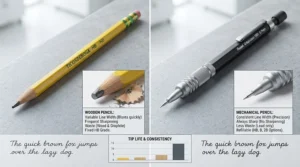
Mechanical Pencil vs Wooden Pencil for High School
This is the debate that never quite dies, so let’s settle the practical parts of it. Wooden pencils have one clear advantage: they’re dirt cheap, and nobody cries if one gets lost. But once you factor in the realities of a full high school timetable, mechanical pencils win on almost every dimension that matters day to day.
| Factor | Mechanical Pencil | Wooden Pencil |
|---|---|---|
| Line consistency | Stays the same width all day | Gets thicker as tip wears |
| Sharpening required | Never | Constant, needs a sharpener |
| Lead diameter | Precise, ranges from 0.3-0.9mm | Thicker, ~2mm, less precise |
| Cost per pencil | Higher upfront, refillable | Cheaper upfront, disposable |
| Best for exams | Consistent, scan-friendly HB lead | Also scan-friendly, but degrades |
The real differentiator is consistency. Wooden pencils have a lead core approximately 2mm thick, while mechanical pencils typically use lead between 0.3mm and 0.9mm, meaning mechanical lead is manufactured differently and comes in fewer but more precise grades. In practice, that precision means your handwriting and diagrams look the same on line one as they do on line fifty, whereas a wooden pencil visibly dulls within a page of heavy note-taking, forcing a sharpening break mid-class or mid-test — a genuine problem when you can’t leave your seat during an exam.
Cost is where wooden pencils still have an argument. A dozen wooden HB pencils can cost less than a single mechanical pencil upfront. But mechanical pencils are refillable — a tube of replacement lead costs a few dollars and lasts months, meaning the total cost of ownership evens out or even favours mechanical pencils over a full school year, especially once you stop losing sharpened stubs in the bottom of your backpack. For math and drawing specifically, the fixed lead diameter of a mechanical pencil also means your line width stays predictable for diagrams, graphs, and geometric constructions — something a wooden pencil simply can’t guarantee as it wears unevenly.
Best Mechanical Pencils for Math and Drawing in Grade 11
Grade 11 is usually where course loads split hardest between writing-heavy and diagram-heavy work — functions, physics, and visual arts or drafting electives often land in the same semester, and that combination has real implications for pencil choice. What most buyers overlook is that a pencil great for essays isn’t automatically great for graphing a parabola against a ruler, and vice versa.
For pure math work — long division, function tables, statistics — a 0.5mm pencil with a standard sleeve like the Pentel Twist-Erase III or Uni Kuru Toga handles daily note-taking and problem sets comfortably, with the Kuru Toga’s rotating lead keeping numerals crisp through long problem sets. For diagram-heavy math (geometry, vectors, graphing) and any drafting or visual arts crossover, the Staedtler Mars Micro 775 and Pentel GraphGear 1000 pull ahead specifically because of their rigid, ruler-compatible lead sleeves — a feature that plastic click pencils without a fixed sleeve simply don’t offer. Reviewers who use these pencils for both writing and technical drawing consistently note that switching between the two tasks doesn’t require switching pencils, which matters when your locker doesn’t have room for five separate tools.
There’s also a study-skills angle worth mentioning honestly: handwriting itself carries a documented cognitive benefit over typing for retention. Research summarized by a University of Waterloo cognitive neuroscience graduate student notes that handwriting requires more of the brain’s motor programs than typing, because forming letters by hand engages movements tied to the structure of the words themselves. That’s not a reason to abandon your laptop entirely, but it’s a reasonable argument for keeping a reliable mechanical pencil in rotation for math work specifically, where working through a problem by hand is often faster and clearer than typing equations anyway. For broader note-taking strategy tied to this idea, University of Waterloo’s student note-taking guide is a genuinely useful, non-pencil-related resource worth bookmarking.
How to Choose a Mechanical Pencil for High School
If you only remember one section from this whole guide, make it this checklist:
- Match the lead size to your workload. Choose 0.5mm as a safe default; go 0.7-0.9mm if you write large or press hard, and 0.3mm only as a secondary pencil for fine detail work.
- Prioritize break-resistance if you’re heavy-handed. If you’ve broken more than two leads in the past month, a double-spring pencil like the Zebra DelGuard will save you real frustration.
- Consider your dominant coursework. Diagram-heavy math or drafting electives favour a rigid-sleeve drafting pencil; essay-heavy humanities courses favour comfort and line consistency instead.
- Factor in exam length. For courses with long, written final exams, an ergonomic grip like the Pilot Dr. Grip genuinely reduces hand fatigue over a two- or three-hour block.
- Check the eraser situation honestly. If you erase constantly, an oversized eraser like the Pentel Twist-Erase III‘s saves you from constantly buying separate erasers.
- Think in years, not months, if budget allows. A metal-bodied pencil like the Rotring 600 or Pentel GraphGear 1000 costs more upfront but can realistically last through multiple school years.
- Buy a backup. Whatever you choose, keep a second pencil in your bag — the single most common exam-day disaster is a broken or lost primary pencil with no spare.
Each of these criteria maps directly onto one or more pencils above, so if you’re still unsure, work through the list in order and you’ll land on the right one by step three or four.
Practical Usage Guide: Setup, Refilling, and Maintenance
Getting a new mechanical pencil dialed in takes about ninety seconds, but skipping this step is exactly how students end up thinking a good pencil is “broken” when it’s actually just not loaded correctly.
First-use setup: Most pencils ship with one or two leads already loaded. Click the top button several times until lead extends about 2-3mm past the tip — extending it further than that before your first write invites breakage, especially on non-DelGuard mechanisms. If the pencil uses a twist-erase or shaker system, test that mechanism a few times before your first class so you’re not fumbling with an unfamiliar tool during a lecture.
Refilling leads: Pull the eraser assembly (or twist it, depending on the model) to expose the lead reservoir, and drop in 5-10 replacement leads at a time — most tubes hold that range. Refill leads for mainstream brands like Pentel, Staedtler, and Uni are inexpensive and widely available at any Canadian office supply retailer, so there’s rarely a reason to run a pencil dry mid-semester if you plan ahead.
Maintenance schedule: Every few weeks, especially for drafting-style pencils with an exposed metal sleeve, wipe the tip clean of graphite dust that accumulates from erasing nearby. If a click mechanism starts feeling loose or skips advancing lead, a small amount of internal graphite dust is usually the culprit — a gentle tap with the tip pointed down often clears it without needing tools. If budgeting for school supplies as a family is part of your back-to-school planning, CBC’s roundup of back-to-school tips has practical advice on where it’s worth spending versus saving.
Common first-30-days mistakes: The most frequent error is over-extending lead before writing, which snaps thinner 0.3mm and 0.5mm leads almost immediately. The second is forcing a jammed eraser twist mechanism, which can strip the internal threads. The third — and most avoidable — is not buying a spare pencil at all, then discovering the hard way during an exam that pencils do occasionally fail regardless of price point.
Real-World Scenarios: Which Pencil Fits Which Student
The budget-conscious note-taker: A Grade 9 or 10 student taking mostly writing-based courses, on a tight allowance, who loses pencils fairly often. Best fit: Pentel Twist-Erase III, bought two or three at a time given the low per-unit cost, so a lost pencil doesn’t derail a study session.
The math-and-drafting double load: A Grade 11 student in functions, physics, and a visual arts or technological design elective in the same semester, needing one tool that handles both diagrams and dense note-taking. Best fit: Pentel GraphGear 1000 or Staedtler Mars Micro 775, both offering the rigid ruler-compatible sleeve this workload demands.
The standardized-test veteran: A student prepping for the SAT, AP exams, or a provincial literacy/numeracy assessment, who needs total reliability over a multi-hour sitting with zero tolerance for a broken lead mid-question. Best fit: Zebra DelGuard for break-resistance paired with a Pentel GraphGear 1000 as a technical-drawing backup for any diagram-based math sections.
Matching yourself to one of these profiles isn’t about brand loyalty — it’s about recognizing which specific failure mode (cost, breakage, comfort, precision) is most likely to actually disrupt your school year, and buying against that risk specifically rather than the most expensive pencil on the shelf.
Common Mistakes When Buying a Mechanical Pencil for School
The single most common mistake is buying based on barrel colour or aesthetic appeal alone, then discovering the lead size doesn’t suit the coursework at all — a cute 0.9mm pencil is a poor choice for detailed geometry notation, regardless of how good it looks in a pencil case.
A close second: assuming a more expensive pencil is automatically better for every student. The Rotring 600 is objectively a superior piece of engineering to the Pentel Twist-Erase III, but if you’re a student who loses pencils regularly, spending C$50 on something you’ll lose within a month is a worse decision than buying three cheaper backups.
Third, students frequently ignore lead grade entirely and assume all mechanical pencil lead is interchangeable in darkness. It isn’t — HB pencils sit in the middle of the hardness-and-blackness scale, balancing the two for everyday writing and sketching, while harder H-grade leads produce lighter, more precise lines and softer B-grade leads produce bolder, darker ones. Loading the wrong grade for a scan-based test can genuinely affect how your answers are read.
Finally, many students buy a single pencil and treat it as irreplaceable, which turns any mechanical failure into a crisis during an exam. Buying a backup costs a few dollars and eliminates that risk entirely — a lesson usually learned the hard way exactly once per school career.
Long-Term Cost & Maintenance: Lead and Eraser Refills
Sticker price is only part of the real cost of a mechanical pencil. A tube of standard HB lead refills typically runs a few dollars and contains enough leads to last a full semester of normal use, meaning the ongoing cost of any pencil on this list is genuinely low regardless of the upfront price. Eraser refills follow a similar pattern — a multi-pack costs a small amount and outlasts a school term easily.
Where the math actually diverges is durability. A C$8 plastic-click pencil that breaks or gets lost every couple of months, requiring replacement two or three times a year, can end up costing more over three years of high school than a single C$25-C$50 metal-bodied pencil bought once and maintained properly. That’s not an argument that everyone should buy the priciest option — plenty of students genuinely do lose pencils regardless of quality, in which case a cheaper, replaceable pencil remains the financially smarter choice. But for a student with a stable pencil case and a multi-year need (particularly anyone heading toward an engineering, architecture, or design-adjacent post-secondary path), the total cost of ownership on something like the Rotring 600 or Pentel GraphGear 1000 can work out favourably once you account for not repurchasing every semester.
Features That Actually Matter (And Those That Don’t)
Actually matters: lead break-resistance, sleeve rigidity for ruler work, grip comfort for long writing sessions, and eraser size relative to how much you erase. These directly affect your day-to-day writing experience and exam performance.
Doesn’t matter much: barrel colour, novelty shapes, and “limited edition” branding — none of these affect how the pencil actually writes. Similarly, the number of lead sizes a single model offers matters less than picking the one size that suits your handwriting; you don’t need a pencil that comes in four sizes if you’re only ever going to use 0.5mm.
Matters more than most students realize: the specific mechanism type. A shaker pencil like the Pilot Dr. Grip solves fatigue but requires learning a different motion than a standard click pencil; a rotating pencil like the Uni Kuru Toga solves smudging but keeps a fully manual click mechanism. Understanding which specific problem a mechanism solves — rather than assuming “mechanical pencil” is a single undifferentiated category — is the difference between buying the right tool and buying an expensive pencil that doesn’t actually fix your particular frustration.
Frequently Asked Questions
❓ What is the best mechanical pencil for a Grade 11 student?
❓ Is 0.5mm or 0.7mm better for high school exams?
❓ Do mechanical pencils work for standardized tests in Canada?
❓ Are mechanical pencils better than wooden pencils for school?
❓ How often should I replace mechanical pencil lead?
Recommended for You
- Pens for Writing Essays High School: 7 Picks for 2026
- Study Tools for High School Students: 7 Picks That Work (2026)
- Exam Prep Supplies for High School Students: 7 Picks (2026)
Disclaimer: This article contains affiliate links. As an Amazon Associate, I earn from qualifying purchases. If you purchase products through these links, we may earn a small commission at no additional cost to you.
✨ Found this helpful? Share it with your friends! 💬🤗
