
In This Article
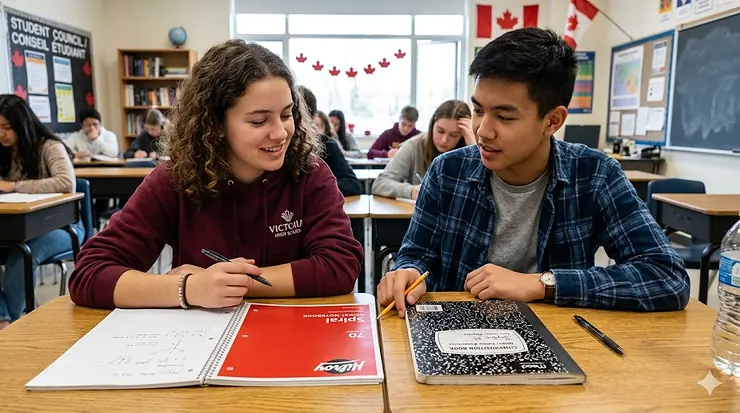
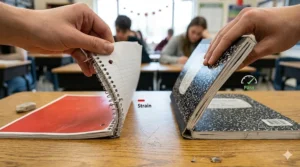
A spiral notebook uses a coiled wire binding that lets pages lie flat and tear out cleanly, while a composition notebook uses a sewn or glued binding inside a stiff cardboard cover, keeping pages permanently bound together. For Canadian high schoolers, the practical split usually comes down to this: spirals win on flexibility and per-subject organization, composition books win on durability and archiving a full semester of notes without losing a single page.
Quick Comparison Table
| Feature | Spiral / Coil Notebook | Composition Notebook |
|---|---|---|
| Binding | Wire coil, pages tear out easily | Sewn/glued, pages stay permanent |
| Lies flat? | Yes, 180° | Mostly (better with sewn binding) |
| Backpack durability | Coil can bend or snag | Holds shape better under weight |
| Best for | Quick notes, handouts, binder filing | Long-term subject journals, labs, journaling |
| Typical price (CAD) | $2–$8 for a single subject | $3–$10 depending on page count |
| Common Canadian brands | Hilroy, Five Star, Oxford | Hilroy, Mead, Five Star, Oxford |
Looking at the table, the real trade-off isn’t quality — both formats come from the same handful of manufacturers — it’s workflow. Spirals suit students who move loose pages into a binder by subject, while composition books suit students (or teachers) who want one continuous, tamper-evident record, like a lab notebook or a journal a teacher will collect and return. Cost-wise, neither format carries a meaningful price premium in Canada; page count and paper weight move the needle more than binding style.
💬 Just one click — help others make better buying decisions too! 😊
✨ Don’t Miss These Exclusive Deals!
🔍 Take your athletic performance to the next level with these carefully selected recovery products. Click on any highlighted item to check current pricing and availability on Amazon.ca. These tools will help you recover faster, train harder, and achieve the results your effort deserves!
How to Choose: A Quick Decision Framework
- If you switch binders by subject or unit → go spiral. Pages tear out cleanly without the ragged edge composition books leave.
- If a teacher requires a bound, sequential notebook (common in science labs, where pages shouldn’t be removable) → composition book.
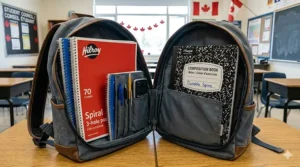
- If you’re hard on your backpack → composition books resist getting crushed; coils can bend if a textbook lands on them.
- If you take notes on a laptop most of the time → buy one cheap notebook of either kind for diagrams and formulas rather than a full set — see the note-taking research below before assuming a notebook isn’t worth carrying at all.
- If budget is tight → multi-subject coil notebooks (5-subject, 200+ pages) usually cost less per page than buying five separate composition books.
Does Handwriting Actually Help You Learn? What the Research Says
This is genuinely relevant to the spiral-vs-composition question, because if you’re choosing a notebook at all, it’s worth knowing what handwritten notes are good for. A widely cited 2014 study in Psychological Science by Pam Mueller and Daniel Oppenheimer found that students taking longhand notes performed better on conceptual questions than students typing on laptops, because handwriting’s slower pace forces students to summarize and rephrase ideas instead of transcribing them word-for-word — engagement that seems to matter more than the volume of notes captured (Mueller & Oppenheimer, 2014, Psychological Science).
It’s worth being even-handed here: a 2019 replication in Educational Psychology Review found the effect was smaller and less consistent than the original study suggested, with performance differences shrinking once students reviewed their notes afterward (Morehead, Dunlosky & Rawson, 2019). The honest takeaway for a Grade 9–12 student: handwriting a notebook isn’t magic, but the act of rephrasing material in your own words — easier to do by hand — is what seems to help, regardless of whether that notebook is spiral-bound or sewn.
Top Notebook Picks Available on Amazon.ca
Prices below are CAD ranges, not exact figures — Amazon.ca pricing fluctuates often, so check current pricing on the listing before buying.
1. Hilroy Premiere Spiral Bound Notebook (1-subject, wide ruled)
Hilroy is the household name in Canadian school supplies, and its standard coil notebook is the default many provincial supply lists assume. The 80-sheet, wide-ruled format suits students who haven’t transitioned to dense college-ruled note-taking yet — typically grades 9–10. It’s 3-hole punched, so torn-out pages slot straight into a binder.
- ✅ Cheapest reliable option, widely stocked, fits binders
- ✅ Bilingual cover labelling (standard for products sold in Canada)
- ❌ Coil can deform if packed tightly with textbooks
- Price: roughly $2–$4 CAD
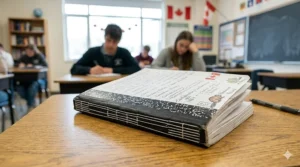
2. Hilroy 5-Subject Coil Notebook (8″ x 10.5″, wide ruled, 360 pages)
For students juggling five courses who don’t want to carry five separate books, this consolidates a semester’s worth of notes with built-in subject dividers. It’s a heavier book, so it suits a backpack rather than a single binder pocket.
- ✅ One book covers a full course load
- ✅ Better cost-per-page than buying singles
- ❌ Bulkier and heavier than separate notebooks
- ❌ Losing the book means losing every subject at once
- Price: roughly $6–$10 CAD
3. Hilroy Stitched Exercise Book (8mm ruled, 3-hole punched, 20-pack)
This is the closest Canadian equivalent to a “composition book” for younger or budget-conscious high schoolers: stitched binding, no coil to bend, sold in bulk packs that work well for families covering several kids or a full school year at once.
- ✅ Stitched binding won’t snag like a coil
- ✅ Bulk packaging brings the per-unit cost down sharply
- ❌ Thinner paper than premium composition books
- Price: roughly $0.30–$0.50 CAD per book when bought as a 20-pack
4. Five Star 1-Subject Spiral Notebook (college ruled, wirebound, poly cover)
Once students move to dense, fast-paced note-taking in grade 11–12, the wide-ruled format gets cramped. Five Star’s college-ruled spiral with a tougher poly cover (instead of cardstock) holds up better to a year of being shoved into a backpack pocket.
- ✅ College ruling fits more content per page — useful for AP/IB-track students
- ✅ Durable poly cover outlasts standard cardstock
- ❌ Less common on Canadian supply lists, so it can look slightly out of place if a teacher specifies “standard ruling”
- Price: roughly $5–$9 CAD
5. Mead Composition Notebook (wide or college ruled, sewn binding)
Mead’s composition book is the classic black-and-white marbled cover most students picture when a teacher says “composition notebook.” The sewn binding (not glued) means pages won’t fall out even after a full year of daily use, which matters for journals or lab books a teacher collects partway through term.
- ✅ Genuinely durable — sewn pages rarely loosen
- ✅ Standard size fits most backpack organizers
- ❌ Pages can’t be removed cleanly, which is a problem if your school requires loose-leaf submissions
- Price: roughly $3–$7 CAD
6. Oxford Spiral Notebook (pressboard cover, micro-perforated, college ruled)
Oxford sits between Hilroy and premium brands: a pressboard cover that resists bending better than thin cardstock, with micro-perforated pages that tear out neatly — a small but real upgrade if you regularly hand in torn-out notes.
- ✅ Clean tear-out edges (no ragged strips left behind)
- ✅ Pressboard cover adds privacy and rigidity
- ❌ Pricier than basic Hilroy or Amazon Basics options for a similar page count
- Price: roughly $6–$9 CAD
7. Blueline Executive Notebook (hardcover, college ruled, 150+ pages)
Blueline is a long-standing Canadian stationery brand, and its hardcover executive notebooks are worth knowing about for students taking a course (or a part-time job) that calls for a more formal, durable bound notebook than typical classroom stock — a hardcover holds up better in a bag with no binder for protection.
- ✅ Hardcover survives loose-in-backpack carrying
- ✅ Lies flatter than most softcover spirals when full
- ❌ Higher price point for a basic class notebook
- ❌ Bulkier and heavier than thin coil notebooks
- Price: roughly $8–$14 CAD
Looking at these seven side by side, the pattern holds: Hilroy and Amazon Basics-tier products win on price and availability across Canada, Five Star and Oxford add durability upgrades worth paying for if a notebook needs to survive a full school year, and Mead/Blueline suit situations where pages must stay permanently bound. None of these differences are dramatic enough to justify overspending — match the binding to how the notebook will actually be used, not the brand name.
What High School Notebooks Actually Cost in Canada
Notebooks themselves are cheap, but they’re one line item in a back-to-school bill that’s grown noticeably heavier. A 2025 Retail Council of Canada report pegged total school-supply costs at roughly $600–$750 CAD per child for the year, a figure community organizations have flagged as a real strain for lower-income families (CBC News, 2025). Statistics Canada has also tracked stationery prices rising faster than general inflation in recent back-to-school seasons. Against that backdrop, buying multi-subject notebooks in bulk, or stocking up during late-August sales, makes a bigger dent in the total bill than agonizing over spiral versus composition for a single subject.
Common Mistakes When Buying Notebooks for High School
- Buying wide ruled when the student needs college ruled. Grade 9 students often still use wide ruled; by grade 11–12, dense note-taking usually needs the extra lines college ruling provides.
- Choosing the thinnest notebook to save money, then needing a replacement mid-term. A $1 notebook that runs out in October isn’t actually cheaper than an $6 multi-subject one.
- Ignoring whether a teacher requires removable pages. Some classes (especially labs) explicitly require a bound, non-removable notebook so pages can’t be swapped out — check the supply list before buying coil notebooks in bulk.
- Skipping the cover material. A flimsy paper cover on a notebook that lives loose in a backpack (no binder, no folder) will fray within weeks; pressboard or poly covers cost a little more but last the term.
Storage and Care Tips That Extend a Notebook’s Life
A coil notebook lasts longest stored upright in a backpack rather than flat under heavy textbooks, since lateral pressure is what bends wire coils out of shape. For composition books, a binder clip or rubber band around a half-used notebook keeps pages from curling at the spine. In Canadian winters, damp boots and snowy backpacks are a real threat to paper — a notebook kept in a zippered pocket rather than an open backpack sleeve avoids most moisture damage on the commute to school.
Frequently Asked Questions
❓ Is a spiral or composition notebook better for high school note-taking?
❓ What's the difference between college ruled and wide ruled?
❓ Do Amazon.ca notebook prices include free shipping in Canada?
❓ What notebook brand is most common on Canadian school supply lists?
❓ Should I buy notebooks in bulk for the whole school year?
Conclusion
For most Canadian high schoolers, the spiral-vs-composition decision matters less than matching ruling type to grade level and buying covers sturdy enough to survive a full term in a backpack. Hilroy and Amazon Basics-tier notebooks cover the budget end reliably; Five Star, Oxford, and Blueline are worth the extra dollar or two when a notebook needs to last an entire year without falling apart. Whichever format you pick, the actual note-taking research suggests the bigger lever for learning is writing notes in your own words rather than copying verbatim — something both notebook styles support equally well.
✨ Don’t Miss These Exclusive Deals!
🔍 Ready to recover smarter? Click on any highlighted product to check current pricing and availability on Amazon.ca. Give your legs the professional-grade recovery they’ve earned!
Recommended for You
- 7 Best Notebooks for High School Students in Canada (2026)
- Best Budget Friendly School Supplies in Canada 2026 — Save Big
- Best Back to School Supplies Grade 7 Canada: 7 Must-Haves for 2026
Disclaimer: This article may contain affiliate links. As an Amazon Associate, this site may earn from qualifying purchases, at no additional cost to you.
✨ Found this helpful? Share it with a friend getting ready for the school year! 💬
