

In This Article
The best notebooks for high school students in Canada balance three things: paper that survives a full semester without ink bleeding through, a binding that holds up to being shoved into a locker or backpack between classes, and a price that doesn’t wreck a family’s back-to-school budget. Whether your teen needs a single hardcover journal for English class or a five-subject notebook to carry through an entire timetable, the right pick depends on grade level, subject load, and how rough they are on their supplies.

This guide rounds up seven notebooks for high school students that are actually available on Amazon.ca, broken down by price tier, durability, and the kind of student each one suits — from the budget-conscious Grade 9 starting their first year of high school to the senior who’s switched to a reusable digital notebook for AP coursework. We’ve also dug into Canadian-specific considerations: bilingual packaging requirements, Amazon.ca shipping thresholds, and what back-to-school inflation has done to stationery prices here over the past few years.
Quick Comparison: Best Notebooks for High School in Canada
| Notebook | Type | Best For | Price Range (CAD) |
|---|---|---|---|
| Hilroy 3-Subject Coil Notebook | Wide ruled, coil | Budget shoppers, Canadian classrooms | $5–$10 |
| Mead Spiral Notebook (6-Pack) | College ruled, spiral | Stocking up for a full semester | $15–$22 |
| Five Star Spiral Notebook + Study App (5-Subject) | College ruled, spiral | Heavy note-takers, multiple classes in one book | $12–$18 |
| Oxford Poly Spiral Notebook (2-Subject) | College ruled, poly cover | Backpack durability, spill resistance | $8–$14 |
| Moleskine Classic Hardcover | Ruled or plain, sewn | Seniors, journaling, university-prep habits | $25–$38 |
| LEUCHTTURM1917 Notebook | Dotted or ruled, hardcover | Organized students, bullet-journal planners | $30–$42 |
| Rocketbook Smart Reusable Notebook | Erasable, app-connected | Tech-comfortable students, reducing paper waste | $35–$55 |
Looking at the spread above, the cheapest reliable option is the Hilroy coil notebook, which works well for a single subject that doesn’t need to survive an entire year. If your teen is taking five or six courses and wants one binder-style book instead of five separate notebooks, the Five Star 5-Subject pulls ahead on value per page. At the top end, Rocketbook costs more upfront but eliminates the recurring cost of buying fresh notebooks every semester — something to weigh given how much stationery prices have climbed in Canada lately.
💬 Just one click — help others make better buying decisions too! 😊
✨ Don’t Miss These Exclusive Deals!
🔍 Take your back-to-school shopping to the next level with these carefully selected notebooks. Click on any highlighted item to check current pricing and availability on Amazon.ca. These picks will help your high schooler stay organized all year long!
Top 7 Notebooks for High School Students: Expert Analysis
1. Hilroy 3-Subject Coil Notebook
Hilroy is about as Canadian as a notebook gets — this 8″ x 10.5″ coil notebook ships with 300 pages (150 sheets) split across three subjects, wide ruled with a margin column. The wide ruling matters more than it sounds: it gives students room to write legibly when they’re copying fast from a whiteboard, instead of cramming words into narrow lines and creating illegible exam-prep notes later.
What most Canadian buyers overlook about this model is that the coil binding, while less premium-feeling than a sewn binding, is genuinely better suited to being crammed flat into an overstuffed backpack through a Canadian winter — it won’t crack the way a hardcover spine can when it’s frozen solid in a locker overnight. On Amazon.ca, this exact model carries a strong 4.6 out of 5 star rating from over 1,500 customer reviews, which is a meaningful sample size for a school-supplies product.
✅ Pros: very low price; wide ruling is forgiving for younger students; widely stocked on Amazon.ca every August
❌ Cons: three subjects in one book gets bulky by exam season; cover is plain cardstock, not water-resistant
Price/value verdict: at around $5–$10 CAD, this is the safest “buy a few as backups” pick for any Grade 9 or 10 student.
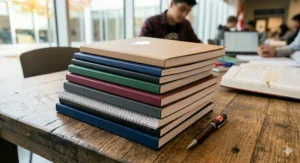
2. Mead Spiral Notebook, 6-Pack, 1-Subject
The Mead six-pack solves a different problem: instead of one notebook trying to cover multiple subjects, your teen gets six single-subject notebooks, one per course, each with 70 college-ruled sheets. The practical upside here is replacement — if math class wears through a notebook by November, you’re not also losing your geography and English notes, since each subject lives in its own book.
In my experience helping families plan school supply lists, the single-subject-per-book approach works best for students who like a clean slate per class rather than flipping through dividers. Mead’s paper is on the thinner side, so it’s not the pick for students who write heavily with gel pens (expect some bleed-through), but for pencil and standard ballpoint use through a Canadian school year, it holds up fine.
✅ Pros: six notebooks for the price of buying singles separately; assorted colours make subjects easy to tell apart at a glance; widely available
❌ Cons: thinner paper shows ink bleed with gel pens; covers are basic and tear if a binder digs into them in a backpack
Price/value verdict: in the $15–$22 CAD range for six notebooks, this is one of the better per-unit deals if your student needs full subject separation.
3. Five Star Spiral Notebook + Study App, 5-Subject
Five Star notebooks are the closest thing to a default choice for North American high schoolers, and the 5-subject, 200-sheet version explains why. The water-resistant front cover and coated back cover genuinely matter in Canadian conditions — a notebook that survives being pulled out of a wet backpack after a slushy walk to the bus stop is worth the extra dollar or two over a plain cardstock cover.
What the spec sheet won’t tell you is how the four built-in pocket dividers change study habits: students can physically separate handouts by subject without needing a binder at all, which is a real advantage for anyone who’s lost loose worksheets in their backpack before. The paper is also treated to resist ink bleed, so double-sided note-taking with a standard pen stays legible — useful if your teen is trying to cut down on how many notebooks they’re buying per year.
✅ Pros: water-resistant cover survives wet commutes; reinforced pockets actually hold up; one book replaces five separate notebooks
❌ Cons: bulkier and heavier than single-subject notebooks; can get unwieldy once more than half the pages are used
Price/value verdict: around $12–$18 CAD, this is the strongest all-in-one option for students juggling a full course load.
4. Oxford Poly Spiral Notebook, 2-Subject
Oxford’s poly-cover spiral notebook trades the typical cardstock front for a flexible plastic cover, which is the single biggest factor in whether a notebook survives a full semester of being tossed into a backpack with textbooks, a water bottle, and a lunch container. Poly covers don’t bend-crease or tear the way paperboard does.
For a Canadian high schooler specifically, this matters during the colder months: cardstock covers tend to get brittle and crack in near-freezing temperatures after sitting in an unheated locker or car overnight, while poly covers stay flexible. The double-pocket dividers between the two subjects also mean handouts stay sorted without needing a separate folder.
✅ Pros: poly cover resists cracking in cold weather; pocket dividers keep two subjects organized in one book; lighter than a 5-subject notebook
❌ Cons: only two subjects per book, so heavy course loads need multiples; college ruling can feel cramped for students with larger handwriting
Price/value verdict: at roughly $8–$14 CAD, this is a smart middle-tier pick for students who want durability without paying for a full hardcover notebook.
5. Moleskine Classic Hardcover Notebook
Moleskine’s classic hardcover notebook is a step up in both price and intent — this isn’t built for jamming five subjects’ worth of lecture notes into one book, it’s built for the student who treats note-taking as a habit worth investing in, often a senior preparing for the kind of note-taking expected at university. The elastic closure band and inner storage folder are small details, but they mean loose handouts and bookmark pages stay put through a backpack commute.
What most people overlook about Moleskine in a Canadian high school context is that the thick, cream-coloured paper is genuinely better suited to fountain pens and fineliners than the thin paper in budget spiral notebooks — useful for students taking art-adjacent electives or who simply prefer a nicer writing surface for daily journaling assignments. It is, however, overkill as a disposable subject notebook for a 14-year-old’s chemistry class.
✅ Pros: durable sewn binding and hardcover survive years of use, not just one semester; thick paper handles a wide range of pens; doubles as a journal beyond school
❌ Cons: noticeably pricier per page than spiral options; no subject dividers, so it suits single-subject or journal-style use rather than juggling a full timetable
Price/value verdict: in the $25–$38 CAD range, this is best reserved for one specific class, a journaling elective, or a student heading toward university-style note-taking.
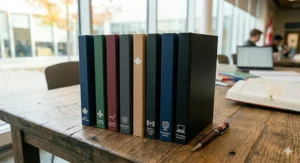
6. LEUCHTTURM1917 Notebook
LEUCHTTURM1917 sits in the same premium tier as Moleskine but adds a numbered table of contents and page numbers printed directly into the notebook — a feature that’s surprisingly practical for a student trying to reference back to notes from three weeks ago without flipping through the entire book. The dotted-page version in particular has become popular with students who plan their assignments and study schedules using bullet-journal-style layouts rather than a separate planner.
In practice, this is the pick for the organized type of high schooler — the one already colour-coding their binder by subject — rather than the student who’ll lose track of a $35 notebook by October. For that more disciplined user, the structured page numbering genuinely changes how usable a semester’s worth of notes are during exam review.
✅ Pros: built-in table of contents and page numbers make review faster; dotted pages support both writing and visual planning; durable hardcover
❌ Cons: among the priciest options on this list; the bullet-journal dotted format has a learning curve for students used to plain ruled lines
Price/value verdict: at around $30–$42 CAD, this suits an organized student in Grade 11 or 12 more than a Grade 9 student still building study habits.
7. Rocketbook Smart Reusable Notebook
Rocketbook flips the entire premise of a school notebook: instead of buying a new one every semester, students write with a special erasable pen, scan pages to a cloud folder through the companion app, then wipe the page clean with a damp cloth and reuse it indefinitely. For a Canadian household trying to cut down on the recurring back-to-school notebook bill — and on paper waste — this is the only entry on this list that pays for itself over multiple years instead of being a single-semester consumable.
The trade-off most reviews don’t emphasize enough: it only works properly with the included Pilot FriXion pen, and writing with regular ballpoints or gel pens won’t erase. That’s a real behaviour change for a teenager used to grabbing whatever pen is closest, and it’s worth testing with your student before committing a whole semester’s note-taking to it.
✅ Pros: reusable indefinitely, so it replaces multiple notebook purchases over a school career; cloud backup means notes survive a lost backpack; genuinely reduces paper waste
❌ Cons: only works with specific erasable pens; higher upfront cost than any paper notebook on this list
Price/value verdict: around $35–$55 CAD upfront, but the long-term cost per year drops below paper notebooks once a student sticks with it for more than one semester.
How to Choose the Right Notebook for High School in Canada
- Match ruling to subject, not habit. Wide ruled suits younger students (Grade 9) and subjects with diagrams like science; college ruled fits older students fitting more notes per page for subjects like history or English.
- Count your teen’s course load before choosing single vs. multi-subject. A student with eight rotating courses needs either several single-subject notebooks or one well-divided 5-subject book — not five separate notebooks they’ll mix up.
- Prioritize cover material if the backpack gets rough use. Poly or water-resistant covers cost a little more but consistently outlast cardstock through a full Canadian school year of wet commutes and cold lockers.
- Decide if reusability is worth the upfront cost. If your household is buying new notebooks every single semester, a reusable option like Rocketbook can break even within a year or two.
- Check binding type against how the notebook will be carried. Coil and spiral notebooks lie flatter in a backpack; sewn hardcover notebooks like Moleskine and LEUCHTTURM1917 are sturdier long-term but bulkier day to day.
- Buy in bulk only where you’ll actually use it. A 6-pack like Mead’s is genuine value if your student is filling notebooks regularly — but if a 1-subject notebook routinely lasts a full year, you don’t need a multi-pack sitting unused in a drawer.
Notebooks vs. Binders: Which Should Canadian High Schoolers Use?
Plenty of Canadian schools issue supply lists that ask for binders rather than (or alongside) notebooks, and the two solve different problems. A bound notebook keeps notes in permanent chronological order, which is useful for subjects like English or history where students review material sequentially before a test. A binder with loose-leaf paper, by contrast, lets students reorganize, remove, and insert handouts freely — better suited to subjects like math or science where worksheets and formula sheets need to sit next to related notes regardless of when they were handed out.
In practice, many Canadian high schoolers end up using both: a notebook for daily lecture notes in subjects with a clear linear flow, and a binder for classes where handouts pile up fast. If your teen is constantly losing loose pages, lean toward notebooks; if they’re constantly running out of room to insert new material mid-unit, lean toward a binder instead.
Practical Usage Guide: Getting the Most Out of a School Notebook
Setting a new notebook up properly in the first week of school avoids the mid-semester scramble to find old notes. A few habits make a real difference:
✅ Label the front cover with subject, teacher, and block/period the very first day — colour alone (as Hilroy and Mead notebooks rely on) isn’t enough once three subjects share the same shade by October.
✅ Leave the first two pages blank for a running table of contents, especially in a multi-subject notebook like the Five Star 5-Subject — flipping through 200 pages to find one lecture wastes real study time before a test.
✅ For coil and spiral notebooks, reinforce the binding holes with small adhesive rings if pages start tearing loose by midterms — a $3 pack of reinforcement stickers easily outlasts a full school year.
✅ Store notebooks flat rather than upright in a locker over winter break; cardstock covers (Hilroy, Mead) can warp or crack if left standing in a cold, dry locker for two weeks.
❌ Avoid leaving a notebook in a car overnight during a Canadian winter — extreme cold makes coil bindings brittle and more likely to snap when reopened.

Real-World Scenarios: Matching Notebooks to Canadian Student Profiles
The Toronto transit commuter (Grade 10, six courses): A student riding the TTC or a school bus daily needs something that survives being dropped, sat on, and occasionally rained on between transfers. The Oxford Poly 2-Subject or Five Star 5-Subject both fit, since their covers resist the damage a daily commute causes faster than a typical school year would on its own.
The rural Manitoba student with a long bus ride (Grade 9, first year of high school): With less frequent access to a Staples or office supply store between trips into town, buying in bulk makes more sense. The Mead 6-Pack or a few Hilroy coil notebooks bought at once reduce the number of mid-semester supply runs, and Amazon.ca delivery to less central addresses is worth planning a few extra days for compared to delivery in a major city.
The Ottawa senior preparing for university-style note-taking (Grade 12, AP/IB coursework): A student already practicing the kind of structured note-taking expected in post-secondary classes benefits more from a LEUCHTTURM1917 or Moleskine, where the page-numbering and durable binding support reviewing a full semester of dense notes — or from switching to a Rocketbook if they’re also comfortable reviewing notes digitally on a laptop.
Common Mistakes When Buying Notebooks for High School
Parents and students consistently run into the same handful of issues each September. Buying a single 5-subject notebook for every class crammed into one book sounds efficient, but it backfires for students with eight or more rotating courses — the book runs out of room unevenly, with some subjects’ sections filling up by October while others stay half-empty. Choosing the cheapest cardstock-cover notebook for a student who’s hard on their supplies is a false saving once you account for replacing a torn notebook mid-semester. Skipping wide ruling for a younger Grade 9 student because “college ruled looks more grown-up” often results in cramped, harder-to-read notes during their first year of high school. And buying an expensive premium notebook like Moleskine or LEUCHTTURM1917 for a student who hasn’t yet developed consistent note-taking habits risks the notebook sitting half-used while cheaper backups get reached for instead.
Long-Term Cost & Care in Canada
Stationery hasn’t been immune to the inflation Canadian households have felt elsewhere. Statistics Canada data reported by CBC News showed school stationery supplies were running roughly 13% more expensive year over year during a recent back-to-school season, a steeper jump than most other back-to-school categories tracked that year. That same coverage noted bulkier, lower-value-per-kilogram items like notebooks and binders tend to absorb a larger share of rising transportation and material costs than smaller school supplies.
That backdrop is why the cost comparison across this list isn’t just about which notebook is cheapest today — it’s about how many notebooks a student burns through per year. A student replacing a single $7 notebook three times a semester due to torn pages is paying more annually than one Five Star or Oxford notebook bought once at $14. At the far end, a Rocketbook’s higher upfront cost spreads across multiple school years rather than resetting every September, which is worth factoring in if your household is buying new notebooks for the same subjects every single term.
Shipping, Labelling & Amazon.ca Shopping Notes for Canadian Families
A few Canada-specific details are worth knowing before checking out. Amazon.ca currently sets free shipping at $35 CAD or more in eligible items for non-Prime customers, with Prime members getting free shipping regardless of order size — worth bundling a few notebooks together with pens or a binder to clear that threshold in one order rather than paying shipping on a single $6 notebook. Households outside major metro areas should also expect slightly longer delivery windows, since Amazon.ca’s free-shipping terms explicitly exclude remote postal codes from the fastest delivery options.
On packaging: federal rules under Canada’s labelling requirements mean retail products sold here, including school supplies, are generally expected to carry bilingual English/French labelling — something Hilroy’s packaging leans into directly, since the brand markets itself specifically around being built for Canadian classrooms.
Worth noting for transparency: any time a Canadian blog, influencer, or affiliate site recommends specific products with purchase links, the Competition Bureau of Canada requires that any material connection — including affiliate commissions — be clearly and conspicuously disclosed, since unclear disclosure can be treated as misleading advertising under the Competition Act. The Bureau’s own guidance is a useful read if you want to understand what that disclosure is supposed to look like before clicking through any “best of” list, including this one.
It’s also worth mentioning that the handwriting itself may matter more than the notebook brand. A widely cited meta-analysis covering thousands of student participants found a measurable advantage in performance for students who took notes by hand rather than typing them, an effect that held regardless of how long after the lecture students were tested. The Learning Scientists’ breakdown of that research is a good starting point if you’re deciding whether a paper notebook is worth sticking with over a laptop for your teen’s note-taking. For students who want structured strategies once they’ve got the notebook itself sorted, the University of Waterloo’s note-taking and study skills guide covers methods like sequential notes and annotated pages that work in any of the notebooks reviewed above.

FAQ
❓ What is the best notebook for high school students in Canada?
❓ How many notebooks does a typical high school student need per semester?
❓ Does Amazon.ca ship notebooks to rural and remote parts of Canada?
❓ Is a 5-subject notebook better than separate notebooks for each class?
❓ Are reusable notebooks like Rocketbook worth it for high schoolers in Canada?
Conclusion
There’s no single best notebook for every Canadian high schooler — the right pick depends on how many subjects your teen is juggling, how roughly they treat their supplies, and whether you’re trying to minimize cost per semester or cost per school career. For most families starting out, a budget Hilroy or Mead notebook is the lowest-risk way to test what your student actually needs before investing in a premium hardcover or a reusable system like Rocketbook. Whatever you choose, checking current availability and pricing directly on Amazon.ca before back-to-school season gets busy will save you a last-minute scramble in late August.
✨ Don’t Miss These Exclusive Deals!
🔍 Take your back-to-school shopping to the next level with these carefully selected notebooks. Click on any highlighted item to check current pricing and availability on Amazon.ca. These picks will help your high schooler stay organized all year long!
Recommended for You
- Best Budget Friendly School Supplies in Canada 2026 — Save Big
- Best Back to School Supplies Grade 7 Canada: 7 Must-Haves for 2026
- Best School Supplies for Grade 6 Canada: Top 7 Picks (2026)
Disclaimer: This article contains affiliate links. As an Amazon Associate, I earn from qualifying purchases. If you purchase products through these links, we may earn a small commission at no additional cost to you.
✨ Found this helpful? Share it with your friends! 💬🤗
