
In This Article
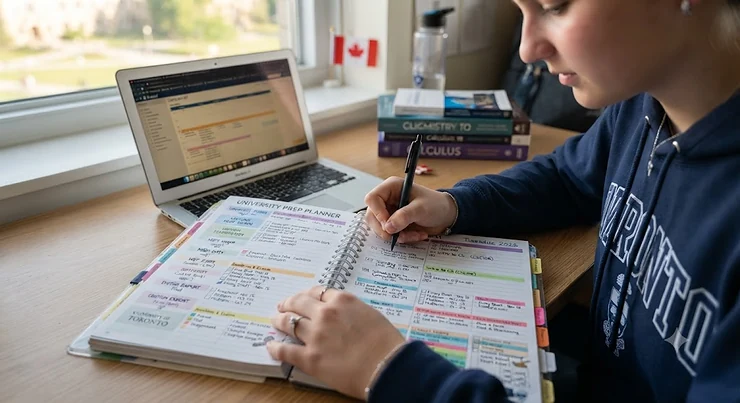
A planner for high school graduates going to university is a dated organizer — usually running July or August through the following summer — built around class schedules, assignment deadlines, and exam blocks instead of a plain January-to-December grid. It exists because the jump from a bell schedule someone else manages to a syllabus you’re expected to track yourself is bigger than most 18-year-olds expect.

Here’s the thing nobody puts on the graduation card: the skill that gets you through high school — showing up when told — isn’t the skill that gets you through first year. First year runs on self-management, and self-management runs on something you can actually see. That’s really what a good student planner Amazon.ca shoppers keep coming back to is solving. Not aesthetics. Not stickers (though, sure, stickers are nice). Visibility. You can’t manage a deadline you forgot exists.
This guide walks through seven real, currently available planners — from no-frills budget grids to premium layflat systems — with honest analysis of who each one actually suits, not just a spec dump. We’ll also cover the practical stuff that surrounds the planner itself: graduation party supplies, a university prep checklist Canada families can actually use, and the transition supplies that quietly make or break the first month of dorm life. As CBC News has reported, the jump to post-secondary life carries real stress for first-year students, which is exactly why the organizational side of this transition deserves more thought than a last-minute Target run in August.
Quick Comparison Table
For readers in a hurry, here’s the fast version before we go deep on each pick.
| Planner | Format | Best For | Price Range (CAD) |
|---|---|---|---|
| Blue Sky 2026-2027 Weekly and Monthly Academic Year Planner | 8.5″ x 11″, wirebound | Visual planners who like a big grid | C$20-C$25 range |
| Cambridge Academic Planner 2026-2027 (Madison) | 8.5″ x 11″, flexible cover | Budget-first, no-frills students | C$15-C$20 range |
| SUNEE Academic Planner 2026-2027 | 6.4″ x 8.3″, spiral | Backpack-sized, sticker fans | C$12-C$18 range |
| Forvencer 18 Month Academic Planner 2026-2027 | 8.5″ x 11″, hardcover | Students who want runway into second year | C$18-C$24 range |
| Clever Fox Academic Student Planner 2026-2027 | 6.3″ x 8.5″, hardcover | Goal-setters and habit trackers | C$35-C$45 range |
| Erin Condren 12-Month Softbound Academic Planner | A5, layflat wire-o | Daily grinders who write a lot | C$55-C$70 range |
| Moleskine Classic 18 Month Weekly Planner (Large) | 5″ x 8.25″, hardcover | Minimalists who want a notebook-planner hybrid | C$32-C$42 range |
Looking at the spread, the price gap between Cambridge Academic Planner 2026-2027 (Madison) and Erin Condren 12-Month Softbound Academic Planner is roughly four to five times, but that gap buys binding quality and paper weight, not more organizational function — a C$15 planner and a C$60 planner both hold the same 12 months. What actually separates them is durability under a semester of backpack abuse and how much writing space each hourly or daily block gives you. Students juggling heavy note-taking or a packed extracurricular schedule tend to get more real value from the pricier tier; students who just need to track due dates are usually better served spending the difference on textbooks.
💬 Just one click — help others make better buying decisions too!😊
Top 7 Planners for High School Graduates Going to University: Expert Analysis
We researched real, currently listed products across budget, mid-range, and premium tiers — no invented models, no filler entries. Each one below covers different priorities, from a graduating student on a tight budget to someone who wants a planner sturdy enough to survive to April.
1. Blue Sky 2026-2027 Weekly and Monthly Academic Year Planner — best big desk-size grid for visual planners
The 8.5″ x 11″ wirebound format is the standout feature here, and it matters more than it sounds: a bigger grid means bigger writing boxes, which means less cramming five assignments into a half-inch square. Running July 2026 through June 2027 with a flexible cover and laminated tabs, this planner is built for someone who wants to flip straight to “October” without hunting. The laminated tabs hold up to daily flipping in a way plain paper dividers don’t, which matters when you’re pulling this out of a backpack multiple times a day. Based on the spec comparison, the wirebound spine is the real advantage over stapled or perfect-bound planners — it lies flatter on a dorm desk, which sounds minor until you’re trying to write while balancing a laptop on the same surface. Reviewers consistently report that the monthly tabs make the planner easy to navigate mid-semester, though a few note the desk-size format doesn’t fit neatly into a smaller backpack pocket. If you’re someone who thinks in a wall-calendar way rather than a pocket-notebook way, this is the shape to buy.
Pros:
- ✅ Large grid boxes fit full assignment descriptions
- ✅ Laminated tabs survive a full academic year
- ✅ Lies flat for writing at a dorm desk
Cons:
- ❌ Too large for smaller backpacks or bags
- ❌ Flexible cover offers less protection than hardcover
At around C$20-C$25, the value verdict is solid for a student who wants desk-anchor planning rather than pure portability.

2. Cambridge Academic Planner 2026-2027 (Madison) — best budget classic for no-frills students
The standout feature is simplicity: an 8.5″ x 11″ flexible-cover planner with monthly tabs and a weekly-and-monthly layout, priced to be an easy add to a back-to-school cart without a second thought. What most buyers overlook about this model is that “basic” doesn’t mean “worse” — for a student who just needs due dates and exam dates visible at a glance, extra features like goal-tracking pages just add bulk nobody uses. The large page size gives comfortable writing room despite the modest price point, and the monthly tabs cover the same functional ground as pricier competitors. On paper, this is the planner equivalent of a reliable used car: it does the job without asking you to pay for features you won’t touch. Aggregated review sentiment for Cambridge’s academic line tends to praise the straightforward tab navigation, while some users wish the cover offered more rigidity for tossing into a crowded bag. This is a strong first pick for a graduating student who’s never used a paper planner and doesn’t want to overspend testing the habit.
Pros:
- ✅ Lowest price point in this roundup
- ✅ Large writing boxes despite budget pricing
- ✅ Simple monthly tab navigation
Cons:
- ❌ Flexible cover bends and creases over time
- ❌ No bonus pages like goal trackers
In the C$15-C$20 range, this is the safest low-risk entry point into paper planning.
3. SUNEE Academic Planner 2026-2027 — best compact pick with stickers and tabs
At 6.4″ x 8.3″, the standout feature is portability — this is a planner sized to actually live in a backpack’s front pocket rather than take up a laptop sleeve’s worth of space. It ships with thick paper designed to resist ink bleed-through, monthly tabs, an included bookmark, and pockets for loose papers like a syllabus printout. Here’s what the spec sheet won’t tell you outright: thick paper matters disproportionately for students who use gel pens or highlighters, since standard planner paper often ghosts or bleeds with heavier ink, making the week behind it harder to read. For a first-year student juggling a lighter course load or living in residence where desk space is minimal, the compact footprint is the genuine advantage over the desk-size options above. Reviewers frequently mention the bonus stickers as a nice touch for colour-coding classes, while a smaller number note the compact weekly boxes feel tight if you’re a dense note-taker. Budget-conscious and portability-focused buyers overlap heavily here, and this planner sits right at that intersection.
Pros:
- ✅ Genuinely backpack-friendly compact size
- ✅ Thick paper resists bleed-through
- ✅ Includes pockets and colour-coding stickers
Cons:
- ❌ Weekly boxes are tight for heavy note-takers
- ❌ Smaller format means smaller monthly overview
Priced around C$12-C$18, it’s arguably the best value-per-dollar pick for a minimalist planner user.
4. Forvencer 18 Month Academic Planner 2026-2027 — best extra-long runway into second year
The standout feature is right in the name: an 18-month span from roughly July 2026 through December 2027, which means this hardcover planner doesn’t run out mid-way through second-year orientation. The A4-adjacent 8.5″ x 11″ size and tabbed hardcover construction give it more physical durability than flexible-cover competitors, which matters over an 18-month lifespan rather than a standard 12. Based on the spec comparison, the extended date range is the real differentiator — most academic planners force a repurchase every August, while this one bridges directly into the following fall semester before a student even needs to think about buying a new one. That’s a genuine planning advantage for students who dislike the September scramble to find next year’s planner before the old one runs out. Aggregated reviewer sentiment on Forvencer’s academic line highlights the hardcover’s resistance to bending in a backpack, alongside occasional comments that the pink and similar colourways run limited compared to more neutral competitors. Anyone who hates re-shopping for planners every single year should have this one on their shortlist.
Pros:
- ✅ 18-month span skips a repurchase cycle
- ✅ Hardcover resists bending and creasing
- ✅ Tabs make monthly navigation fast
Cons:
- ❌ Bulkier than 12-month equivalents
- ❌ Limited colourway selection versus rivals
At C$18-C$24, the extra six months of coverage make this one of the stronger long-term value picks here.
5. Clever Fox Academic Student Planner 2026-2027 — best for goal-driven, habit-tracking students
The standout feature is structure beyond the calendar itself: dedicated goal-setting pages, a class schedule section, and weekly spreads that push you to name a goal before you list your tasks. Running August 2026 through July 2027 in a compact 6.3″ x 8.5″ hardcover, it’s built less like a plain agenda and more like a lightweight productivity system. What most buyers overlook is that the goal pages aren’t filler — they force the kind of weekly “what actually matters” reflection that a bare grid never prompts, which is genuinely useful for a first-year student whose only structure used to be a five-period school day. Reviewers on Clever Fox’s academic planners often mention the layout’s usefulness for staying accountable to bigger goals, not just due dates, while a segment of buyers note the extensive layout takes an adjustment period compared to a simple grid. For a graduating student who wants their planner to double as a light self-management coach, this is the strongest option in this roundup.
Pros:
- ✅ Dedicated goal-setting and reflection pages
- ✅ Class schedule section built in
- ✅ Backed by a stated satisfaction guarantee
Cons:
- ❌ Higher price point than basic grid planners
- ❌ Extensive layout has a learning curve
In the C$35-C$45 range, it’s a mid-to-premium buy that suits intentional planners more than casual note-jotters.

6. Erin Condren 12-Month Softbound Academic Planner — best premium layflat for daily grinders
The standout feature is the layflat wire-o binding paired with 80 lb. text-weight paper and vegan leather covers — this is the planner built for someone who writes in it constantly rather than glancing at it twice a week. Covering two semesters with monthly calendars, weekly spreads, deadline trackers, and productivity pages, it reads as an all-in-one academic organizer rather than a bare calendar. Based on the spec comparison, the heavier paper weight is the detail that matters most day-to-day: thin planner paper shows through when you’re using highlighters or fine-liners for colour-coded scheduling, and this is thick enough to avoid that. Reviewers frequently point to the layflat binding as the standout in daily use — a planner that won’t stay open on a desk becomes annoying fast, and this one is engineered specifically to solve that. Some buyers do flag that the premium price is a real barrier for students already stretching a tight back-to-school budget. If budget isn’t the deciding factor and daily heavy use is the plan, this is the most complete system on this list.
Pros:
- ✅ Layflat binding stays open while writing
- ✅ Heavy 80 lb. paper resists ink bleed
- ✅ Deadline tracker and productivity pages included
Cons:
- ❌ Highest price point in this roundup
- ❌ A5 size means smaller daily writing boxes
At C$55-C$70, this is a premium buy best justified by daily, heavy use rather than light reference-checking.
7. Moleskine Classic 18 Month Weekly Planner (Large) — best minimalist notebook-planner hybrid
The standout feature is its dual identity — a weekly planner on the left page and a blank ruled notebook page on the right, running an 18-month span from July 2026 through December 2027 in a 5″ x 8.25″ hardcover. That layout means it doubles as a lecture-note pad and a deadline tracker in one object, which appeals to students who’d rather carry one book than two. Here’s what most spec sheets skip: the ivory-coloured, acid-free 70 g/m² paper is genuinely nicer to write on than the average planner stock, and the elastic closure plus ribbon bookmark are small details that keep a bag-carried planner from flopping open and getting dog-eared. Reviewers consistently describe the format as a favourite for students and professionals who like combining scheduling with free-form notes, while a smaller group notes the weekly boxes are narrower than a dedicated academic planner’s, since half the spread is notebook space rather than calendar space. This is less a spec-sheet winner and more a “fits how I actually think” pick for minimalist planners.
Pros:
- ✅ Combines weekly planning with notebook pages
- ✅ Premium acid-free paper feels notably nicer to write on
- ✅ 18-month span extends into second year
Cons:
- ❌ Weekly boxes are narrower than dedicated academic layouts
- ❌ Undated day labels require some manual orientation
Priced around C$32-C$42, it’s the best fit for someone who wants one notebook to rule them all rather than a strict grid.
How to Set Up Your Student Planner: First 30 Days at University
Buying the planner is the easy part — the first month is where most students either build the habit or quietly abandon it in a drawer by week three. Start on day one, before classes even begin: transfer every syllabus deadline you receive into the planner during orientation week, not after the first assignment sneaks up on you. This single habit is one of the most common pieces of first year university supplies advice that gets skipped because nobody frames a planner as “supplies” the way they frame a laptop or bedding.
A simple maintenance rhythm works better than an elaborate system. Check the planner every morning for five minutes and every Sunday for a proper fifteen-minute weekly reset — moving unfinished tasks forward and blocking time for upcoming exams. Colour-code by course if your planner (like the SUNEE Academic Planner 2026-2027 or Clever Fox Academic Student Planner 2026-2027) includes stickers or tabs for it; a glance at colour clusters is faster than reading fine print during a rushed morning. Common first-30-days mistakes include writing assignments down without noting the actual due time, forgetting to block study sessions ahead of exams rather than just listing the exam date, and abandoning the planner the first week it feels like “extra work” instead of pushing through the two-week habit-formation window. Keep the planner in the same spot in your bag every day — inconsistency in where it lives is the single biggest reason students stop using one.
Real Campus Scenarios: Which Student Planner Fits Your Life
Consider Maya, a commuter student living at home and taking the bus to a community college campus 40 minutes away. Her days are fragmented by transit time, so a compact, durable option like the SUNEE Academic Planner 2026-2027 makes sense — it survives being crammed into a bag alongside textbooks and doesn’t demand desk space she doesn’t reliably have between classes.
Now picture Devon, moving into residence for the first time, taking five courses with heavy reading loads and joining two clubs. Devon needs a planner that can also absorb notes and reflections, which points toward the Moleskine Classic 18 Month Weekly Planner (Large) or the Erin Condren 12-Month Softbound Academic Planner — both give writing room beyond a bare grid, useful when residence life adds unpredictable social commitments on top of coursework.
Finally, there’s Priya, a budget-conscious first-generation university student paying her own way through a part-time job. For her, the Cambridge Academic Planner 2026-2027 (Madison) or Forvencer 18 Month Academic Planner 2026-2027 make more financial sense — solid function without premium pricing, and in Forvencer’s case, an 18-month span that avoids a second purchase come next September. None of these profiles is “correct” — they’re a reminder that the best planner for graduating students is the one that matches your actual daily movement, not the one with the most Instagram-friendly cover.
Graduation Party Supplies and Transition Essentials from Amazon Canada
Before the university countdown starts, there’s usually a graduation party to get through, and Amazon Canada carries the predictable essentials: banners and balloon garlands in school colours, disposable tableware sets, personalized cake toppers, and photo-backdrop kits sized for a backyard or rec-hall gathering. Practically speaking, buy tableware in bulk multi-packs rather than piecing together individual items — it’s consistently the better cost-per-guest option, and most sets ship with matching napkins, plates, and cups already coordinated so you’re not colour-matching three separate listings.
Once the party’s over, the transition supplies from high school to college Canada families actually need shift fast from celebratory to functional: a laundry bag or hamper sized for shared residence laundry rooms, a lockable storage bin for valuables in a dorm with roommates, over-the-door organizers that don’t require damaging rented walls, and a basic first-aid and toiletry restock kit. The overlap between these two categories matters — a student moving four hours from home doesn’t get a second trip to fix a forgotten shower caddy, so building both the party list and the move-in list at the same time, rather than sequentially, avoids a scramble in the final week of August. If you’re shopping Amazon Canada for both categories together, filtering by “back to school” and “dorm essentials” collections tends to surface the transition items faster than searching graduation party supplies alone.
Your University Prep Checklist Canada: What to Pack Beyond the Planner
A university prep checklist Canada students can actually follow needs to separate “documents,” “dorm,” and “daily” categories, because packing everything into one mental list is how things get forgotten. On the documents side: your acceptance and enrollment confirmation, provincial health card, any scholarship or OSAP/provincial loan paperwork, and a copy of your course registration confirmation. Canada’s official guidance for preparing to study is aimed primarily at international students, but the document-organization logic — keep originals and copies separate, know exactly which office needs which form — applies just as well to a domestic student moving provinces for school.
For dorm essentials specifically: bedding sized for a twin XL if your residence uses that (many Canadian residences do not, so confirm first), a compact fan since not all older residence buildings have air conditioning, a power bar with surge protection, and shower shoes for shared bathrooms. On the daily-use side, this is where the planner itself belongs on the checklist, alongside a lockable filing folder for course syllabi and a whiteboard or corkboard for your door or desk. The mistake most families make is treating the planner as a “nice to have” stationery item rather than as core university prep — but a student who can see their semester at a glance is measurably less likely to hit that classic first-month wall of missed readings and forgotten deadlines.
✨ Ready to build your own list? Tap through to compare current planner picks before move-in day!
How to Choose a Planner for Graduating Students: 7 Steps
- Confirm the date range first. A planner for graduating students should start in July or August, not January — otherwise you’re managing half a school year with a mismatched calendar.
- Decide desk-size versus backpack-size. Bigger grids like the Blue Sky 2026-2027 Weekly and Monthly Academic Year Planner suit dorm-desk planners; compact options like the SUNEE Academic Planner 2026-2027 suit commuters.
- Check the binding type. Layflat wire-o or spiral bindings, as in the Erin Condren 12-Month Softbound Academic Planner, matter more than they sound if you’ll be writing directly in the planner at a shared desk.
- Weigh paper weight against your pen choice. Highlighter or fountain-pen users should prioritize thicker stock, which is where the Moleskine Classic 18 Month Weekly Planner (Large) and Erin Condren’s 80 lb. paper both outperform thinner budget stock.
- Match structure to personality. Goal-tracking layouts like the Clever Fox Academic Student Planner 2026-2027 suit intentional planners; a bare grid like the Cambridge Academic Planner 2026-2027 (Madison) suits students who just want due dates.
- Factor in planner lifespan. An 18-month option like the Forvencer 18 Month Academic Planner 2026-2027 avoids a repurchase before second year even starts.
- Set a real budget range in CAD before you shop, since prices for this category span roughly C$12 to C$70, and the most expensive option isn’t automatically the most useful one for your workload.

Common Mistakes When Buying a Student Planner Amazon.ca
The most frequent mistake buying a student planner Amazon.ca shoppers make is purchasing a January-to-December calendar because it was cheaper or more visually appealing, then realizing in September that half the planner is already “used up” by a school year that doesn’t match the calendar year. A second common error is prioritizing cover design over paper quality — a beautiful cover on cheap, thin paper leads to ink bleed-through within the first month of heavy highlighter use, which then discourages continued use entirely.
A third mistake is buying based on size alone without considering how the student actually carries their belongings; a gorgeous 8.5″ x 11″ planner is a poor fit for someone who bikes to campus with a small daypack. Finally, some buyers skip checking whether the planner includes a class-schedule page or note pages, then end up needing a second notebook anyway — effectively paying twice for organizational tools that a planner like the Clever Fox Academic Student Planner 2026-2027 or Moleskine Classic 18 Month Weekly Planner (Large) would have covered in one purchase.
Paper Planner vs Digital Calendar Apps for University Students
| Factor | Paper Planner | Digital Calendar App |
|---|---|---|
| Visibility | Whole week/month visible at a glance | Requires opening app, scrolling |
| Distraction risk | None — no notifications, no other apps | High — same device as social media |
| Retention research | Handwriting linked to better recall | Typing/tapping shows weaker recall |
| Sync across devices | Not applicable | Syncs automatically |
| Best For | Cambridge Academic Planner 2026-2027 (Madison), Clever Fox Academic Student Planner 2026-2027 | Students juggling shared family calendars |
The honest answer here isn’t “paper wins” or “apps win” — it’s that they solve different problems. Digital calendars are unbeatable for shared scheduling (a family calendar, a group project timeline everyone can edit), but they compete for attention with every other app on the same screen, which is exactly the distraction risk a paper planner sidesteps entirely. What most buyers overlook is that plenty of successful students run both in parallel: a phone calendar for shared or recurring events, and a paper planner like the ones above for the daily assignment-level detail that a shared calendar would clutter beyond usefulness.
What to Expect: Real-World Performance During Exam Season
On paper, a planner’s job looks simple — write down what’s due. In practice, exam season is where the format gets stress-tested. Expect the weekly boxes in a compact planner like the SUNEE Academic Planner 2026-2027 to feel noticeably tighter once you’re tracking three finals, two papers, and a group project deadline in the same seven-day window; this is where a bigger grid or a hybrid notebook-planner format earns its keep. A pan-Canadian study on post-secondary student stress found stress and psychological distress levels remained consistently high across the academic year for surveyed students, with academic pressure among the most severe reported stressors — which is a fairly direct argument for a planning tool that reduces the “what’s due when” anxiety before it compounds with everything else.
Real-world performance also means checking how a planner handles overflow — sudden schedule changes, a rescheduled exam, an unexpected group meeting. Planners with dedicated note pages, like the Moleskine Classic 18 Month Weekly Planner (Large) or the Erin Condren 12-Month Softbound Academic Planner, absorb that overflow more gracefully than a bare grid, since you can jot the change on the facing notes page instead of squeezing it into an already-full box.
Long-Term Cost and Value: Is a Paper Planner Worth It?
| Planner | Approx. Price Range (CAD) | Lifespan | Cost Per Month |
|---|---|---|---|
| SUNEE Academic Planner 2026-2027 | C$12-C$18 | 12 months | ~C$1.25 |
| Cambridge Academic Planner 2026-2027 (Madison) | C$15-C$20 | 12 months | ~C$1.50 |
| Forvencer 18 Month Academic Planner 2026-2027 | C$18-C$24 | 18 months | ~C$1.20 |
| Erin Condren 12-Month Softbound Academic Planner | C$55-C$70 | 12 months | ~C$5.20 |
Broken down by cost-per-month rather than sticker price, the value picture shifts meaningfully — the Forvencer 18 Month Academic Planner 2026-2027 actually posts one of the lowest per-month costs here because its 18-month span spreads the price further. The Erin Condren 12-Month Softbound Academic Planner remains the priciest per month by a wide margin, and that premium is only worth paying if the layflat binding and heavier paper translate into daily use rather than sitting half-filled in a drawer. Total cost of ownership for a planner is really a question of whether you’ll still be writing in it in April, not just whether you buy it in August.
Features That Actually Matter (And Those That Don’t)
Features that genuinely matter: paper weight (thin paper bleeds and ghosts under highlighters), binding type (layflat and spiral outperform glued spines for daily writing), a dated range that actually matches an academic year, and enough box space to write a full assignment title rather than an abbreviation. Tabs, whether laminated like the Blue Sky 2026-2027 Weekly and Monthly Academic Year Planner or sticker-based like the SUNEE Academic Planner 2026-2027, genuinely speed up navigation mid-semester when you’re flipping under time pressure.
Features that matter far less than marketing suggests: cover material prestige (vegan leather looks nice but doesn’t organize your semester any better than a flexible cover), and elaborate goal-setting frameworks for students who know they’ll never fill them in — a feature only adds value if you’ll actually use it. The Clever Fox Academic Student Planner 2026-2027‘s goal pages are genuinely useful for an intentional planner and genuinely wasted space for someone who just wants due dates. Match the feature set to your actual behaviour, not your aspirational behaviour.
FAQ
❓ What is the best planner for a graduating high school student going to university?
❓ When should I buy a student planner for university?
❓ Is a paper planner still useful when I have a phone calendar?
❓ How much should I budget for a good university planner in Canada?
❓ What transition supplies do I need besides a planner when moving from high school to college in Canada?
Conclusion
Choosing a planner for high school graduates going to university isn’t really about finding the “best” one in some universal sense — it’s about being honest with yourself about how you actually move through a day. A commuter needs something different from a resident student; a heavy note-taker needs something different from someone who just wants due dates visible at a glance. What all seven picks here share is real specs, real trade-offs, and no invented hype.
Global News’ reporting on the transition out of high school makes a point worth sitting with: graduation rates have climbed for decades, but that doesn’t automatically mean students feel ready for what comes next. A planner won’t solve that gap on its own, but it’s one of the few tools that puts the semester’s full shape in front of you before it becomes an emergency. Pair it with a proper university prep checklist Canada families can follow, get the transition supplies sorted before move-in week, and the actual academic side of first year gets meaningfully less chaotic.
✨ Don’t Miss These Exclusive Deals!
🔍 Take your back-to-school prep to the next level with these carefully selected planners and transition supplies. Click on any highlighted item to check current pricing and availability on Amazon.ca. These picks will help you build a genuinely organized first year — the kind future-you will thank present-you for.
Recommended for You
- 7 Best Laptop Backpacks for CEGEP Commute in 2026
- 7 Best High School Graduation Gifts in 2026
- Waterproof Lab Notebook for High School: 7 Picks for 2026
Disclaimer: This article contains affiliate links. As an Amazon Associate, I earn from qualifying purchases. If you purchase products through these links, we may earn a small commission at no additional cost to you.
✨ Found this helpful? Share it with your friends! 💬🤗
