

In This Article
Somewhere between the fortieth browser tab and the third “quick” Teams call of the morning, a lot of us quietly gave up on our phones as note-taking tools and went back to paper. There’s a reason for that comeback, and it isn’t nostalgia. Wirebound notebooks for office use solve a specific, boring, extremely common problem: you need somewhere to write things down that lies flat on a crowded desk, survives being tossed in a bag, and doesn’t lose pages the moment you flip past the halfway mark. A wirebound notebook is a notebook bound with a continuous metal or plastic coil running through punched holes along one edge, letting the pages rotate 360 degrees and fold flat — unlike glued (perfect-bound) or stitched notebooks, which resist opening fully and tend to bulge in the middle.
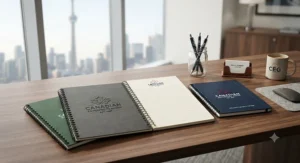
If you’ve searched “wirebound notebooks for office use” hoping for a straightforward shortlist, you’re in the right spot. We looked at seven real, currently sold notebooks spanning bargain bulk packs to executive-grade options, weighed their coil construction, paper weight, and organizational features, and pulled in aggregated review sentiment where it’s genuinely available. This isn’t a rewritten spec sheet. It’s a practical comparison built for people who actually have to sit down and take notes for a living — whether that’s running back-to-back meetings, sketching product ideas on a whiteboard-adjacent pad, or just trying to keep the sticky-note avalanche off their monitor. Canadian shoppers get metric sizing and CAD pricing context throughout, and if you want to pair your new notebook with a sharper note-taking method, the Cornell note-taking system is a genuinely useful starting template regardless of which notebook you pick.
By the end, you’ll know which of these seven notebooks fits your actual workflow, not just which one photographs well.
Quick Comparison Table: Wirebound Notebooks for Office Use at a Glance
| Notebook | Binding Style | Best For |
|---|---|---|
| Blueline NotePro Executive Notebook | Twin-wire, hard cover | Long-term meeting archives |
| Cambridge Limited Business Notebook | Wirebound, soft-touch cover | Structured meeting notes |
| Rocketbook Core Executive | Wirebound, synthetic pages | Digital-first offices |
| Rhodia Wirebound Notepad | Wirebound, coated card cover | Fountain pens & fine paper fans |
| Canson XL Series Sketchbook | Top wirebound | Sketching and visual planning |
| Oxford Coil Notebooks (12-Pack) | Coil-lock spiral | Bulk desk restocking |
| TOPS Coil Lock Wirebound Notebook | Coil-lock spiral | Everyday budget note-taking |
A few patterns jump out once you line these up side by side. The Blueline NotePro Executive Notebook and Cambridge Limited Business Notebook are both purpose-built for structured, dated note-taking rather than freeform writing, which is exactly why they dominate meeting-note organization conversations in office supply forums. On the other end, the Oxford Coil Notebooks (12-Pack) and TOPS Coil Lock Wirebound Notebook aren’t trying to be fancy — they’re the restock-the-supply-closet answer, and their coil-lock construction is specifically engineered to survive that kind of high-turnover, low-babying office life. The Rocketbook Core Executive is the outlier here: it looks and feels like a wirebound notebook, but it’s really a bridge product for teams half-committed to going paperless.
💬 Just one click — help others make better buying decisions too!😊
Top 7 Wirebound Notebooks for Office Use: Expert Analysis
1. Blueline NotePro Executive Notebook — hard cover twin-wire binding that lies fully flat
The standout here is the hard, lizard-textured cover paired with true twin-wire binding, which means the book folds all the way back on itself without the spine cracking the way a soft-cover spiral eventually does. Specs-wise, you’re looking at a 27.3 cm x 21.6 cm (10.75″ x 8.5″) page size, up to 300 ruled, micro-perforated sheets, a built-in index sheet, self-adhesive tabs, and an interior storage pocket — the kind of feature set that turns one notebook into a full year of archived meeting records instead of three notebooks you lose track of. Based on the spec comparison, this is the closest thing on this list to a proper executive daybook rather than a disposable pad. It’s a strong fit for managers, project leads, or anyone who needs one searchable, indexed record for months of meeting-note organization rather than a drawer of loose pads. Reviewers consistently report that the twin-wire binding holds up under daily office use for a year or more without pages tearing free, and several specifically flag the FSC-certified, acid-free paper as a reason they repurchase. A recurring caveat in user reviews: the paper weight isn’t published, and multiple reviewers estimate it around 80 gsm, which is fine for ballpoint and gel pens but not ideal for fountain pens prone to bleed-through.
Pros:
- ✅ Hard cover folds flat for stable one-handed writing
- ✅ Built-in index and adhesive tabs speed up filing
- ✅ FSC-certified, acid-free paper resists yellowing
Cons:
- ❌ Unpublished paper weight is a gamble for fountain pens
- ❌ Bulkier and heavier than a soft-cover alternative
At around C$18-C$24 depending on the page count you choose, this sits at the premium end of this list — but given it can realistically replace three or four smaller notebooks over a year, the cost-per-page math works out reasonably well for anyone serious about meeting-note organization.
2. Cambridge Limited Business Notebook — pre-printed meeting headers built into every page
What most buyers overlook about this model is that the value isn’t the notebook itself, it’s the pre-formatted page layout. Each sheet has designated header fields for date, time, meeting objective, and attendees, with the main body ruled for notes and a bottom strip formatted specifically for action items with checkboxes. The notebook measures roughly 21 cm x 28 cm (8-1/4″ x 11″) with 80 sheets (160 usable sides) and a soft-touch flexible cover. On paper, this means you’re not designing your own meeting-note template every time — the structure does the organizing for you, which matters more than it sounds like it should when you’re taking notes in a rushed 15-minute stand-up. This is a strong pick for coordinators, project managers, or anyone whose job is largely made of back-to-back meetings that need to be followed up on afterward. Because the pages are perforated, action items can be torn out and handed off without photocopying, which is a small but genuinely useful workflow shortcut for meeting-note organization in a hybrid office. Aggregated reviewer sentiment is largely centred on the layout itself — people repeatedly mention that having Date/Time/Objective fields pre-printed saves real time compared to a blank wirebound notebook, though a smaller number note the soft cover offers less support than a hard-cover option like the Blueline NotePro Executive Notebook above.
Pros:
- ✅ Pre-printed meeting fields cut setup time to zero
- ✅ Perforated pages allow clean action-item hand-offs
- ✅ Soft-touch cover keeps overall weight low
Cons:
- ❌ Less rigid than hard-cover business notebooks
- ❌ 80-sheet count means more frequent replacement
Priced in the C$9-C$13 range per notebook (often cheaper in multi-packs), it’s one of the more affordable ways to add real structure to meeting-note organization without paying executive-notebook prices.
3. Rocketbook Core Executive — reusable synthetic pages that scan straight to the cloud
The standout feature is right there in the name: this wirebound notebook is designed to be wiped clean and reused indefinitely rather than filled and shelved. It uses synthetic, wipeable pages bound with a wire coil, sized at roughly 15 cm x 22 cm (6″ x 8.8″), and it’s meant to be written in exclusively with Pilot FriXion pens, whose heat-sensitive ink can be erased with a damp cloth. Here’s what to weigh: the notebook pairs with a companion app that scans handwritten pages, applies simple OCR-based smart search, and routes each page to a chosen cloud folder (Google Drive, OneDrive, Dropbox, and similar), so your handwriting effectively becomes a searchable digital archive without retyping anything. For offices trying to cut down on physical storage or standardize note digitization across a team, that’s a genuinely different value proposition than any paper notebook on this list. What the spec sheet won’t tell you, but reviewers note, is that the synthetic page has a noticeably different feel than paper — a bit more resistance, slightly glossy — and it takes most users a few days to adjust. Reviewers are also consistent on one operational detail: ink needs about 15 seconds to bond to the page before it can be safely erased, and using a non-FriXion pen by accident means that page won’t wipe clean.
Pros:
- ✅ Pages wipe clean and reuse indefinitely
- ✅ App scans notes straight into existing cloud folders
- ✅ Reduces physical storage for archived meeting notes
Cons:
- ❌ Only works reliably with Pilot FriXion-brand pens
- ❌ Synthetic page texture takes adjustment for heavy writers
At roughly C$40-C$50 for the notebook plus the included pen and cloth, it’s the priciest single unit here, but the case for it is really about eliminating an ongoing habit of buying paper notebooks altogether.
4. Rhodia Wirebound Notepad — French-made 80g paper built for fountain pens and gel ink
The standout advantage is paper quality most office notebooks simply don’t compete on: a smooth, 80 gsm extra-white sheet manufactured in France specifically to resist feathering and bleed-through, wrapped in a coated card cover for durability. It’s available in A5 (14.8 cm x 21 cm) and A4 (21 cm x 29.7 cm) formats, dot-grid or lined, with double wire-binding that Rhodia markets specifically as snag-resistant compared to single-loop spirals. Based on the spec comparison, this is the pick if you write with anything beyond a basic ballpoint — rollerball, gel, or fountain pen users get noticeably cleaner lines and less show-through on the reverse side than they would on the paper used in most budget notebooks on this list, including the Oxford and TOPS options below. It’s the clearest fit among professional stationery brands for anyone whose notebook doubles as a client-facing object — think consultants, designers, or executives who take notes in front of people who notice paper quality. Reviewers consistently single out the paper smoothness and the micro-perforated tear-out pages as the reasons they stick with the brand despite the higher price point, though a recurring complaint is that the dot-grid version isn’t stocked as widely in Canadian retail, pushing most buyers toward ordering online.
Pros:
- ✅ 80g French paper resists bleed-through and feathering
- ✅ Double wire-binding resists snagging in bags
- ✅ Micro-perforated pages tear out cleanly
Cons:
- ❌ Premium price relative to page count
- ❌ Dot-grid format has spottier in-store availability
Expect to pay in the C$14-C$19 range for an A5 pad, positioning it as an affordable taste of high-end professional stationery brands rather than a full executive commitment.
5. Canson XL Series Sketchbook — heavyweight wirebound paper for sketching, not just writing
This is the one entry on this list built for a different job entirely, and the standout feature is paper weight: 74-96 gsm (50-65 lb) acid-free stock, in wirebound formats up to 23 cm x 30 cm (9″ x 12″), constructed with sturdy double-wire binding and a chip cover stiff enough to sketch against without a table underneath. Canson has manufactured art paper for over two centuries, and on paper that heritage translates into something concrete: the surface is designed to erase cleanly under graphite and hold up to layered pencil or charcoal work without pilling — something standard notebook paper does poorly. For an office context, this matters most for design teams, architects, UX researchers, or anyone whose “notes” are frequently rough diagrams, wireframes, or storyboards rather than sentences. If your role blurs into spiral notebooks for artists and sketching more than pure meeting minutes, a standard ruled notebook will frustrate you fast, and this is the realistic upgrade. Aggregated reviewer sentiment across Canson’s XL line is unusually consistent for a mass-market product: people repeatedly praise the paper’s erasability and the double-wire durability, with the most common criticism being that lighter-weight sheets (around 74 gsm) will show ghosting from markers or heavy ink, so buyers doing marker work should size up to the 160 gsm mixed-media variant instead.
Pros:
- ✅ Acid-free paper erases cleanly under pencil layers
- ✅ Double-wire binding withstands frequent flipping
- ✅ Stiff chip cover works as a portable drawing surface
Cons:
- ❌ Lighter sheets ghost through with marker or heavy ink
- ❌ Not ruled, so it’s a poor fit for dense text notes
Priced around C$16-C$22 for a full pad, it’s a reasonable add-on purchase for any office where visual thinking happens alongside written notes.

6. Oxford Coil Notebooks (12-Pack) — coil-lock construction built for bulk office restocking
The standout here isn’t any single notebook — it’s the pack. Twelve individual 1-subject, college-ruled notebooks at roughly 20 cm x 27 cm (8″ x 10.5″) with 70 sheets each, all using a coil-lock spiral that’s engineered to resist unwinding or catching on bag zippers and paperwork, a common failure point on cheaper spiral bindings. Each notebook is 3-hole punched, so pages can migrate into a binder system later, and the sheets are perforated for tear-out use. What most buyers overlook about a pack like this is that the real value proposition is procurement, not any individual notebook’s premium features: for an office manager restocking a shared supply cabinet or a team lead handing out notebooks to new hires, buying twelve at once solves a recurring desk supply essentials problem in a single order rather than a dozen separate small purchases. Here’s what to weigh: this isn’t the notebook you hand to your VP for board minutes, but it’s exactly the notebook you want on hand when someone needs one right now and the supply closet shouldn’t be empty. Reviewer sentiment aggregated across Oxford’s coil-lock line is heavily focused on the coil itself holding up over months of use without the classic spiral “unwinding at one end” problem, alongside consistent praise for the perforated tear-out edges leaving a clean line rather than the ragged edge some competitors leave behind.
Pros:
- ✅ Coil-lock spiral resists unwinding and snagging
- ✅ 3-hole punching allows binder migration later
- ✅ Bulk pack solves office restocking in one order
Cons:
- ❌ Bright colour-assortment covers can look inconsistent in a professional setting
- ❌ 70 sheets per book means more frequent turnover
At roughly C$28-C$38 for the full 12-pack, the per-notebook cost lands well below buying individually, which is exactly the point for anyone treating notebooks as a recurring desk supply essentials line item rather than a one-off purchase.
7. TOPS Coil Lock Wirebound Notebook — snag-resistant coil at genuine bargain pricing
The standout advantage is durability-per-dollar. This is a straightforward legal/wide-ruled notebook at roughly 27 cm x 20 cm (10.5″ x 8″), 70 sheets, using the same coil-lock philosophy as the Oxford pack above — a snag-resistant wire specifically designed not to catch on backpacks, papers, or clothing, which is the single most common complaint about cheap spiral notebooks generally. Reviewers consistently note that the coil doesn’t loosen or bend out of shape the way ultra-budget spiral notebooks often do within a few weeks of bag use, which is exactly the kind of heavy duty spiral notebooks category this product is built to serve. It’s a smart pick for anyone who just needs a reliable, no-frills notebook for daily desk use — jotting phone numbers, quick to-do lists, or scratch calculations — without paying for indexing systems or premium paper they’ll never use. TOPS has manufactured office paper products since the 1950s, and on paper that manufacturing scale shows up as consistency: sheet-to-sheet paper quality doesn’t vary the way it sometimes does with newer budget brands entering the notebook market. The trade-off, and it’s an honest one, is that this notebook makes no attempt at organization features — no index, no dated headers, no meeting-note structure — so it works best as a supplementary scratch notebook rather than your single system of record.
Pros:
- ✅ Coil-lock wire resists catching and unwinding
- ✅ Consistent paper quality from a long-running manufacturer
- ✅ Genuinely low price for daily-use durability
Cons:
- ❌ No organizational features like dating or indexing
- ❌ Wide/legal ruling only, limited format choice
At around C$6-C$9 per notebook, this is the cheapest genuinely durable option on this list, and it pairs well as a backup to a more structured notebook like the Cambridge Limited Business Notebook for anyone who needs both a system and a scratch pad.
Setting Up a Wirebound Notebook System for Everyday Office Use
Buying the right notebook is only half the job — how you set it up in the first week decides whether it actually gets used past month one. Start by dedicating the first two pages to a running index, even if your notebook (like the TOPS Coil Lock Wirebound Notebook or Oxford Coil Notebooks) doesn’t come with one pre-printed; just number your pages as you go and jot a one-line description of each section back on page one. Date every entry, even quick scratch notes — it costs three seconds and saves ten minutes of flipping back later trying to remember when a decision was made. If sustainable sourcing matters to your office’s purchasing policy, it’s worth glancing at how FSC forest certification works before you buy in bulk, since it’s a fast way to confirm a notebook’s paper actually meets a verified standard rather than just an “eco-friendly” label. A common first-30-days mistake is starting a new notebook for every project; instead, use one notebook per time period (weekly or monthly) and rely on the index to separate topics, which keeps meeting-note organization consistent even across unrelated projects. If you’re using a structured notebook like the Cambridge Limited Business Notebook, resist the urge to skip the header fields “because it’s obvious” — filling them in every single time is what makes the notebook searchable months later. For reusable notebooks like the Rocketbook Core Executive, set a weekly recurring reminder to actually scan and file pages before wiping them; the most common regret reviewers mention is forgetting to scan a page before erasing it. Finally, keep a spare notebook in your bag or desk drawer at all times — running out mid-meeting is a small but entirely avoidable failure.
Which Wirebound Notebook Fits Your Work Style? Three Real-World Scenarios
If you’re a project coordinator running four to six meetings a day across a hybrid team, the pre-printed headers on the Cambridge Limited Business Notebook will save you real time compared to formatting your own layout under time pressure, and its lower per-unit price means you can burn through several a year without the cost adding up. If you’re a UX designer or architect who sketches wireframes and rough layouts as often as you write sentences, a ruled office notebook will constantly frustrate you — the Canson XL Series Sketchbook‘s heavier paper and lack of ruling make it the more honest fit, even if it looks unconventional sitting on a boardroom table. And if you’re an operations manager trying to standardize note-taking across a 40-person office while cutting down on paper waste and storage boxes, the Rocketbook Core Executive solves a real logistics problem: everyone’s notes land in the same searchable cloud folder structure without a scanning policy anyone has to remember to follow manually. None of these are “better” notebooks in the abstract — they’re solving different problems, which is exactly why this list includes options across meeting-note organization, sketching, and daily desk supply essentials rather than one universal winner.
How to Choose Wirebound Notebooks for Office Use
Picking the right notebook comes down to answering a short list of questions before you buy, rather than judging by cover design alone.
- Decide what the notebook needs to survive. A notebook living in a bag needs a snag-resistant coil-lock spiral like the ones on the Oxford and TOPS picks; a desk-only notebook can use a lighter binding.
- Match paper weight to your pen. Fountain pens and gel ink need 80 gsm or heavier paper, like the Rhodia Wirebound Notepad, or you’ll fight bleed-through daily.
- Check whether you need built-in structure. If your notebook is mostly meeting notes, a pre-formatted layout like the Cambridge Limited Business Notebook‘s date/objective/action-item fields will save more time than a blank page ever will.
- Consider page count against replacement frequency. A 300-page hard-cover option lasts longer per purchase but costs more upfront than replacing a 70-sheet pad every few weeks.
- Decide if digitization matters to your team. If notes need to be searchable and shareable, a scan-friendly option like the Rocketbook Core Executive solves that natively instead of relying on someone photographing pages later.
- Factor in ruling type for your actual work. Lined for text, dot-grid for flexible layouts and light sketching, or unruled/heavier stock like the Canson XL Series Sketchbook for real drawing work.
- Buy in bulk if you’re provisioning a team. A 12-pack solves desk supply essentials for a shared office far more efficiently than repeat single purchases.
Common Mistakes When Buying Wirebound Notebooks for the Office
The most frequent mistake is buying based on cover aesthetics rather than coil quality, which is invisible in product photos but is exactly what determines whether the notebook survives six months of bag use without unwinding. A close second is ignoring paper weight entirely — plenty of buyers discover bleed-through only after they’ve already filled several pages with their usual pen. Another common misstep is choosing a single notebook to do every job: using one generic notebook for both dense meeting minutes and rough sketching usually means the ruling or paper weight is wrong for at least one of those uses, which is why this list separates meeting-note organization picks from spiral notebooks for artists and sketching picks rather than pretending one notebook does both well. People also frequently underestimate how much a built-in index or dated header saves over time, treating those features as unnecessary extras rather than the reason a notebook stays useful past the first few weeks. Finally, a subtler mistake: buying a reusable notebook like the Rocketbook Core Executive without checking pen compatibility first, then discovering standard pens won’t erase — a five-minute check that prevents a genuinely frustrating first week.
Notebooks vs. Bound and Composition Notebooks
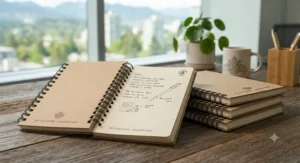
The core mechanical difference is simple: wirebound notebooks use a continuous coil through punched holes, letting pages rotate a full 360 degrees and fold flat against the back cover, while bound (perfect-bound or stitched) notebooks — including most composition books — are glued or sewn along the spine, which keeps them rigid but means they never lie fully flat and tend to bulge as you write through them. In practice, that difference matters most in meetings: a wirebound notebook like the Blueline NotePro Executive Notebook can be folded back to a single-page footprint on a crowded table, while a composition notebook needs both hands and roughly twice the surface area to stay open. Bound notebooks do have real advantages, though — they’re generally more resistant to accidental page tear-out, which matters for anything meant to be an unalterable record (some workplaces still require bound lab or incident notebooks for exactly this reason), and they avoid the specific failure mode of a bent or snagged coil. For general office note-taking, meeting-note organization, and anything you’ll be flipping through repeatedly, a wirebound notebook with a coil-lock design like the Oxford or TOPS picks above is the more practical daily-use choice; a bound notebook makes more sense only when tamper-resistance specifically matters to your role.
| Feature | Wirebound Notebook | Bound/Composition Notebook |
|---|---|---|
| Lies fully flat | Yes | No |
| Page rotation | 360 degrees | Limited |
| Tamper resistance | Lower | Higher |
| Bag durability | Depends on coil quality | Generally high |
| Best For | Meetings, sketching, daily use | Records requiring tamper resistance |
The table above makes the trade-off concrete: wirebound wins decisively on usability for anyone taking notes throughout the day, while bound notebooks only pull ahead in the narrow case where a permanent, unalterable record is a genuine workplace requirement rather than a nice-to-have.
✨ Ready to build your own notebook shortlist? Compare current prices on any of the seven picks above before you commit.
What to Expect: Real-World Performance in a Busy Office
Specs on a product page rarely capture what a notebook actually feels like on day 40 of daily use, so here’s the honest version. Coil-lock spirals on the Oxford and TOPS notebooks genuinely do resist the classic failure mode of loosening at one end after repeated bag transport — that’s not just marketing language, it’s the specific mechanical fix those brands built in response to years of the opposite complaint on cheaper spirals. Hard-cover options like the Blueline NotePro Executive Notebook feel noticeably more stable when writing standing up or balanced on a knee during a hallway conversation, which sounds minor until you’ve tried to write legibly on a soft-cover notebook with nothing underneath it. The Rocketbook Core Executive‘s synthetic pages take real adjustment — expect your handwriting to look slightly different for the first week as the pen glides differently than it does on paper. And premium paper like the Rhodia Wirebound Notepad‘s French-made stock is one of those upgrades you don’t notice you needed until you go back to a cheaper notebook and suddenly see every pen stroke feathering slightly at the edges.
Wirebound Notebooks for Meeting-Note Organization
Meeting-note organization is arguably the single biggest reason office workers reach for a wirebound notebook over a laptop in the first place — it’s faster to open, doesn’t create a visual barrier across the table, and doesn’t invite the temptation to check email mid-conversation. The two clearest picks for this specific job are the Cambridge Limited Business Notebook, with its pre-printed date/objective/attendee/action-item fields, and the Blueline NotePro Executive Notebook, whose built-in index and tab system turns months of scattered meetings into one searchable archive. The practical difference between them comes down to volume and permanence: choose the Cambridge option if you’re generating a lot of discrete, single-meeting records that get filed or discarded relatively quickly, and choose the Blueline option if you need one continuous, indexed record spanning many months that you’ll realistically go back and search through later. Either way, the core discipline that makes meeting-note organization actually work is consistency — using the same notebook, the same header format, and the same follow-up review habit every single time, rather than switching systems every few weeks looking for a perfect one that doesn’t exist.

Long-Term Cost & Maintenance of Office Wirebound Notebooks
Judging these purely on sticker price misses the real cost-per-use picture. A Blueline NotePro Executive Notebook at roughly C$18-C$24 for up to 300 pages works out to a lower cost per page than repeatedly buying 70-sheet notebooks like the TOPS Coil Lock Wirebound Notebook, even though the upfront price looks steeper. On the other end, the Oxford Coil Notebooks (12-Pack) wins decisively on bulk economics for an office provisioning multiple employees, since the per-unit cost drops well below buying individual notebooks one at a time. The Rocketbook Core Executive flips this calculation entirely: at C$40-C$50, it looks expensive next to any single paper notebook, but if it genuinely replaces four or five paper notebooks a year indefinitely, the multi-year math can favour it — provided your team actually maintains the scan-and-wipe habit consistently, which is the real variable, not the notebook itself. Maintenance-wise, coil-bound notebooks need almost none beyond keeping the coil away from crushing pressure in a bag (a laptop pressed directly against one is a common cause of bent wires), while the Rocketbook requires occasional cloth replacement and a commitment to the FriXion pen ecosystem specifically.
Features That Actually Matter (And Those That Don’t)
Coil-lock construction matters — it’s the single biggest predictor of whether a spiral notebook survives daily bag transport without unwinding, and it’s worth prioritizing over almost any cosmetic feature. Paper weight matters if you use anything beyond a basic ballpoint; below roughly 70 gsm, most pens will show at least some bleed-through on the reverse side. Built-in structure — dated headers, an index, action-item fields — matters enormously for meeting-note organization specifically, even though it looks like a minor convenience on a spec sheet. What doesn’t matter nearly as much as marketing suggests: cover material beyond basic durability (a laminated soft cover and a hard cover both protect pages fine; the difference is mostly about writing stability, not longevity), and page count alone, since a thinner notebook you actually finish and archive beats a thick one that sits half-used in a drawer. Colour and print design on the cover genuinely don’t affect function at all — they’re a personal preference call, not a purchasing criterion worth spending research time on. If sustainability is part of your office’s purchasing criteria, everyday FSC-certified stationery options are worth a quick look before you finalize a bulk order.
Sustainability and Paper Sourcing Standards for Office Notebooks
Paper sourcing has become a more visible purchasing factor for Canadian offices over the past few years, and it’s worth understanding briefly rather than treating it as a marketing checkbox. FSC certification exists to give buyers a traceable chain of custody back to responsibly managed forests, rather than relying on a vague “eco-friendly” claim with nothing behind it — which is why several notebooks on this list, including the Blueline NotePro Executive Notebook, specifically call out FSC-certified paper in their specs. Canada’s forestry and paper sector has a long institutional history behind these standards too — the industry body now known as the Forest Products Association of Canada traces back to 1913 under its original name, the Canadian Pulp and Paper Association, reflecting just how long paper sourcing practices have been an organized, regulated part of Canadian industry rather than a recent trend. For an office manager weighing sustainability alongside durability and price, checking for the FSC check-tree logo on a notebook’s packaging is a fast, reliable proxy — it doesn’t cost anything to look for, and it’s a genuinely meaningful signal rather than a vague “eco-friendly” label with no standard behind it.
Frequently Asked Questions
❓ What is the difference between spiral and wirebound notebooks?
❓ Are wirebound notebooks good for daily office note-taking?
❓ What size wirebound notebook is best for meetings?
❓ Can wirebound notebooks be recycled?
❓ Are Rocketbook reusable notebooks worth it for office use?
Conclusion
There’s no single best wirebound notebook for office use — there’s a best one for what you’re actually doing all day. If meeting-note organization is your main job, the Cambridge Limited Business Notebook or Blueline NotePro Executive Notebook will do more real work for you than any generic option. If your notes are as much visual as written, the Canson XL Series Sketchbook is the honest upgrade over forcing sketches into ruled lines. If your office is genuinely trying to cut paper waste and standardize digital archiving, the Rocketbook Core Executive solves a logistics problem no paper notebook can. And if you just need reliable, no-drama notebooks on hand for a team, the Oxford Coil Notebooks (12-Pack) and TOPS Coil Lock Wirebound Notebook cover that desk supply essentials base without overspending. Whichever direction fits your actual week, prioritize coil quality and paper weight over cover design — those two specs quietly decide whether a notebook survives past month one, and that survival, more than any single feature, is what makes a notebook worth buying in the first place.
Recommended for You
- 7 Best Spiral Notebooks For Students In Canada (2026 Picks)
- Premium Notebooks for Gifting: 7 Best Picks for 2026
- Notebooks for University Students: 7 Best Picks (2026)
Disclaimer: This article contains affiliate links. As an Amazon Associate, I earn from qualifying purchases. If you purchase products through these links, we may earn a small commission at no additional cost to you.
✨ Found this helpful? Share it with your friends! 💬🤗
