
In This Article
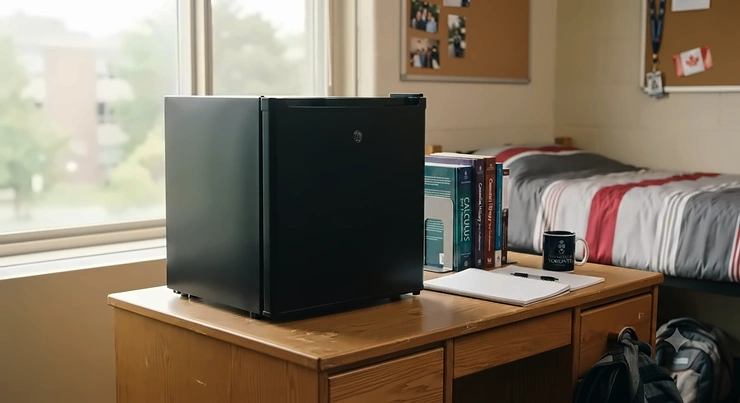
Move-in day has a way of humbling even the most organized student. You’ve got a bed frame to assemble, a closet the size of a phone booth, and a roommate who’s already claimed the good outlet. Somewhere on that packing list sits one appliance that quietly does more heavy lifting than almost anything else in the room: a mini fridge for dorm room living. It’s the difference between a 2 a.m. snack run down four flights of stairs and just reaching over from your desk chair.
But not all mini fridges are created equal, and residence policies, shared-room noise limits, and Canadian electricity rates all complicate what looks like a simple purchase. This guide walks through seven real, currently available models — spanning budget, mid-range, and premium — with honest analysis based on real specifications and aggregated reviewer sentiment (never fabricated testimonials). You’ll also get a practical framework for matching size, sound level, and energy draw to your actual dorm situation, because the “best” mini fridge for dorm room use isn’t the same for every student.
Quick Comparison Table: Mini Fridges at a Glance
| Fridge | Capacity | Freezer | Best For | Price Range (CAD) |
|---|---|---|---|---|
| Danby Designer | 3.1 cu. ft. | Small chiller box | Overall reliability | C$220-C$280 |
| Midea WHS-160C1 | 1.6 cu. ft. | None | Tiniest rooms | Under C$150 |
| BLACK+DECKER BCRK25V | 2.5 cu. ft. | Small chiller box | Quiet budget pick | C$180-C$230 |
| EUHOMY 3.2 Cu. Ft. | 3.2 cu. ft. | True separate freezer | Freezer on a budget | C$230-C$290 |
| Frigidaire EFR451 | 4.5 cu. ft. | Full-width freezer | Heavy users, meal prep | C$320-C$400 |
Even at a glance, the spread here matters more than it looks. The Midea WHS-160C1 wins on footprint alone, but it sacrifices any real frozen storage, while the Frigidaire EFR451 trades some desk-side portability for genuinely useful freezer space. If you’re choosing between the Danby Designer and BLACK+DECKER BCRK25V, the deciding factor usually comes down to whether you want Canadian-engineered brand history or a marginally quieter compressor — both are covered in more depth below.
💬 Just one click — help others make better buying decisions too!😊
What Is a Mini Fridge for a Dorm Room?
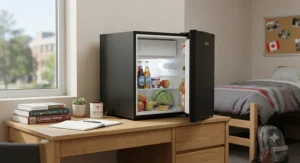
A mini fridge for dorm room use is a compact refrigerator, typically between 1.6 and 4.5 cubic feet, designed to fit under a desk or beside a bed while running on a standard household outlet. Unlike a full-size kitchen fridge, it prioritizes a small footprint, low noise, and modest power draw over storage volume — making it a practical fit for a compact fridge for small dorm rooms where every square foot of floor space is already spoken for.
Capacity is the first variable that matters, but it’s not the only one. Door style (single versus two-door with a real freezer), noise output measured in decibels, and whether the compressor cycles on and off audibly overnight all shape day-to-day livability far more than the spec sheet number most listings lead with. According to Natural Resources Canada, compact refrigerator-freezer models are formally classified as units under 219.5 litres (7.74 cu. ft.) with a height below 91.4 cm — which covers essentially every dorm-appropriate mini fridge on the market.
How to Choose a Mini Fridge for Dorm Room
- Check your residence’s size cap first. Before comparing features, confirm your school’s maximum cubic footage — this eliminates half the market instantly and prevents a costly return.
- Match capacity to your actual eating habits. A 1.6 cu. ft. fridge suits someone who eats mostly in the dining hall; a 4.5 cu. ft. model suits someone who meal-preps.
- Prioritize noise if you have a roommate. A compressor that cycles loudly at 2 a.m. becomes a relationship problem fast, not just an appliance quirk.
- Look for a genuine freezer compartment if you want frozen food. Many “freezer” flaps barely chill, let alone freeze — check reviewer sentiment, not just the spec sheet.
- Confirm the reversible door hinge. Dorm layouts are unpredictable, and a door that only opens one way can block your desk chair or closet.
- Weigh Energy Star certification against sticker price. The upfront premium is usually small and pays back over an eight-month school year.
- Read the aggregated reviewer sentiment on defrosting and leaks. Chronic condensation pooling is one of the most common real-world complaints across budget models.
Top 7 Mini Fridges for Dorm Rooms: Expert Analysis
Here’s the detailed breakdown of seven real models worth your consideration, drawn from manufacturer specifications and aggregated customer-review themes rather than any single retailer’s marketing copy.
| # | Product | Capacity | Noise (approx.) | Energy Star | Best For |
|---|---|---|---|---|---|
| 1 | Danby Designer | 3.1 cu. ft. | Low-moderate | Yes | All-around dorm use |
| 2 | Midea WHS-160C1 | 1.6 cu. ft. | Low | Yes | Smallest rooms |
| 3 | BLACK+DECKER BCRK25V | 2.5 cu. ft. | Low | Yes | Quiet shared spaces |
| 4 | EUHOMY 3.2 Cu. Ft. | 3.2 cu. ft. | Moderate | Yes | Real freezer storage |
| 5 | Frigidaire EFR451 | 4.5 cu. ft. | Moderate | Yes | Heavy users |
| 6 | Magic Chef Retro | 3.1 cu. ft. | Low-moderate | Yes | Style-conscious students |
| 7 | Galanz 4.3 Cu. Ft. | 4.3 cu. ft. | Moderate | Yes | Budget-premium hybrid |
Looking at the table, the two-door models — the EUHOMY, Frigidaire EFR451, and Galanz — consistently trade a slightly larger footprint for meaningfully better frozen storage, which matters if your meal plan doesn’t cover every night of the week. Single-door units like the Midea WHS-160C1 and Danby Designer claw back desk space and tend to run marginally quieter, since they house fewer moving parts. Budget shouldn’t be the only lens here: the BLACK+DECKER BCRK25V undercuts the Galanz by roughly C$100 while still hitting Energy Star efficiency, which matters more over a two- or four-year degree than it might seem in September.
1. Danby Designer — Canadian-engineered reliability for everyday dorm use
The standout here is brand pedigree: Danby is headquartered in Guelph, Ontario, and has built compact refrigeration for the Canadian market for decades. At 3.1 cu. ft., this model splits the difference between too-small and too-bulky, with a wire shelf, a door bin sized for tall bottles, and a small chiller box rather than a true freezer.
Based on the spec comparison, the reversible door hinge and adjustable thermostat are the features that matter most in a shared room — they let you orient the fridge around whatever layout you’re handed. Reviewers consistently report solid temperature consistency and a compressor hum that fades into background noise within a few nights, which matters enormously in a roommate situation. What most buyers overlook is that Danby’s after-sales support network is genuinely easier to reach from a Canadian address than most import brands.
Pros:
- ✅ Canadian company with established local support
- ✅ Reversible door suits unpredictable dorm layouts
- ✅ Consistently praised temperature stability in reviews
Cons:
- ❌ No true separate freezer, just a small chiller box
- ❌ Slightly pricier than comparable single-door imports
At around C$220-C$280, the Danby Designer lands solidly as a value pick for students who want dependable everyday cooling without chasing the lowest sticker price.
2. Midea WHS-160C1 — smallest footprint for the tightest dorm rooms
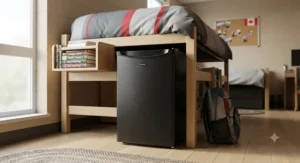
The standout feature here is sheer minimalism: at 1.6 cu. ft., this is one of the smallest fridges that still counts as genuinely useful rather than novelty-sized. It tucks under a lofted bed or a standard dorm desk without eating into already-scarce floor space.
The mechanical thermostat offers seven settings, and the reversible door means it adapts to whichever corner you’re assigned. On paper this means less storage than a two-door model, but in practice it comfortably fits a case of drinks, a few days of leftovers, and dairy — plenty for a student who eats most meals in a dining hall. Reviewers consistently note that this is one of the quieter compressors in its size class, and it’s a frequent best-seller precisely because it solves the “I just need somewhere cold” problem without commitment.
Pros:
- ✅ Fits in the tightest dorm corners available
- ✅ Reversible door for flexible placement
- ✅ Frequently praised as unusually quiet for its size
Cons:
- ❌ No freezer compartment at all
- ❌ Limited to light, dining-hall-supplementing use
Priced under C$150, the Midea WHS-160C1 is the clear budget-and-space champion for a compact fridge for small dorm rooms where inches matter more than capacity.
3. BLACK+DECKER BCRK25V — the quiet-running budget pick
The standout advantage is noise discipline: this 2.5 cu. ft. model is frequently singled out in aggregated reviews as one of the calmer-running compressors at this price point, which is the single biggest factor in shared-room satisfaction.
The small chiller compartment handles ice cubes and short-term frozen snacks without pretending to be a real freezer, while the mechanical thermostat and reversible door keep the fixed-cost list simple. What the spec sheet won’t tell you, but user reports suggest, is that this model’s compressor cycles in shorter, gentler bursts rather than one long grinding run — the kind of detail that shows up in real dorm life far more than raw capacity numbers do. Here’s what to weigh: it’s not the roomiest option on this list, but for a light user prioritizing sleep quality over storage, that trade-off is worth making.
Pros:
- ✅ Reputation for unusually quiet compressor cycling
- ✅ Reversible door for tight or awkward layouts
- ✅ Straightforward mechanical thermostat, few failure points
Cons:
- ❌ Chiller box isn’t a genuine freezer
- ❌ 2.5 cu. ft. feels tight for two roommates sharing
Sitting around C$180-C$230, the BLACK+DECKER BCRK25V is arguably the smartest pick for anyone prioritizing a quiet mini fridge for shared dorm spaces above all else.
4. EUHOMY 3.2 Cu. Ft. — a genuine freezer without the premium price tag
The standout here is the two-door design with an actual separated freezer compartment — not a chiller flap — capable of freezing ice cream solid rather than just chilling it, which is rare at this price tier.
Adjustable glass shelves and a crisper-style bottom bin add flexibility for produce and takeout containers alike, and the mechanical thermostat controls fridge and freezer independently. Based on the spec comparison, this is the model that most closely mimics a real kitchen fridge in miniature. Reviewers consistently report that the freezer genuinely holds items at a hard-frozen temperature, a common complaint about cheaper single-compartment units this model specifically avoids. The trade-off is a slightly larger footprint and a compressor that runs a touch more frequently to maintain two separate zones.
Pros:
- ✅ Real independent freezer that actually freezes
- ✅ Adjustable glass shelving for flexible storage
- ✅ Strong reviewer consensus on temperature accuracy
Cons:
- ❌ Runs its compressor more often than single-door models
- ❌ Larger footprint needs more desk or floor clearance
At roughly C$230-C$290, the EUHOMY 3.2 Cu. Ft. delivers outsized value for students who genuinely want frozen meal storage without stretching into premium pricing.
5. Frigidaire EFR451 — best large-capacity option for heavy users
The standout feature is sheer volume: at 4.5 cu. ft., this two-door model comfortably handles a week of groceries, multiple frozen meals, and drinks for two people sharing a room, making it the largest practical option on this list.
The full-width top freezer section is proportioned like a genuine compartment rather than an afterthought, and the fridge section includes door bins tall enough for 2-litre bottles. Reviewers consistently note that this model performs closer to a genuine apartment-sized fridge than a dorm accessory, which is exactly the audience it serves best — students in suite-style residences or off-campus shared houses rather than a single traditional dorm room. What most buyers overlook is that a fridge this size draws meaningfully more power over a school year, a trade-off worth running the numbers on before buying.
Pros:
- ✅ Largest realistic capacity for two roommates
- ✅ Full-size top freezer, not a small flap
- ✅ Door bins fit tall bottles and cartons
Cons:
- ❌ Height may exceed some residences’ size restrictions
- ❌ Highest energy draw of the group tested here
Priced around C$320-C$400, the Frigidaire EFR451 is the pick for heavy users willing to check residence size limits carefully before ordering.
6. Magic Chef Retro — best for students who want their fridge to have personality
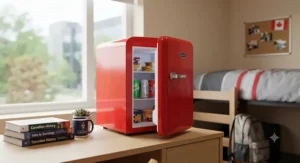
The standout feature is unapologetic style: the rounded 1950s-inspired shell and chrome latch handle turn a purely functional appliance into a room centrepiece, available in colours well beyond standard black or white.
Underneath the retro shell sits a genuinely modern 3.1 cu. ft. interior with two glass shelves, a produce bin, and a soda-can dispensing rack built into the door — a small but clever use of vertical space. Reviewers consistently report that despite the vintage look, temperature control performs in line with more conventionally styled competitors, and Energy Star certification means the throwback design isn’t costing efficiency. Here’s what to weigh: the rounded shape sacrifices a small amount of usable interior volume compared to a boxier competitor of the same rated capacity.
Pros:
- ✅ Distinctive retro design in multiple colourways
- ✅ Built-in can dispenser is a genuinely useful touch
- ✅ Energy Star certified despite the vintage styling
Cons:
- ❌ Rounded shape trims some usable interior space
- ❌ Premium look carries a modest price premium
At around C$260-C$330, the Magic Chef Retro suits students who want their mini fridge for dorm room decor to double as a design statement.
7. Galanz 4.3 Cu. Ft. — the lesser-known budget-premium hybrid
The standout advantage is value density: at 4.3 cu. ft., this two-door model sits just under the Frigidaire EFR451‘s capacity while typically pricing noticeably lower, making it the sleeper pick for students who did their homework.
Adjustable glass shelves, leveling feet for uneven dorm flooring, and a reversible door round out a feature set that punches above its price tier. Based on the spec comparison, Galanz has quietly built a reputation among compact-appliance reviewers as a manufacturer that prioritizes function over brand recognition, and aggregated sentiment reflects that — buyers frequently comment on the fridge outperforming its price point rather than merely meeting expectations. The one honest caveat: as a less internationally recognized brand, its long-term parts and warranty support can be less predictable than a household name.
Pros:
- ✅ Near-Frigidaire capacity at a noticeably lower price
- ✅ Leveling feet help with uneven residence flooring
- ✅ Reviewer sentiment often calls out value-for-money
Cons:
- ❌ Less brand recognition than major competitors
- ❌ Warranty support can be less consistent
At roughly C$250-C$310, the Galanz 4.3 Cu. Ft. is the pick for students who want Frigidaire-adjacent capacity without the full premium price tag.
Mini Fridges vs Traditional Dorm Storage Alternatives
| Factor | Mini Fridge | Dining Hall Only | Shared Kitchen Fridge |
|---|---|---|---|
| Access | 24/7, in-room | Fixed hours | Shared, unreliable space |
| Food safety | Full control | N/A | Frequent theft/spoilage risk |
| Cost over school year | One-time C$150-C$400 | Meal plan cost | Free but unreliable |
| Best For | Privacy and convenience | Students with full meal plans | Backup, not primary storage |
The comparison makes the case plainly: a dining hall covers hot meals but does nothing for a 10 p.m. study-session snack, and a shared kitchen fridge in a communal residence area is notorious for mislabelled or vanished food. A mini fridge for dorm room use essentially buys back convenience and food security in exchange for a modest one-time cost and a small amount of floor space — which is why residence advisors so rarely discourage the purchase outright.
Compact Fridge for Small Dorm Rooms and Dorm Room Size Restrictions
If your room is genuinely tiny, the compact fridge for small dorm rooms category — generally 1.6 to 2.5 cu. ft. — solves a footprint problem the larger models simply can’t. These units are designed to slot under a desk or beside a dresser without eating into walking space, and the trade-off in capacity is usually worth it if you’re not doing serious meal prep.
Dorm room size restrictions vary significantly by school, and Canadian residences are no exception. UBC Vancouver Housing permits mini fridges up to roughly 0.14 cubic metres (about 5 cubic feet), while Brock University’s residence policy caps personal refrigerators at 5 cubic feet with no separate freezer compartment allowed in certain buildings. That single detail — freezer or no freezer — can eliminate several models on this list depending on where you’re living, so always confirm your specific residence’s community standards document before ordering rather than assuming a general “dorm-friendly” label applies.
Quiet Mini Fridge for Shared Dorm Spaces: Noise Levels in Shared Rooms
A quiet mini fridge for shared dorm spaces isn’t a luxury preference — it’s a practical necessity when you’re sleeping eight feet from a compressor that cycles on and off all night. Noise level in shared rooms compounds in ways it wouldn’t in a private bedroom: a hum you’d never notice alone becomes a source of roommate tension within the first week.
Most compact fridges run somewhere in the 40-45 decibel range during active cooling cycles, roughly comparable to a quiet conversation or a running dishwasher heard through a wall. What most buyers overlook is that peak noise usually isn’t the steady hum — it’s the click and vibration when the compressor kicks on, which can startle a light sleeper more than the ambient sound itself. Reviewers consistently flag this start-up click as the real dealbreaker on lower-quality models, more than the sustained running volume. Placing the fridge on a stable, level surface (rather than directly on carpet or an uneven shelf) meaningfully reduces vibration-transmitted noise, often more than the model choice itself does.
Energy-Efficient Dorm Fridge for Students: Energy Consumption and Running Costs
An energy-efficient dorm fridge for students isn’t just an environmental checkbox — it’s a real line item, even when the residence bundles utilities into housing fees, because some newer buildings now sub-meter high-draw appliances separately. Energy consumption for a compact fridge typically runs between 200 and 400 kilowatt-hours annually depending on size and Energy Star status, which Natural Resources Canada notes can be roughly 9% lower for certified models compared to standard units.
Over an eight-month school year, that gap between a certified and non-certified model amounts to real, if modest, savings — usually somewhere in the C$5-C$15 range depending on local electricity rates, which vary considerably across provinces. What the spec sheet won’t tell you, but the underlying math shows, is that a larger two-door fridge like the Frigidaire EFR451 will always draw more than a compact single-door model like the Midea WHS-160C1, so “energy-efficient” and “large capacity” pull in slightly opposite directions. Reviewers rarely mention electricity cost directly, which is exactly why it’s worth calculating yourself rather than assuming Energy Star certification alone tells the whole story.
Common Mistakes When Buying a Mini Fridge for Dorm Room
Students shopping under move-in deadline pressure tend to repeat the same handful of errors, and most are easy to avoid with a little foresight.
- Ordering before checking the residence’s published cubic-foot cap, then scrambling to return an oversized unit during the busiest shipping week of the year.
- Assuming “compact” automatically means “quiet” — the two aren’t correlated, and some of the smallest units run louder than mid-sized ones.
- Skipping the freezer question entirely, then discovering the “freezer” flap barely holds an ice tray, let alone frozen meals.
- Ignoring door-swing clearance, which matters enormously in a room where the fridge sits wedged between a desk and a closet.
- Buying based on price alone and missing Energy Star certification, which usually costs little more upfront and pays back over the year.
Setting Up and Maintaining Your Dorm Mini Fridge
Getting a mini fridge running well in a dorm room takes more than plugging it in, and a few first-month habits determine whether it runs quietly and efficiently for the next four years or becomes a recurring headache.
First 48 hours: Let the fridge stand upright for at least a few hours before powering it on if it was transported on its side — compressor oil needs time to settle, and skipping this step is a common cause of early compressor failure. Confirm the unit carries a recognized CSA, cUL, or ETL safety mark before plugging in; Health Canada notes that electrical products sold in Canada must meet national safety standards and display an accredited certification mark.
Placement: Leave a few centimetres of clearance on all sides for airflow, and avoid tucking it directly against a heat-generating laptop charger or under direct sunlight from a window — both force the compressor to work harder than necessary.
Ongoing maintenance: Wipe down interior shelves monthly, check the door seal for a tight closure by testing whether a piece of paper holds firm when the door shuts on it, and defrost any chiller-box ice buildup before it interferes with airflow. Common first-month mistakes include overpacking shelves (which blocks internal air circulation) and setting the thermostat to maximum cold out of impatience, which often just wastes energy without noticeably faster cooling.
Real-World Scenarios: Matching the Right Fridge to Your Dorm Life
The commuter-adjacent single room: A first-year student with a small single room and a full meal plan mostly needs cold drinks and the occasional yogurt. The Midea WHS-160C1 or BLACK+DECKER BCRK25V covers this without eating precious floor space, and both stay well under most published size restrictions.
The double room with a night-owl roommate: Two students sharing tight quarters need to prioritize noise level in shared rooms above almost every other factor. The BLACK+DECKER BCRK25V or Danby Designer, both flagged in reviews for calmer compressor cycling, minimize the risk of 2 a.m. tension.
The self-cook, budget-conscious upper-year student: Someone off the meal plan and cooking regularly needs genuine freezer space for batch-prepped meals. The EUHOMY 3.2 Cu. Ft. or Galanz 4.3 Cu. Ft. both deliver real frozen storage without the premium pricing of the largest model on this list.
Buyer’s Decision Framework: Which Mini Fridge Fits Your Dorm?
If your room is under 120 square feet, choose a sub-2 cu. ft. model like the Midea WHS-160C1, because floor space will outweigh storage capacity every time. If your top priority is sleep quality with a roommate present, choose the BLACK+DECKER BCRK25V or Danby Designer, since both show consistently favourable noise sentiment in reviews. If you’re off the meal plan and cooking regularly, choose the EUHOMY or Galanz for genuine freezer storage at a moderate price. If you’re in a suite-style residence with more square footage and no strict freezer restriction, the Frigidaire EFR451 offers the most usable capacity. And if personality matters as much as function, the Magic Chef Retro is the only model here designed to double as room decor.
Price Range and Value Analysis
| Fridge | Price Range (CAD) | Value Verdict |
|---|---|---|
| Midea WHS-160C1 | Under C$150 | Best entry price for tiny rooms |
| BLACK+DECKER BCRK25V | C$180-C$230 | Best noise-to-price ratio |
| Danby Designer | C$220-C$280 | Best overall reliability |
| EUHOMY 3.2 Cu. Ft. | C$230-C$290 | Best freezer-per-dollar |
| Galanz 4.3 Cu. Ft. | C$250-C$310 | Best capacity-per-dollar |
| Magic Chef Retro | C$260-C$330 | Best style premium justified |
| Frigidaire EFR451 | C$320-C$400 | Best for heavy, shared use |
Read as a whole, the table shows a fairly linear relationship between price and capacity, with two notable exceptions: the BLACK+DECKER BCRK25V delivers noise performance well above its price tier, and the Galanz delivers capacity well above its price tier. For most first-year students, the sweet spot sits in the C$220-C$290 range, where the Danby Designer and EUHOMY both live — enough capacity for genuine independence from the dining hall without paying a premium reserved for shared-suite living.

Frequently Asked Questions
❓ What size mini fridge for dorm room is typically allowed?
❓ Do mini fridges need to be unplugged over school breaks?
❓ How loud is too loud for a shared dorm room fridge?
❓ Can a compact fridge for small dorm rooms actually freeze food solid?
❓ Is an energy-efficient dorm fridge for students worth the extra cost?
Conclusion
Choosing a mini fridge for dorm room life ultimately comes down to three honest trade-offs: floor space versus capacity, noise versus features, and upfront price versus running cost. None of the seven models covered here is objectively “best” in isolation — the Midea WHS-160C1 wins on footprint, the BLACK+DECKER BCRK25V wins on noise, the EUHOMY wins on freezer value, and the Frigidaire EFR451 wins on raw capacity, while the Danby Designer and Galanz occupy the strongest all-around middle ground.
What matters most is checking your residence’s specific size and freezer restrictions before you fall in love with a model online, since even the best fridge on this list is the wrong choice if it gets flagged during a room inspection. Match capacity to how you actually eat, weight noise heavily if you’re sharing a room, and treat Energy Star certification as a small but genuine long-term saving rather than a marketing sticker. Get that matching right, and a mini fridge quietly becomes one of the most-used, least-thought-about purchases of the entire school year — which is exactly the point.
✨ Don’t Miss These Exclusive Deals!
🔍 Take your dorm room setup to the next level with these carefully selected mini fridges. Click on any highlighted model above to check current pricing and availability, and turn a bare residence room into a genuinely livable space you’ll actually enjoy coming back to.
Recommended for You
- 7 Best Noise-Cancelling Headphones for University Library Study (2026)
- 7 Best Desk Lamps for Dorm Room Study in 2026 (Guide)
- 7 Best Laptop Stand for University Students Picks (2026 Guide)
Disclaimer: This article contains affiliate links. As an Amazon Associate, I earn from qualifying purchases. If you purchase products through these links, we may earn a small commission at no additional cost to you.
✨ Found this helpful? Share it with your friends! 💬🤗
