
In This Article
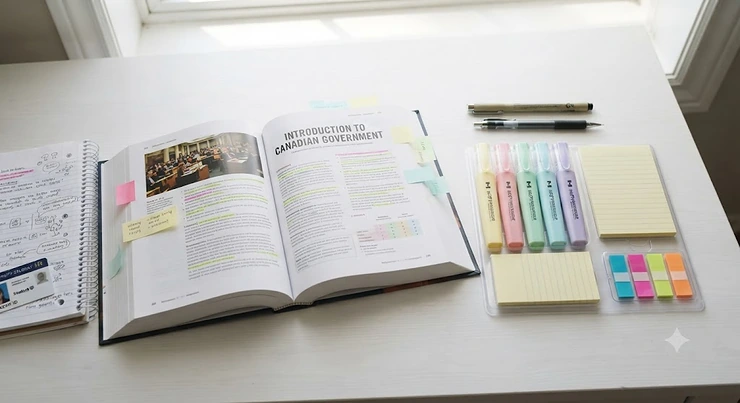
Somewhere between your third cup of coffee and your fourth chapter of readings, you’ll notice the problem: your textbook is a wall of black text, your brain is fried, and nothing on the page is telling you what actually matters for the exam. That’s the real job of a textbook highlighter and sticky note set for university — not decoration, not aesthetics, but triage. A good set lets you sort “core concept,” “definition to memorize,” and “probably on the midterm” at a glance, months before you’d otherwise have to re-read the whole chapter to figure that out again.

Canadian students have a specific version of this problem. Textbooks here are expensive — some engineering and science texts run well past C$200 — and a lot of students plan to resell them at the end of term, which means whatever you use to mark up the pages needs to come off cleanly or, ideally, never touch the paper at all. Add in thin, glossy textbook stock that makes cheap liquid ink bleed straight through to the next page, and “just grab whatever highlighter is in the junk drawer” stops being good enough.
This guide breaks down seven real, currently available highlighter and sticky note products you can find on amazon.ca, compares them head-to-head, and walks through the study systems — colour-coding, tabbing, exam review — that actually make these tools worth buying in the first place. Every recommendation here is grounded in real specs and real aggregated review sentiment, not invented testimonials, so you can judge for yourself what fits your program, your budget, and how brutally you plan to mark up your books.
Quick Comparison Table
| Product | Type | Bleed-Resistant? | Best For | Price Range |
|---|---|---|---|---|
| Mr. Pen No Bleed Gel Highlighters | Gel highlighter, 8-pack | Yes | Thin textbook pages on a budget | Under C$15 |
| Zebra Mildliner Dual-Tip Set | Dual-tip highlighter | Mostly | Colour-coded note systems | C$15-C$30 |
| STABILO BOSS ORIGINAL Pastel | Wedge-tip highlighter | Yes | Long study sessions, low eye strain | C$15-C$25 |
| Sharpie Tank Highlighters | Chisel-tip highlighter, 12-pack | No | Bold, high-visibility marks | Under C$15 |
| Post-it Flags 683-5CF | Sticky tabs, 5 colours | N/A | Chapter and section tabbing | Under C$10 |
| Post-it Super Sticky Notes Collection | Sticky notes, multi-pack | N/A | Margin notes and exam review | C$10-C$20 |
| Mr. Pen Colorful Sticky Tabs (1600 pcs) | Sticky tabs, 30 colours | N/A | Heavy annotators, multi-course use | C$10-C$20 |
Looking at the table, there’s a clear split between products meant to sit directly on the page (the four highlighters) and products meant to sit on top of it without ever touching the ink (the tabs and sticky notes). If textbook resale value matters to you, that split matters more than any colour or price point — the tab-and-note half of this list carries zero bleed risk because nothing ever touches the printed page directly. The Mr. Pen No Bleed Gel Highlighters and STABILO BOSS ORIGINAL Pastel stand out as the safest highlighters for resale-conscious students, while the Sharpie Tank Highlighters trade that safety for maximum visibility on scrap paper, printed handouts, and books you already own outright.
💬 Just one click — help others make better buying decisions too!😊
Top 7 Textbook Highlighter and Sticky Note Products: Expert Analysis
1. Mr. Pen No Bleed Gel Highlighters — budget-friendly and safest for thin pages
The standout feature here is right in the name: this is a gel stick, not a liquid ink pen, and that construction is what keeps it off the back of the page. In practice, a gel highlighter applies pigment as a semi-solid layer that sits on top of the fibres rather than soaking into them, which is exactly why gel and pastel formulas are the go-to recommendation for thin, glossy textbook stock and Bible-paper-thin printouts alike. The 8-pack comes in a mix of muted, low-glare tones rather than neon, which matters more than it sounds like it should when you’re staring at the same page for the fortieth minute of a study session.
Based on the spec comparison with liquid highlighters, the trade-off is application speed — gel sticks need a firmer, slower stroke than a felt-tip pen, so covering a full paragraph takes a beat longer. That’s a fair exchange for a student who has already ruined one textbook page with bleed-through and doesn’t want a repeat. Reviewers consistently report that the gel format resists both bleeding and smearing even on lower-quality paper, and that the twist-up mechanism means no dried-out caps left off overnight in a dorm room. This is the pick for first-year students building a highlighter kit from scratch who don’t yet know how heavily they’ll mark up their books.
Pros:
- ✅ Gel format resists bleed-through on thin textbook paper
- ✅ Muted colour palette reduces eye strain during long sessions
- ✅ No cap-drying issues thanks to the twist-up gel stick design
Cons:
- ❌ Slower to apply across full lines than liquid ink
- ❌ Fewer colours per pack than dedicated colour-coding sets
Sitting in the under-C$15 range at the time of research, this is one of the cheapest ways to get genuinely bleed-safe coverage, making it a strong value pick for students buying highlighters for the very first time.

2. Zebra Mildliner Dual-Tip Set — best for building a colour-coded study system
What immediately sets this one apart is the dual-tip design: a broad chisel tip on one end for blocking out whole sentences, and a fine bullet tip on the other for underlining, circling terms, or annotating in cramped margins. That single-pen, two-jobs structure is exactly what a serious colour-coded study system needs, because you’re not fumbling between a highlighter and a separate fine-liner every time you want to jot a note next to a highlighted line.
The Mildliner’s water-based dye ink is formulated to be softer and less saturated than a standard neon highlighter, which is the whole point of the “mild” branding — it’s built specifically so layered colours and underlying pen or pencil notes stay legible instead of getting blown out by oversaturated ink. What most buyers overlook about this set is that the muted palette isn’t just an aesthetic choice; it’s what lets you use five or six different colours on the same page without the whole thing turning into visual noise. Reviewers frequently note that the trade-off is bleed resistance: on genuinely thin paper, the broad tip can ghost through, so it performs best on standard-weight textbook stock rather than the thinnest paperback pages.
Pros:
- ✅ Dual tips cover both broad highlighting and fine annotation
- ✅ Muted ink tones make five-plus-colour systems easy to read
- ✅ Wide colour range supports subject-by-subject colour coding
Cons:
- ❌ Broad tip can bleed through very thin paper
- ❌ Premium pricing compared to single-tip highlighter packs
Expect to pay in the C$15-C$30 range depending on set size, and for students building out a full colour-coded system across four or five courses, that up-front cost buys a genuinely versatile everyday tool.
3. STABILO BOSS ORIGINAL Pastel — best for marathon study sessions
The wedge-shaped tip is the signature feature of the original BOSS design, and it’s built to lie flat against the page no matter which way you angle the pen, so you get a consistent highlight width whether you’re going for a thin underline or a full-width block. On paper, that translates to fewer streaky, uneven highlights than you’ll get from a standard angled chisel tip, especially once you’re forty pages deep into a reading and your hand grip has gone sloppy.
Here’s what the spec sheet won’t tell you, but user reports suggest: the anti-dry-out cap technology, which keeps the tip usable for hours even if you forget to put the cap back on between classes, is the feature long-time users mention most often when they explain why they keep repurchasing this exact highlighter. The Pastel line trades the brand’s classic neon yellow-orange-green-pink lineup for softer, lower-contrast tones, which — much like the Mildliner — is specifically aimed at students who highlight heavily and don’t want their pages to look like a rave by week six of term. Aggregated reviewer sentiment consistently flags the ink as reliably bleed-resistant on standard textbook paper, though a handful of users note it’s not rated for genuinely tissue-thin stock.
Pros:
- ✅ Wedge tip stays consistent at any highlighting angle
- ✅ Cap-off dry protection survives hours without a lid
- ✅ Pastel tones stay legible even with heavy layering
Cons:
- ❌ Costs more per unit than basic chisel-tip highlighters
- ❌ Not recommended for the very thinnest paper stock
At C$15-C$25 depending on pack size, this sits mid-range, and it earns that price with a reliability record that specifically addresses the two biggest highlighter complaints: drying out and streaking.
4. Sharpie Tank Highlighters — best for bold, high-visibility marking
The Tank’s defining trait is sheer pigment saturation — this is a fluorescent chisel-tip highlighter built to be seen from across a desk, not to blend quietly into a colour-coded system. The wide, sturdy chisel tip covers a full line of text in a single confident stroke, which makes it fast to use when you’re highlighting under exam-week time pressure and don’t want to fuss over precision.
Based on the spec comparison with the gel and pastel picks above, the honest trade-off is bleed resistance: this is a standard liquid ink formula, and reviewers consistently flag that it’s better suited to notebooks, printed handouts, and personal-copy books than to thin, glossy textbook pages you plan to sell back. What most buyers overlook is that this makes the Tank less a “textbook highlighter” and more a general-purpose study and office highlighter that happens to work fine on sturdier textbook paper. For students who own their books outright — say, in a program with custom course packs rather than resalable texts — that trade-off barely matters, and the brightness and 12-colour assortment become a genuine advantage for fast, high-contrast marking.
Pros:
- ✅ Bold, highly visible fluorescent colours
- ✅ Wide chisel tip covers full lines in one stroke
- ✅ 12-count assortment covers most colour-coding needs
Cons:
- ❌ Higher bleed-through risk on thin textbook paper
- ❌ Neon tones can strain eyes over long sessions
Priced under C$15 for the full assortment, it’s one of the cheapest ways to get a dozen genuinely distinct colours, provided your paper can handle the ink.
5. Post-it Flags 683-5CF — best sticky tabs for textbook studying without touching the page
This set’s standout feature is its five-colour, two-dispenser format, which is specifically built for splitting flags across colour categories — one colour per chapter, per theme, or per priority level — right out of the box. Because these are adhesive flags rather than ink, the entire “will this damage my textbook” question disappears: nothing here touches the printed page except a strip of low-tack adhesive along one edge.
Practically speaking, that makes this the safest possible tool for textbook resale value preservation. Aggregated review sentiment on Post-it’s flag and tab line consistently highlights that the adhesive removes cleanly without tearing paper or leaving residue, even after weeks stuck to the same page — a claim that matters enormously if you’re planning to sell the book back at term’s end. Reviewers also note the flags are writable, so you can jot a two-word label (“key formula,” “midterm”) directly on the tab itself, turning a simple page marker into a miniature index. The trade-off, honestly, is quantity: at 200 total flags across five colours, heavy annotators working through a dense semester of readings may burn through a set faster than expected.
Pros:
- ✅ Adhesive removes cleanly with zero page damage
- ✅ Five colours built in for instant category coding
- ✅ Writable surface doubles as a mini page index
Cons:
- ❌ 200 flags can run out fast across multiple courses
- ❌ Narrow width limits how much you can write per tab
At under C$10 at the time of research, this is one of the lowest-cost, highest-value additions to any student’s study kit — and arguably the single best tool on this list for anyone whose textbooks need to come off the shelf in resale-ready condition.

6. Post-it Super Sticky Notes Collection — best colour-coded sticky notes for exam review
The defining feature of the Super Sticky line, as the name suggests, is adhesive strength roughly double that of a standard sticky note, which means these notes stay put through backpack transport, page-flipping during a study group, and the general chaos of exam week without sliding off or curling at the corners. The multi-colour collection packs give you a built-in palette for colour-coded exam review, letting you assign, say, yellow to “definitely on the exam,” pink to “review again,” and blue to “already know this cold.”
What most buyers overlook about sticky notes as a study tool is that they solve a problem highlighters genuinely can’t: they let you write full sentences of commentary, questions, or your own paraphrase directly on the page without permanently altering the textbook. Aggregated reviewer sentiment describes the adhesive as reliably strong through repeated repositioning, and notes that the 3×3 inch pad size gives enough room for a short summary or a practice question, not just a single word. On the honest downside side, some reviewers note that the stronger adhesive can occasionally pull at the surface of very cheap, low-quality paper if left in place for an extended period, so it’s worth testing a spare page corner first on unusually thin stock.
Pros:
- ✅ Extra-strong adhesive stays put through exam-week handling
- ✅ Multi-colour collections support a full review-priority system
- ✅ 3×3 inch size fits short summaries, not just single words
Cons:
- ❌ Stronger adhesive can stress very low-quality paper
- ❌ Multi-pad collections cost more than single-colour packs
Typically priced in the C$10-C$20 range for a multi-pad collection, these notes earn their keep specifically in the final two or three weeks before an exam, when you’re not marking new material anymore but sorting what you already highlighted into priority tiers.
7. Mr. Pen Colorful Sticky Tabs (1600 pcs) — best bulk pick for heavy annotators
The headline spec is simply volume and colour range: 1600 pieces across 30 distinct colours, which is a genuinely different proposition from a five-colour flag dispenser. This is the set for a student running a colour-coded system across four or five courses simultaneously, where “yellow” needs to mean something different in your biology textbook than it does in your economics readings, and running out of a colour mid-semester isn’t an option.
Here’s what the spec sheet doesn’t emphasize but matters in daily use: these tabs are made from transparent PET material, which means you can see the underlined or highlighted text underneath through the tab itself, rather than having it fully obscured the way a paper flag would. Reviewers consistently describe the tabs as easy to write on despite the plastic construction, and note that they reposition cleanly if you misjudge a page edge — a small but genuinely useful feature when you’re tabbing quickly during a first read-through. On the downside, the sheer number of colours can become a liability rather than an asset if you don’t set a clear colour-key system before you start, and a handful of reviewers mention the included ruler markings on some tabs are a nice-to-have rather than something they actually use.
Pros:
- ✅ 1600-piece, 30-colour set covers multiple courses at once
- ✅ Transparent PET material keeps underlying text visible
- ✅ Repositionable without adhesive residue on removal
Cons:
- ❌ Easy to lose track of your own colour system at this scale
- ❌ Individual tabs are narrow, limiting how much you can write
At roughly C$10-C$20 for the full bulk set, this works out to a very low per-tab cost, making it the practical choice for anyone tabbing dozens of pages per week across a full course load.
Practical Usage Guide: Setting Up Your Colour-Coded Study System
Before you touch a single page, spend ten minutes deciding what each colour or tab type means — this single step prevents the single most common first-month mistake, which is highlighting reactively and ending up with half a chapter in neon yellow. A workable starting framework: one colour for definitions and key terms, one for names, dates, or formulas you’ll need to recall exactly, one for supporting examples, and a fourth reserved for anything you genuinely don’t understand yet and need to ask about in office hours or a tutorial.
Once your system is set, apply it sparingly on the first pass through a reading — you’re marking candidates for review, not painting the page. A common mistake in the first thirty days is over-highlighting entire paragraphs because everything feels important on a first read; if more than roughly a quarter of a page is coloured, the highlighting has stopped doing its job of drawing your eye to what matters. For maintenance, do a quick five-minute pass at the end of each week to convert your most important highlighted passages into a tab or a sticky note flag, so your review system builds progressively instead of forcing you to re-skim every chapter the night before an exam. One optimization trick that many colour-coding systems don’t build in from the start: keep a small index card taped inside your textbook’s front cover listing what each colour and tab type means, so the system stays consistent even if you don’t touch that particular course for a few weeks.
Real-World Scenario: Which Set Fits Your Program
Consider a first-year nursing student working through two dense 500-page textbooks per term, largely on campus between labs. For her, the Mr. Pen No Bleed Gel Highlighters paired with Post-it Flags 683-5CF makes sense — the gel keeps thin anatomy-textbook pages bleed-free, and the flags let her tab dosage charts and diagrams for quick reference during clinical rotations without committing ink to the page.
Now picture a third-year commerce student juggling five courses, most with digital PDFs and only two physical texts she intends to resell at term’s end. Her better fit is almost entirely non-ink: Mr. Pen Colorful Sticky Tabs for rapid subject-by-subject coding across a heavy course load, backed by Post-it Super Sticky Notes Collection for margin commentary, keeping both physical texts in resale-ready condition throughout the semester.
Finally, think about a graduate student doing comprehensive exam prep from a stack of owned, previously-read texts she has no intention of selling. Here, the calculus flips: the STABILO BOSS ORIGINAL Pastel or Zebra Mildliner Dual-Tip Set makes more sense, since resale condition isn’t a factor and the priority becomes building a rich, multi-colour annotation layer she can return to repeatedly over months of review.
What Is a Textbook Highlighter and Sticky Note Set?
A textbook highlighter and sticky note set is a bundled or complementary group of study supplies — typically bleed-resistant highlighters, adhesive sticky tabs, and repositionable sticky notes — used to mark, colour-code, and annotate university reading material without permanently damaging or devaluing the book. The goal is faster review, not just decoration.
The three tool types split the work naturally. Highlighters flag important passages directly on the page and work best when bleed-through and ink saturation are under control. Sticky tabs, as covered in an overview of note-taking and annotation methods, mark specific pages or sections for quick physical navigation without any ink touching the paper. Sticky notes go one step further, giving you room to write your own commentary, questions, or summary alongside the original text — something neither a highlighter nor a tab can do on its own.
How to Choose a Textbook Highlighter and Sticky Note Set
- Check your paper thickness first. Thin, glossy textbook stock calls for gel or pastel highlighters; standard paperback or thicker paper tolerates liquid ink formulas like the Sharpie Tank Highlighters with far less bleed risk.
- Decide how many colours you actually need. A simple three- or four-colour system covers most students; only heavy annotators running several courses at once need the 20-30 colour range of a set like Mr. Pen Colorful Sticky Tabs.
- Factor in resale plans. If you’re reselling textbooks, prioritize tabs and sticky notes over ink, and reach for the safest bleed-resistant highlighters, like the Mr. Pen No Bleed Gel Highlighters, for anything you do mark directly.
- Match the tip to your habits. Dual-tip pens like the Zebra Mildliner Dual-Tip Set suit students who annotate as much as they highlight; single-tip pens are faster for pure block-highlighting.
- Think about adhesive strength for notes. Frequent handling and repositioning favours a stronger-hold product like the Post-it Super Sticky Notes Collection over a basic low-tack pad.
- Budget for the semester, not the week. Bulk tab sets and 8-12-pack highlighter kits usually work out to a lower per-use cost than buying single small packs repeatedly through term.
- Test on a spare page before committing. Even reliably no-bleed products can behave differently on a specific textbook’s paper stock, so a quick test swatch on an inside cover saves you from a ruined page later.
Bleed-Free Highlighters vs Standard Highlighters: What Actually Matters
The difference between a bleed-free highlighter and a standard one comes down to ink chemistry, not marketing. Standard liquid-ink highlighters, like the Sharpie Tank Highlighters, use a wetter, more saturated formula that soaks into paper fibres to achieve their bright fluorescent colour — which is exactly what causes ghosting or full bleed-through on thin stock. Gel and pastel formulas, used in products like the Mr. Pen No Bleed Gel Highlighters and STABILO BOSS ORIGINAL Pastel, apply a thinner, semi-solid pigment layer that sits closer to the surface, trading a bit of colour intensity for a page that stays clean on both sides.
| Factor | Standard Liquid Highlighter | Bleed-Free Gel/Pastel Highlighter |
|---|---|---|
| Bleed risk on thin paper | High | Low |
| Colour saturation | Very bright/neon | Muted/pastel |
| Application speed | Fast | Slightly slower |
| Best For | Notebooks, owned books, handouts | Textbooks, resale books, thin paper |
The analysis here is straightforward: if you’re marking a book you plan to keep and reread for years, the brighter, faster-drying standard formula in something like the Sharpie Tank Highlighters is a perfectly reasonable choice, and arguably the better one for visibility. But the moment resale value or paper thickness becomes a concern, the modest speed and saturation trade-off of a gel or pastel highlighter is well worth it, since a single bleed-through page can meaningfully hurt what a campus bookstore or online buyer is willing to pay for the book.

Building a Colour-Coded Study System with Sticky Tabs for Textbook Studying
Sticky tabs solve a problem highlighters can’t touch: page navigation. A highlighter tells you what matters on a page you’re already looking at; a tab tells you which page to flip to in the first place. For a genuinely useful system, assign colours by function rather than by course — for instance, orange for “definitely testable,” blue for “background context only,” and green for “come back and re-read this.” Run that same colour key across every textbook you own this term, and by exam week you can flip straight to your highest-priority material across five different books without re-reading a single page you’ve already triaged.
Products like Post-it Flags 683-5CF work well for a simple, low-volume version of this system, while Mr. Pen Colorful Sticky Tabs suits students who want enough colour range to run a genuinely granular, subject-specific key across a full course load. Either way, the core discipline matters more than the product: write your colour key down once, keep it consistent, and resist the urge to invent a new colour meaning mid-semester just because you’ve run out of your usual one.
Colour-Coded Sticky Notes for Exam Review
Where tabs handle navigation and highlighters handle emphasis, sticky notes handle synthesis — the step where you actually process what you’ve marked rather than just marking it. In the final stretch before an exam, colour-coded sticky notes let you re-sort everything you’ve already highlighted into a priority system based on how confident you actually feel about each concept, which is a fundamentally different task from your first read-through.
A workable exam-review colour key using something like the Post-it Super Sticky Notes Collection might run: green for “I could explain this to someone else right now,” yellow for “I recognize it but couldn’t explain it,” and red for “I need to relearn this from scratch.” Walking through your textbook and re-tagging your existing highlights with this second colour layer turns a static, already-marked book into an active study tool — you can see at a glance, chapter by chapter, exactly where your remaining review time needs to go, rather than re-reading everything equally in the days before an exam.
Textbook Resale Value: Protecting Your Buyback Price
Canadian textbook prices are a genuine financial pressure point — one CBC report on the issue found students pushing back specifically because required texts were running into the hundreds of dollars each, prompting campaigns for lower-cost alternatives at several Canadian universities. That pressure is exactly why so many students plan from day one to resell their books at term’s end, and it’s worth treating your highlighter and sticky note choices as part of that financial plan, not an afterthought.
The single biggest resale-value mistake is heavy ink use on pages a buyback program or resale buyer will actually inspect — cover pages, table of contents, and the first few chapters in particular. Favouring Post-it Flags 683-5CF or Mr. Pen Colorful Sticky Tabs over ink for navigation, and reserving a bleed-resistant option like the Mr. Pen No Bleed Gel Highlighters for genuinely essential passages, keeps most of the book’s interior clean. When it’s time to sell, remove every tab and sticky note carefully before the sale — most bookstores and peer buyers judge condition partly on residue and tab marks left behind, not just ink, so a clean removal pass is worth the ten minutes it takes.
✨ Building a kit that protects your book’s resale value? The picks above are a solid place to start.
Exam Review Methods That Make Your Highlights Work Harder
Highlighting and tabbing only pay off if your review method actually uses what you’ve marked, rather than treating the coloured page as the finish line. Spaced, active review — testing yourself on material rather than just re-reading it — is consistently shown to outperform passive rereading for long-term retention, a finding well documented in cognitive psychology research on active recall and the testing effect. Practically, that means your highlighted and tabbed pages should become the source material for self-quizzing, not the endpoint of your studying.
A workable method: use your tabs to jump straight to previously flagged sections, cover the highlighted answer with your hand or a sticky note, and try to recall it before checking. Rotate through your colour-coded sticky notes starting with your “red” or lowest-confidence tags first, since those need the most repetition before an exam, and save your highest-confidence green-tagged material for a quick final pass the night before. This turns a passive stack of coloured pages into an active, self-testing review session — which is, ultimately, the entire point of building a colour-coded system in the first place.
Common Mistakes When Buying Study Supplies for University
The most common mistake is buying a single highlighter colour and expecting it to carry an entire semester’s colour-coding system — you’ll run out mid-term and end up mixing incompatible brands with slightly different shades, which undermines the whole point of a consistent visual key. A second frequent error is choosing based on price alone and skipping the paper-thickness question entirely, which is how students end up with a bled-through page in an expensive textbook they’d planned to resell.
A third, subtler mistake is overbuying tabs and notes without a plan, ending up with a drawer full of unused colours because no colour key was ever actually written down. Finally, many students buy their full kit in September and never touch a sticky tab again after the second week of classes — the tools only pay off with consistent, weekly use, not a one-time enthusiastic setup session that fizzles out by the first assignment deadline.
Buyer’s Decision Framework
If you’re reselling most of your textbooks, choose tabs and sticky notes as your primary tools, adding a bleed-free gel highlighter like the Mr. Pen No Bleed Gel Highlighters only for must-mark passages. If you’re keeping your books for years or working from course packs you won’t resell, choose a higher-saturation highlighter such as the Sharpie Tank Highlighters or a dual-tip system like the Zebra Mildliner Dual-Tip Set for maximum flexibility. If your program involves heavy, multi-course annotation load — think double majors or five-course terms — prioritize bulk, high-colour-count products like Mr. Pen Colorful Sticky Tabs over smaller starter packs. And if your priority is comfort during marathon study sessions, the low cap-off dry risk and gentle tones of STABILO BOSS ORIGINAL Pastel are worth the modest price premium over basic highlighter packs.

Frequently Asked Questions
❓ What is the best textbook highlighter and sticky note set for university students in Canada?
❓ Do bleed-free highlighters actually work on textbook pages?
❓ Will using sticky tabs or highlighters affect my textbook's resale value?
❓ How many sticky notes and tabs do I actually need for one semester?
❓ What's the best colour-coded system for exam review?
Conclusion
The right textbook highlighter and sticky note set for university isn’t really about finding the single “best” product on this list — it’s about matching the tool to how you actually study and what you plan to do with your books afterward. A resale-conscious student juggling five courses gets the most value from tab-and-note-heavy kits like Mr. Pen Colorful Sticky Tabs and Post-it Super Sticky Notes Collection, while a student building a long-term personal library benefits more from a saturated, dual-tip highlighter like the Zebra Mildliner Dual-Tip Set.
What matters more than any individual product is the system behind it: a consistent colour key, a habit of converting highlights into active review rather than passive rereading, and a bit of restraint on that first pass through a new chapter. Build that discipline once, at the start of term, and the specific pens and tabs you chose become a lot less important than the fact that you actually use them, consistently, all the way through exam season.
✨ Don’t Miss These Exclusive Deals!
🔍 Take your study setup to the next level with these carefully selected highlighters, tabs, and sticky notes. Click on any highlighted item to check current pricing and availability on amazon.ca. These small tools can make a genuinely noticeable difference in how organized — and how much less stressful — exam season feels.
Recommended for You
- 7 Best Mini Fridge for Dorm Room Picks: Canada 2026 Guide
- 7 Best Noise-Cancelling Headphones for University Library Study (2026)
- 7 Best Desk Lamps for Dorm Room Study in 2026 (Guide)
Disclaimer: This article contains affiliate links. As an Amazon Associate, I earn from qualifying purchases. If you purchase products through these links, we may earn a small commission at no additional cost to you.
✨ Found this helpful? Share it with your friends! 💬🤗
