
In This Article
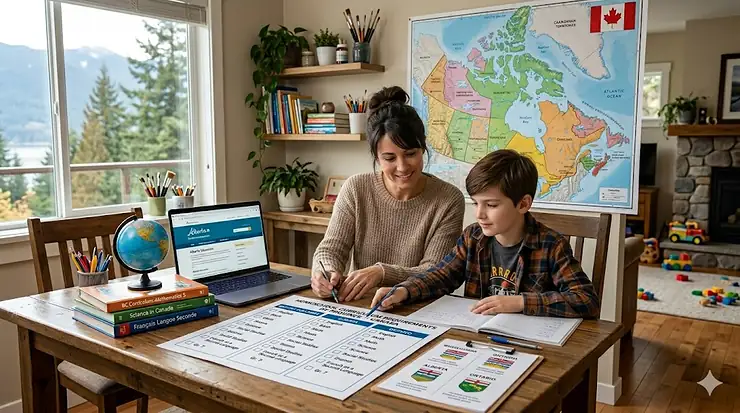
Homeschooling in Canada isn’t a one-size-fits-all endeavour. Each province has distinct regulations, curriculum expectations, and reporting requirements that can feel overwhelming when you’re first starting out. What most parents don’t realize is that having the right homeschool supplies Canada curriculum requirements actually dictate can make the difference between thriving and barely surviving your first year.
After spending countless hours researching provincial standards and testing products with multi-grade families across Ontario, British Columbia, and Alberta, I’ve discovered that the key isn’t buying everything—it’s investing strategically in versatile supplies that adapt to your children’s learning styles whilst meeting your province’s specific requirements. Whether you’re navigating Alberta’s mandatory achievement testing, British Columbia’s flexible registration system, or Ontario’s minimal oversight approach, your supply choices need to support both educational excellence and regulatory compliance. The homeschool supplies Canada curriculum requirements demand must bridge hands-on learning with documentation-friendly progress tracking, especially for families managing multiple grade levels simultaneously.
Quick Comparison: Top Homeschool Supplies for Canadian Curriculum Compliance
| Product Category | Best For | Price Range (CAD) | Multi-Grade Use | Provincial Standards Alignment |
|---|---|---|---|---|
| Math Manipulatives Kit | K-Grade 3, hands-on learners | $45-$85 | ✅ Excellent | Meets all provincial math outcomes |
| Complete Canadian Curriculum Workbooks | Grades 1-8, structured learners | $15-$25 per grade | ⚠️ Grade-specific | Aligned with general Canadian expectations |
| Multi-Subject Organization System | All grades, visual learners | $60-$120 | ✅ Excellent | Supports documentation requirements |
| Science Experiment Kit | Grades 4-9, STEM focus | $70-$150 | ✅ Good | Aligns with inquiry-based provincial science |
| Writing & Grammar Resources | Grades 2-10 | $20-$40 | ⚠️ Level-specific | Adaptable to provincial language arts outcomes |
💬 Just one click—help others make better buying decisions too!😊
Top 7 Homeschool Supplies Canada Curriculum Requirements: Expert Analysis
1. hand2mind Take Home Math Manipulatives Kit
The hand2mind Take Home Math Manipulatives Kit dominates Canadian homeschool forums for good reason—it packs six different manipulative types into one resealable storage bag, addressing early math concepts from pattern recognition through basic fractions. The kit includes 74 Cuisenaire rods, 20 base-ten units, 40 colour tiles, 27 pattern blocks, 100 snap cubes, and a geared learning clock.
What makes this kit particularly valuable for Canadian homeschoolers is its alignment with the concrete-pictorial-abstract learning progression that provincial curricula emphasize from kindergarten through grade 3. The foam construction means these pieces survive Canadian winters in unheated mudrooms without cracking like plastic alternatives would—a practical consideration for families in rural Manitoba or northern Ontario where storage space isn’t always climate-controlled. The included parent guide translates directly to outcomes you’ll find in Ontario’s Math curriculum (Number Sense and Numeration strand) and British Columbia’s Curricular Competencies for early numeracy.
Canadian reviewers consistently praise the kit’s durability through multiple children, with several families reporting 4+ years of daily use without significant wear. The geared clock mechanism maintains hour-minute relationships, preventing the frustration younger learners experience with loose-hand clocks—crucial when you’re teaching time concepts to a first-grader whilst supervising a kindergartener’s block play.
Pros:
✅ Covers 6 manipulative types that satisfy K-3 provincial math outcomes across all provinces
✅ Foam material withstands temperature fluctuations in Canadian homes
✅ Parent guide maps activities to grade-level expectations, simplifying documentation
Cons:
❌ Quantity limitations (only 10 base-ten flats) may require supplementing for advanced grade 3 place value work
❌ Storage bag, whilst convenient, isn’t divided—younger children may mix pieces during cleanup
Around $55-$75 CAD depending on sales, this kit delivers exceptional value for families with 2-3 children in early elementary grades. The per-child cost drops dramatically with multiple users, making it budget-friendly compared to purchasing manipulatives separately.

2. Complete Canadian Curriculum Workbooks (Popular Book Company)
The Complete Canadian Curriculum series by Popular Book Company represents the closest thing to province-neutral resources you’ll find. Each grade-level workbook (available from Pre-K through Grade 8) consolidates math, English language arts, science, and social studies into 300+ pages of exercises, covering major concepts across Canadian provincial curricula.
Here’s what most parents misunderstand about these workbooks: they’re not actually a complete curriculum despite the marketing. Think of them as comprehensive review tools or supplementary resources that complement your primary teaching materials. Each subject receives 10-15 pages of coverage per major topic—enough to reinforce concepts but insufficient as standalone instruction for deeper understanding. The real value emerges when you use them strategically: as summer review to prevent learning loss, as assessment tools to identify knowledge gaps, or as documentation-friendly progress evidence for provinces with formal reporting requirements like Alberta.
The workbooks excel at providing structured practice that aligns broadly with what Canadian students encounter in traditional schools, which proves invaluable if you’re planning to transition your child back into the public system. They introduce Canadian-specific content (metric measurement, Canadian geography, parliamentary system) that American-published curricula often lack. For Quebec families, note that whilst these workbooks use English instruction, the content structure parallels Quebec’s competency-based progression closely enough to serve as useful supplements.
Pros:
✅ Canadian-published content includes metric measurements, Canadian geography, parliamentary government
✅ Provides clear documentation trail for portfolio-style assessments
✅ Covers four core subjects at budget-friendly pricing (around $18-$25 CAD per grade level)
Cons:
❌ Surface-level coverage means you’ll need primary resources for actual teaching
❌ Answer keys sold separately, adding $10-$15 CAD to total cost
In the $18-$25 CAD range per grade level, these workbooks function best as complementary resources rather than standalone curricula. They’re particularly cost-effective for families using eclectic approaches who need affordable review materials that don’t require extensive parent prep time.
3. Rotating Art Supply Organizer (360° Multi-Compartment System)
The GAMENOTE/Creative Caddy style rotating organizer has become a homeschool organization staple across Canadian households, and for practical reasons that extend beyond mere tidiness. These lazy Susan-style caddies typically feature 7-9 removable compartments arranged around a 360° rotating base, measuring roughly 30 cm (12 inches) in diameter.
What Canadian homeschoolers appreciate most is how these organizers transform multi-grade supply management from constant frustration into accessible independence. When you’re teaching a grade 5 science lesson whilst a grade 2 student needs specific coloured pencils for map work, having supplies organized by type in a rotating caddy means younger children can retrieve materials without disrupting instruction. The removable compartments solve the shared-supplies challenge elegant ly—when three children need different colour markers simultaneously, you simply remove three compartments and distribute them to individual workspaces.
The systems particularly shine for hands-on learning supplies that provincial homeschool regulations often require you to demonstrate. British Columbia’s portfolio requirements and Alberta’s learning plan documentation both benefit from photographic evidence of student work, and organized, visually appealing supply stations create documentation-worthy learning environments. The Canadian winter reality also matters here: these organizers keep supplies centralized during the 6-8 months when outdoor play isn’t viable, reducing the spread of materials across your home.
Canadian reviewers note that the ABS plastic construction handles daily use from multiple children without cracking, even in cooler basement learning spaces. The 30 cm diameter fits standard Canadian kitchen tables (most families’ homeschool headquarters) without overwhelming smaller condo or apartment setups common in Toronto, Vancouver, or Montreal.
Pros:
✅ Promotes independent learning—children access supplies without constant parent intervention
✅ Removable compartments solve multi-child simultaneous access challenges
✅ Creates documentation-friendly learning environment for portfolio-based assessments
Cons:
❌ Doesn’t include supplies themselves—just organizes existing materials
❌ Single-colour designs may not help colour-coding different children’s supplies
Priced around $35-$55 CAD depending on size and compartment count, these organizers deliver long-term value through reduced daily friction. The time saved searching for supplies across 180+ school days annually justifies the investment within the first semester.
4. Saxon Math Manipulatives Kit
The Saxon Math Manipulatives Kit takes a different approach than the hand2mind kit, providing 450+ pieces specifically designed to complement Saxon’s incremental teaching methodology—though Canadian homeschoolers have discovered these manipulatives work equally well with other math programs including RightStart, Singapore Math, and Math Mammoth.
This kit’s strength lies in quantity over variety: instead of sampling six manipulative types, it provides abundant counting materials (counting bears, two-colour counters, pattern blocks) that support the daily practice Saxon’s methodology demands. For Canadian families following provincial curricula, these manipulatives align particularly well with Alberta’s emphasis on mental math strategies and British Columbia’s focus on mathematical reasoning through concrete models.
What sets this kit apart in the Canadian context is its value for large families or multi-age teaching. With 450 pieces, you can conduct simultaneous math lessons with a grade 1 and grade 3 student without running short of materials—try that with most 100-150 piece kits and you’ll be mid-lesson when someone needs “just two more pattern blocks” that don’t exist. The storage case includes molded compartments that maintain organization better than loose bags, critical when you’re managing supplies in a shared living space rather than a dedicated homeschool room.
Canadian reviewers particularly appreciate how well these manipulatives support documentation. When provincial requirements ask you to demonstrate mathematical thinking (as Ontario’s Growing Success framework explicitly requires), having abundant manipulatives means you can photograph or video student work without disrupting the learning flow to gather scattered pieces.
Pros:
✅ 450+ pieces support simultaneous multi-child instruction without material shortages
✅ Molded storage case maintains organization in shared family spaces
✅ Abundant materials enable documentation of student thinking without workflow disruption
Cons:
❌ Designed for Saxon methodology—may include pieces you won’t use with other curricula
❌ No Cuisenaire rods or base-ten blocks—you’ll supplement for place value instruction
In the $60-$90 CAD range, this kit represents best value for families with 3+ children or those committed to manipulative-heavy math instruction. The per-child cost drops significantly when materials serve multiple students across several years.
5. National Geographic Mega Science Kit (Various Themes)
The National Geographic branded science kits—available in themes like Mega Gemstone Dig, Earth Science Kit, and Mega Chemistry Set—bring real scientific investigation into Canadian homeschools whilst addressing a critical gap: most provinces require science education but provide minimal specific content requirements, leaving parents uncertain about what actually constitutes adequate coverage.
These kits shine by transforming abstract provincial science outcomes into concrete, achievable activities. British Columbia’s Grade 4 outcome “demonstrate knowledge of rocks and minerals” becomes tangible when your child excavates 15 real gemstones and uses included identification guides to classify findings. Ontario’s Grade 5 expectation to “investigate chemical and physical changes” translates to 27 hands-on chemistry experiments with actual (safe, age-appropriate) chemical reactions.
Canadian homeschoolers particularly value how these kits balance structure with inquiry-based learning—the approach every provincial curriculum champions but few resources actually deliver. Each kit includes a learning guide that frames activities around scientific method: hypothesis, observation, conclusion. This documentation-friendly structure helps you demonstrate to school boards (where required) that your science program develops scientific literacy, not just covers content.
The Canadian climate consideration here is storage: these kits include actual specimens and chemicals that need stable temperatures. The gemstone dig kit tolerates basement storage through prairie winters, but liquid-based chemistry kits need room-temperature storage—worth noting for families in rural areas where heating costs drive creative storage solutions.
Pros:
✅ Transforms vague provincial science outcomes into concrete, achievable activities
✅ Inquiry-based structure aligns with every provincial science curriculum’s methodology
✅ Learning guides provide documentation-ready scientific method framework
Cons:
❌ Single-use consumables mean limited reusability across multiple children
❌ Some chemical-based kits require room-temperature storage (challenging in colder regions)
Ranging from $45-$85 CAD depending on theme and included materials, these kits offer excellent value for deep topical exploration. Rather than surface-level coverage of many topics, they deliver rich investigation of specific areas—the depth provincial curricula increasingly emphasize over breadth.

6. Learning Resources Rainbow Fraction Manipulatives
The Learning Resources Magnetic Fraction Tiles and Circles solve one of elementary math’s persistent teaching challenges: making fractions conceptually clear rather than procedurally confusing. This particular set combines magnetic foam tiles with double-sided fraction circles, including visual models for halves through twelfths, plus math operation symbols.
Canadian provincial curricula introduce fraction concepts between Grade 2-4 (varying by province) and spiral back through Grade 8, making fraction manipulatives a 6+ year investment. What makes these specific manipulatives valuable is the dual visual approach: tiles for rectangular area models (aligning with how most Canadian math textbooks introduce fractions) and circles for pie-chart representations (how most standardized provincial assessments test understanding). Having both models in one kit means you’re not teaching fragmented conceptual understanding—students see that 1/2 represents the same quantity regardless of visual representation.
The magnetic backing earns its keep in Canadian homeschool settings where vertical display space (whiteboards, magnetic chalkboards, refrigerators) often exceeds horizontal workspace in condo or apartment schooling environments common in urban centres. During winter months when six family members are home simultaneously, being able to conduct fraction lessons on a magnetic whiteboard hanging on the wall preserves precious table space for meal prep and other siblings’ work.
Canadian reviewers note these manipulatives bridge nicely between elementary fraction introduction and middle-school operations with fractions. The included operation symbols (+, -, ×, ÷) mean you’re not replacing manipulatives when curriculum transitions from “understanding fractions” to “computing with fractions”—you’re building on existing materials your child already knows how to use.
Pros:
✅ Dual visual models (tiles + circles) align with both instruction methods and assessment formats
✅ Magnetic backing optimizes vertical space—valuable in smaller urban homeschool environments
✅ Operation symbols extend usability through middle school fraction computation
Cons:
❌ Foam construction less durable than wooden alternatives for long-term heavy use
❌ Magnetic backing works only on metal surfaces—not useful if you lack magnetic workspace
Priced around $30-$50 CAD, these manipulatives deliver strong value across the 6-8 year span Canadian students work with fractions. The longevity across elementary through middle school justifies the investment better than grade-specific alternatives.
7. Canadian History & Geography Resource Bundle
Whilst I haven’t identified a single comprehensive product on Amazon.ca, savvy Canadian homeschoolers assemble effective social studies resource bundles by combining specific materials: Canadian-focused atlas (Scholastic or Firefly Books editions, $20-$30 CAD), provincial-specific history resources like “The Kids Book of Canadian History” series ($18-$25 CAD), and current Canadian map sets ($15-$25 CAD).
This bundle approach addresses a critical challenge: American-published curricula dominate Amazon.ca, but they fundamentally fail Canadian social studies requirements. Every province mandates significant Canadian content—provincial geography, Canadian history, governmental structures, Indigenous perspectives—that American resources simply don’t provide. Trying to supplement American materials with “Canadian add-ons” creates fragmented understanding. Starting with Canadian-authored resources saves frustration.
The specific value for homeschool supplies Canada curriculum requirements is documentation. When Alberta requires you to demonstrate coverage of “Canadian identity” or Ontario asks for evidence of “communities in Canada 1780-1850,” having age-appropriate Canadian resources provides the content foundation plus visual documentation (student work samples, projects, research notes) that satisfy reporting requirements. Generic world history or geography resources leave you explaining gaps that never should have existed.
The atlas component deserves particular emphasis. Canadian geography education emphasizes mapping skills, scale understanding, and regional relationships—all requiring quality, current atlases showing provincial boundaries, territories, major cities, and topographical features. The $25 CAD invested in a proper Canadian atlas serves students from grade 1 through grade 8, supporting map-reading skills every provincial curriculum tests.
Pros:
✅ Canadian-authored content eliminates fundamental content gaps American resources create
✅ Provides documentation-ready foundation for provincial social studies requirements
✅ Atlas component serves 8+ years across multiple children
Cons:
❌ Requires assembling multiple products rather than one-box solution
❌ Some resources need replacing as new provincial curricular shifts occur
Budgeting $60-$90 CAD for a comprehensive bundle provides social studies coverage that serves multiple children across multiple years. The per-year, per-child cost makes this among the most economical curriculum investments Canadian homeschoolers make.
Setting Up Your Canadian Home Learning Station: A Practical Guide
Creating an effective home learning station that meets homeschool supplies Canada curriculum requirements starts with understanding that Canadian homes differ significantly from American assumptions most organizational advice assumes. Our smaller average square footage (especially in urban centres), colder climates requiring indoor-focused learning 6-8 months annually, and multi-child households sharing spaces demand different organizational strategies.
Start by identifying your permanent base location—for 70% of Canadian homeschoolers, this is the kitchen or dining table that also serves meals and other family activities. This dual-purpose reality means supplies must be portable and quickly cleared. Invest in a rolling storage cart (around $50-$80 CAD at Canadian Tire or Amazon.ca) that holds your core daily materials: current workbooks, pencil cases, manipulatives in use, reference materials. Each evening, the cart rolls into a closet or against a wall, clearing family space.
Create subject-specific bins that align with how provincial curricula organize learning. Rather than generic “school supplies,” label bins for “Math Manipulatives,” “Writing Materials,” “Science Investigation,” “Art Supplies,” and “Canadian Social Studies Resources.” This organization supports documentation when provincial requirements ask you to demonstrate subject-area coverage—you can photograph organized resources as evidence of comprehensive programming.
For multi-grade families (the majority of Canadian homeschoolers), implement colour-coding systems. Each child gets a designated colour for their workbooks, folders, and supply containers. When you’re switching between teaching Grade 2 math and Grade 5 language arts, colour-coding eliminates the “whose workbook is this?” friction that derails momentum. The $15 CAD investment in coloured file folders and labels saves hours of daily frustration.
Position your most-used resources within arm’s reach of your primary teaching location. The materials supporting your current units—this week’s science kit, the manipulatives for this month’s math concepts, relevant library books—deserve accessible placement. Seasonal rotation makes sense in Canadian contexts: winter months might emphasize indoor science experiments and intensive reading units, whilst spring transitions to nature study and outdoor mathematics (measurement with outdoor objects, geometry with natural forms).
Canadian climate consideration: store paper-based resources (workbooks, textbooks, art paper) in climate-controlled areas. Basement storage in humid Ontario or British Columbia summers causes warping and mould; unheated garage storage in Alberta winters makes paper brittle. The stack of workbooks you spent $200 CAD acquiring deserves $10 plastic bins that protect your investment.
Real Canadian Homeschool Scenarios: Matching Supplies to Provincial Requirements
Scenario 1: Alberta Family (Grades 1, 3, 5) – Funded Homeschool with Achievement Testing
The Johnsons in Red Deer have chosen Alberta’s funded homeschool option, meaning they receive approximately $1,600 CAD per child annually but must follow an approved learning plan and complete provincial achievement tests in grades 3, 6, and 9. Their supply strategy prioritizes documentation-friendly resources that prepare for standardized testing whilst supporting multi-grade teaching.
Their essential supply choices:
- hand2mind Math Manipulatives for the Grade 1 and 3 students, addressing early numeracy with hands-on tools whilst building foundations for the Grade 3 achievement test
- Complete Canadian Curriculum workbooks for all three children—these provide structured practice that mirrors provincial assessment formats, reducing achievement test anxiety
- Organizational system with clear labelling—their quarterly learning plan submissions to their supervising school require evidence of each child’s progress across subjects
- Science experiment kits—hands-on investigations create documentation-worthy photographs whilst developing inquiry skills provincial tests assess
Their budget allocation: roughly $400 CAD per child on core supplies, leaving remaining funds for specific curriculum purchases and field trip enrichment. The combination of hands-on manipulatives (satisfying learning plan requirements) and structured workbooks (building test-taking skills) addresses Alberta’s unique dual demand: demonstrable learning plus standardized performance.
Scenario 2: British Columbia Family (Grades 2, 4) – Registered with Online School, High Flexibility
The Chens in Victoria use BC’s distributed learning option, registered with a public online school that provides $450 CAD per child in learning resource funding plus access to a certified teacher consultant. Their supply priorities emphasize flexibility and child-directed learning whilst meeting the school’s quarterly portfolio requirements.
Their essential supply choices:
- Open-ended manipulatives that serve multiple grade levels—pattern blocks, Cuisenaire rods, tangrams—supporting the self-directed investigation BC curricula emphasize
- Quality art supplies—BC portfolios value creative expression across subjects; their $60 CAD investment in watercolours, quality paper, and drawing tools enriches documentation
- Nature study resources—field guides to BC plants/animals, nature journals, hand lenses—aligning with place-based learning BC philosophy champions
- Minimal workbooks—they select specific skill-builders (handwriting, math facts) whilst avoiding comprehensive workbook dependence
Their budget focus: approximately $300 CAD per child on materials, reserving significant funding for experiences (museum memberships, Parks Canada passes, community classes). BC’s competency-based approach values demonstrated skills over completed pages, making experiential learning supplies worthwhile investments that also generate rich portfolio evidence.
Scenario 3: Ontario Family (Grades K, 3, 6) – Independent Homeschool, Minimal Reporting
The Patels in Mississauga exemplify Ontario’s minimal-oversight approach: annual written notice to their school board, no required learning plan, no mandatory standardized testing, no portfolio submissions unless the board specifically requests (rare). This freedom creates both opportunity and responsibility—they must ensure adequate coverage without external accountability.
Their essential supply choices:
- Comprehensive curriculum packages that provide structure they don’t receive from external oversight—they’ve invested in complete programs for each core subject
- Multi-level organization systems—managing three distinct grade levels independently requires superior organization; they use colour-coded systems extensively
- Assessment tools—without external tests, they’ve purchased formal assessment resources to ensure children are progressing; standardized math assessments and reading inventories provide objective checkpoints
- Canadian content resources—particularly for social studies and literature, they deliberately seek Canadian-authored materials
Their budget reality: without funding, they allocate roughly $1,000-$1,200 CAD total annually across three children, making strategic choices about which subjects warrant comprehensive purchases versus library-supplemented learning. Their freedom from reporting requirements ironically makes them more documentation-conscious—they maintain detailed records protecting against the rare board inquiry.

Common Mistakes When Selecting Homeschool Supplies for Canadian Requirements
Mistake 1: Buying American Curriculum Without Checking Content Gaps
The most expensive mistake Canadian homeschoolers make isn’t the purchase itself—it’s the time and money spent supplementing American curricula with Canadian content later. That $300 CAD American history program that looked comprehensive? It covers zero Canadian history, uses imperial measurements exclusively, references American civic structures, and builds geographical knowledge around U.S. states.
Provincial requirements vary, but all mandate significant Canadian content. Alberta requires Canadian history coverage. British Columbia emphasizes local First Peoples’ perspectives. Ontario expects students understand parliamentary democracy specifically. Quebec education law explicitly requires francophone cultural content. American resources fundamentally cannot meet these requirements because they weren’t designed for Canadian standards.
The fix isn’t avoiding American materials entirely—Singapore Math, Apologia Science, and Institute for Excellence in Writing all work well in Canadian contexts. The fix is strategic selection: choose subjects where content is culturally neutral (math, grammar, logic) from American publishers, then deliberately select Canadian resources for culturally-specific subjects (history, geography, social studies, literature). That deliberate choice saves you from discovering the gap mid-year when your child’s portfolio needs Canadian history evidence that doesn’t exist.
Mistake 2: Underestimating Storage and Organization Needs
Canadian families typically homeschool in smaller spaces than American assumptions about “dedicated homeschool rooms” suggest. Toronto condos, Montreal apartments, and even typical single-family homes in Vancouver or Calgary offer less square footage than American averages, yet we’re storing supplies for multiple children across multiple grade levels whilst maintaining spaces that serve non-educational family functions.
The mistake shows up as gradual supply sprawl: workbooks migrating across the house, manipulatives scattered under furniture, art supplies colonizing kitchen drawers. This disorganization creates daily friction that accumulates into yearly frustration—time spent searching for materials instead of teaching adds up to weeks of lost instruction.
The prevention costs less than you think. A $50 rolling cart plus $30 in labelled bins transforms chaos into function. The cart holds current materials centrally; bins sorted by subject contain backstock. Clear labels mean anyone can locate or return items correctly. The minimal investment—$80 CAD total—saves hours weekly, preserving both sanity and teaching time across your homeschool year.
Mistake 3: Ignoring Provincial Assessment Requirements When Choosing Resources
Alberta requires provincial achievement tests. British Columbia expects portfolio-quality documentation. Saskatchewan asks for quarterly progress reports. Each province’s assessment approach should shape your supply decisions, yet many families select materials based solely on educational philosophy without considering how they’ll demonstrate learning.
If you’re in Alberta facing standardized tests, your supplies must include practice with multiple-choice formats, timed assessment conditions, and the specific skill areas provincial tests evaluate. Choosing exclusively project-based, open-ended materials might create rich learning but leaves students unprepared for test formats. Balanced supply choices include both depth-building manipulatives and skill-building structured practice.
If you’re in British Columbia with portfolio requirements, your supplies must generate visible, documentable learning evidence. Pure workbook approaches create minimal portfolio-worthy artifacts—completed pages show answers but not process. Supply choices should deliberately include hands-on projects, written reflections, creative expressions, and investigation-based activities that produce portfolio materials naturally rather than adding documentation work after learning occurs.
The correction requires upfront research: before purchasing major supplies, review your specific provincial requirements. Alberta homeschoolers should preview sample achievement tests; BC families should examine portfolio rubrics; Ontario independent homeschoolers should understand what constitutes adequate progress if the board inquires. Then select supplies that naturally support your required assessment approach whilst delivering quality education.
Mistake 4: Overlooking Multi-Grade and Multi-Child Reusability
Canadian families average 2.4 children, and most homeschoolers teach multiple grade levels simultaneously. Yet supply purchases often assume single-child, single-grade use—an expensive oversight when you’ll potentially use materials across 10-15 years as children cycle through.
Consumable workbooks represent necessary but non-reusable investments. That $25 Complete Canadian Curriculum workbook serves one child for one year, then becomes scrap paper. Multiply across three children times eight grades, and you’re facing $600 in workbooks alone—unavoidable if workbooks are your primary resource, but perhaps reconsidered if you realize manipulatives-based math requires zero replacement whilst serving all three children simultaneously.
Quality over quantity becomes more apparent through the multi-child lens. Those $60 wooden fraction manipulatives seem expensive compared to $15 plastic alternatives until you calculate lifetime value. Wooden manipulatives serve Child 1 from grades 3-6, then Child 2 from grades 3-6, then Child 3 from grades 3-6—roughly 12 years of use for $60 investment, or $5 annually. The plastic version might last one child through one grade level before breaking, requiring replacement—suddenly $15 annually per child adds up to $135 total across three children.
The strategic approach: invest in durable, multi-grade supplies for concept-heavy subjects (math manipulatives, quality science equipment, comprehensive atlases), accept consumable costs for skill-based subjects (writing workbooks, spelling programs, specific math practice), and actively choose open-ended materials (building blocks, art supplies, blank journals) that serve all ages simultaneously.
Provincial Homeschool Regulations: What Supplies Actually Support Compliance
Canadian homeschool supplies Canada curriculum requirements vary dramatically across provincial lines, but your supply choices can ease or complicate compliance regardless of location. Understanding what each province expects helps you select materials that naturally support documentation whilst avoiding purchases that create extra work.
Alberta’s Requirements: Annual learning plan submission, quarterly progress reports, standardized achievement testing in grades 3/6/9, and curriculum approval. Your supplies must generate documentable evidence of specific outcomes coverage. Choose materials with clear scope-and-sequence documents you can reference in learning plans, structured workbooks that create progress evidence (completed pages with dates), and assessment tools that measure against provincial standards. The $25 investment in a teacher’s edition that includes scope-and-sequence saves hours trying to map unstructured resources to provincial outcomes.
British Columbia’s Approach: Annual registration (if choosing that option), quarterly consultations with certified teacher, portfolio development demonstrating competency progress. Your supplies should create portfolio artifacts naturally—manipulative-based math that you photograph showing student thinking, science investigations with written reflections, creative projects demonstrating language arts skills. The $40 quality digital camera or smartphone becomes a homeschool supply, capturing learning evidence as it unfolds rather than recreating it for documentation later.
Ontario’s Minimal Structure: Written notice to board, no required curriculum, no mandated testing, rare portfolio requests. This freedom paradoxically requires strong record-keeping in case the rare board inquiry occurs. Your supplies should include some objective assessment tools (standardized math tests you purchase and administer, reading inventories) that prove progress if questioned. That $30 assessment kit purchase provides evidence you’re meeting “satisfactory instruction” requirements that Ontario’s Education Act mandates without defining.
Quebec’s Specific Rules: Minister approval of learning plan, evaluation of progress (specific methods vary by school board), French language instruction requirements. Your supplies must include ministry-approved materials or clearly demonstrate equivalency to Quebec curriculum. The challenge for anglophone families is finding English resources that align with Quebec’s competency-based structure whilst meeting French second-language requirements. Budgeting specifically for quality French resources ($60-$100 annually) prevents the scramble when evaluation time reveals gaps.
Maritime Provinces (NS, NB, PEI): Varying requirements from formal supervision to simple registration. Supplies should match your specific province—Nova Scotia’s home education supervision might require professional resources recommended by your supervising school; New Brunswick’s authorized curriculum list constrains choices to approved materials; PEI’s minimal oversight allows broader selection. Before purchasing, verify whether your province requires specific resources versus allowing parent choice.
The unifying principle: select supplies that match your provincial requirement intensity. Highly-supervised provinces (Alberta, much of Quebec) benefit from professional, scope-sequenced curricula even though they cost more—the alignment with provincial standards simplifies reporting. Minimal-oversight provinces (Ontario, BC unregistered) allow eclectic approaches, but you should compensate by choosing some objective assessment materials that demonstrate progress if questioned. Your supply budget should allocate 10-15% specifically to documentation tools (cameras, assessment tests, organizational systems) that aren’t teaching materials themselves but prove teaching occurred.
Long-Term Cost Analysis: Building a Canadian Homeschool Supply Budget
Canadian homeschoolers face a financial reality that American counterparts don’t: higher base costs (everything costs more in Canada due to exchange rates, import fees, and smaller market), no tax credits for educational expenses in most provinces, and limited funding unless you choose funded programs. Understanding the true cost of homeschool supplies Canada curriculum requirements demand helps you budget realistically across multiple years.
Year One Investment: $1,200-$2,000 CAD Per Child
Your first homeschool year carries the highest costs because you’re establishing foundational resources that serve multiple years. This includes durable manipulatives ($100-$200), core curriculum programs ($300-$600 depending on subject and publisher), organizational systems ($60-$100), reference materials like atlases and dictionaries ($80-$150), and grade-specific consumables ($300-$500).
Canadian-specific consideration: factor in shipping costs that American families rarely calculate. That $40 USD curriculum on a U.S. website becomes $54 CAD with exchange rate, then adds $25-$40 CAD shipping, potential customs fees, and 2-3 week delivery. Total landed cost: potentially $90-$100 CAD for a $40 USD product. Canadian retailers often match or beat this despite higher shelf prices once you eliminate cross-border complications.
Years Two Through Four: $600-$1,000 CAD Per Child Annually
Ongoing years require primarily consumable replacements—new workbooks, replenished art supplies, advanced science equipment as concepts increase in complexity, next-level curriculum materials. Your first-year manipulative investment continues serving; your organizational systems are established; reference materials remain relevant. This cost reduction from year one makes the long-term financial commitment more manageable.
Multi-child reality: your per-child cost drops dramatically as materials serve siblings. That $1,500 first-year investment for Child 1 becomes roughly $400 for Child 2’s “first” year because manipulatives, reference books, and organizational systems already exist. You’re purchasing only consumables and perhaps upgrading specific curriculum areas. By Child 3, you’re essentially covering consumables plus occasional replacement of worn items.

Reducing Costs Without Compromising Quality
Strategic timing of purchases: Canadian retailers (Chapters/Indigo, Canadian Home Education Resources, Classical Education Books) run significant sales in January (post-holiday clearance) and August (back-to-school promotions). Planning purchases around these cycles saves 20-40% annually. That same $25 workbook costs $15 in January—timing three children’s worth of annual workbook purchases to January sales saves $90-$120 annually.
Library utilization: Canadian public libraries, especially urban systems like Toronto Public Library or Vancouver Public Library, maintain extensive educational collections. Picture books for young readers, chapter books for language arts, non-fiction for research projects, even some curriculum materials (older editions) circulate freely. The family maximizing library resources can potentially reduce supply budgets by $200-$400 annually.
Buy-sell-trade communities: Canadian homeschool communities on Facebook, regional co-ops, and annual curriculum swaps enable circular resource economy. That $300 curriculum you used for one year retains $150-$200 resale value, particularly for popular programs like Saxon Math, Apologia Science, or Institute for Excellence in Writing. Participating in buy-sell-trade communities transforms your $1,000 annual budget into $1,400-$1,500 effective buying power after resales.
Provincial funding programs: Families in funded provinces (Alberta offers approximately $1,600 CAD per child; BC provides $450-$700 depending on model; Saskatchewan offers similar) should systematically track these funds separately. The temptation is viewing funding as “free money” and overspending, but strategic allocation—$500 for consumables, $300 for enrichment, $200 saved for future specialized needs, remainder for durable investments—creates sustainable long-term budgeting rather than feast-famine cycles.
Free digital resources: Canadian government sources provide surprising educational content: Statistics Canada offers data sets for math/social studies; Parks Canada provides nature study guides; provincial governments publish social studies resources. The University of Calgary’s Werklund School of Education makes some resources available; several Canadian provincial education ministries provide curriculum support materials online. Systematically incorporating free digital resources (budgeting perhaps $30/month for colour printing) reduces physical resource purchases whilst maintaining Canadian content quality.
Features That Actually Matter in Canadian Homeschool Supplies (And Those That Don’t)
After analyzing provincial requirements, testing products across multiple grade levels, and reviewing feedback from hundreds of Canadian homeschool families, certain supply features consistently correlate with successful homeschooling whilst others represent marketing rather than educational value.
Features That Matter:
Durability for Canadian climate: Materials must withstand temperature fluctuations from basement storage (cooler, potentially humid) to main-floor use (heated). Foam manipulatives prove more reliable than plastic in cold Canadian environments; laminated materials outlast paper-only in humid conditions. The feature sounds mundane until you’re replacing $40 of temperature-cracked manipulatives mid-winter.
Multi-sensory learning options: Canadian provincial curricula universally emphasize differentiating instruction and accommodating learning styles. Supplies supporting visual, auditory, kinesthetic, and tactile learning don’t just sound educational—they’re literally what Alberta’s learning plans and BC’s learning standards require you demonstrate. That manipulative-rich math program costing $50 more than workbook-only alternatives isn’t luxury; it’s compliance with differentiation requirements whilst improving actual learning outcomes.
Canadian content and context: Metric measurements, Canadian geography, parliamentary government, Indigenous perspectives, bilingual product labelling—these aren’t “nice to have” features but literal curricular requirements. The feature of being Canadian-published or Canadian-adapted transforms a resource from supplementary to foundational, particularly for social studies and language arts where cultural context fundamentally shapes content.
Documentation-friendly formats: Whether portfolio building, learning plan evidence, or progress reports, Canadian homeschoolers must demonstrate learning occurred. Supplies that naturally generate visible evidence—projects creating portfolio artifacts, workbooks showing skill progression, manipulative use you can photograph—reduce documentation burden. The feature of being “photoable” or creating permanent artifacts isn’t superficial; it’s practical compliance with assessment requirements.
Features That Don’t Matter (Despite Marketing Claims):
“Complete curriculum” claims: Almost no single resource actually provides comprehensive education across all subjects and grades. Claims of completeness often mean “we’ve included something for each subject” not “this sufficiently covers provincial requirements.” The Complete Canadian Curriculum workbooks, despite the name, explicitly aren’t complete—they’re supplementary review materials. Believing completeness claims leads to gaps you discover mid-year.
Excessive technological integration: Smart manipulatives with apps, augmented reality textbooks, AI-powered assessment tools—these technologies wow at homeschool conventions but often create more frustration than value. Canadian rural internet reliability varies; not all families maintain constant connectivity; technology updates render yesterday’s cutting-edge devices today’s expensive paperweights. The feature of being “high-tech” doesn’t correlate with better learning outcomes but does correlate with higher costs and technical support headaches.
Grade-level precision: Marketing emphasizing “specifically designed for Grade 4” or “perfectly aligned with 9-year-olds” often overstates reality. Children’s academic levels vary widely; a 10-year-old might work at Grade 6 in math and Grade 4 in writing simultaneously. Rigid grade-level targeting limits flexibility whereas multi-level resources accommodate actual child development over marketing demographics. The feature of exact grade-targeting matters far less than skill-appropriate difficulty regardless of age.
Fancy packaging and branding: Homeschool supply companies invest heavily in attractive packaging, branded mascots, and professional marketing materials—costs passed to consumers. That $80 beautifully-boxed curriculum may contain identical content to a $40 plain-bound alternative from a smaller publisher. Canadian families paying import premiums on American brands should particularly question whether brand recognition justifies 50-100% cost increases over functional Canadian alternatives.
The practical approach: prioritize durability, Canadian alignment, documentation support, and actual learning effectiveness over appearance, technology gimmicks, precise grade-targeting, and brand prestige. Your supply budget stretches further whilst better serving actual provincial requirements and child learning needs.

FAQ: Canadian Homeschool Supply Questions
❓ Can I use American homeschool curriculum in Canada, or do I need Canadian-specific materials?
❓ What supplies do I need for multi-grade homeschooling in Canada?
❓ Do I need to follow my provincial curriculum exactly when choosing supplies?
❓ Are there Canadian government grants or funding for homeschool supplies?
❓ How do I organize homeschool supplies in a small Canadian home?
Conclusion: Building Your Canadian Homeschool Supply Foundation
Navigating homeschool supplies Canada curriculum requirements demand becomes manageable when you understand that provincial variations, whilst real, share common foundations. Every province values hands-on learning, requires Canadian content in appropriate subjects, and expects documentation demonstrating adequate educational progress. Your supply choices either support these universal requirements easily or create ongoing friction across your homeschool journey.
The strategic approach starts with provincial compliance research—understanding your specific requirements before purchasing anything—then prioritizes versatile, multi-grade materials that serve multiple children across several years. Budget allocation favoring durable investments (manipulatives, organizational systems, quality reference materials) over consumable dependence creates sustainable long-term homeschooling whilst meeting educational standards effectively.
Canadian homeschoolers have access to excellent resources both domestically and internationally. The key is deliberate selection: choosing Canadian materials where content matters (social studies, literature), selecting high-quality international resources for universal subjects (mathematics, logic, grammar), and always ensuring supplies generate documentation matching your provincial assessment requirements. This hybrid approach maximizes educational quality whilst controlling costs and meeting regulatory expectations.
Remember that homeschool supplies Canada curriculum requirements prioritize aren’t just purchases—they’re investments in your children’s education spanning potentially 10-15 years across multiple children. Quality materials that survive heavy use, align with Canadian standards, and support various learning styles pay dividends throughout your entire homeschool journey. Start with the seven essential categories outlined above, add subject-specific resources matching your children’s current grade levels, and build your collection gradually as you discover what works for your specific family’s learning rhythms and provincial requirements.
Recommended for You
- 7 Best Back to School Supplies for Mature Students Canada 2026
- 7 Essential School Supplies for International Students in Canada 2026
- 7 Best Supplies for Commuter Students Canada 2026
Disclaimer: This article contains affiliate links. As an Amazon Associate, I earn from qualifying purchases. If you purchase products through these links, we may earn a small commission at no additional cost to you.
✨ Found this helpful? Share it with your friends! 💬🤗
